Affiliate Disclosure: This post contains affiliate links. If you buy through one of them, we may earn a small commission — at no extra cost to you. We only recommend kits we’ve actually researched and would suggest to a friend.
The Friend Who Never Gets Bitten
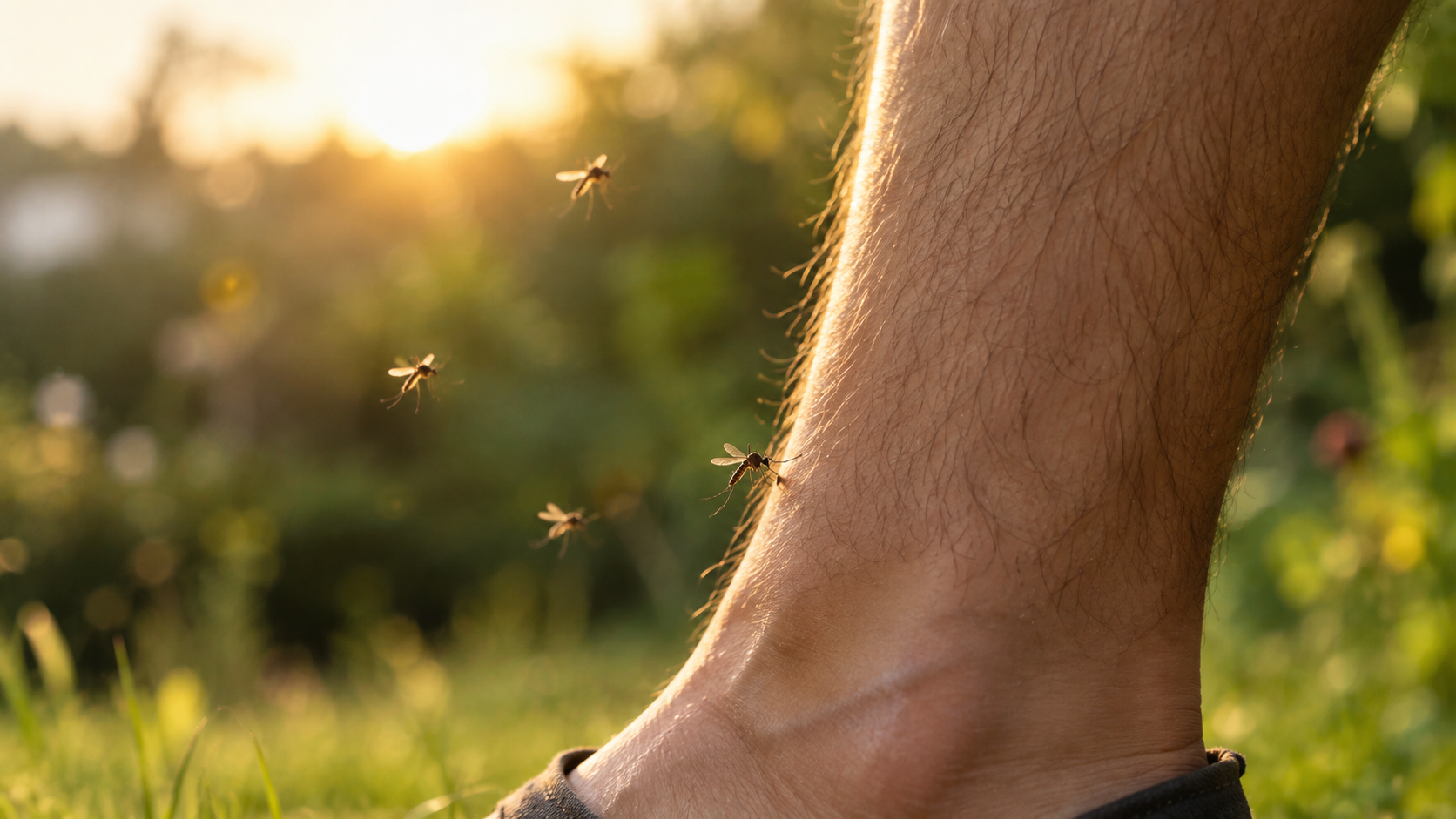
You’re sitting outside on a summer evening with friends. By the end of the night, your ankles are covered in itchy red bumps — and the person sitting right next to you doesn’t have a single one. It happens every time, and it’s starting to feel personal.
It isn’t your imagination. Research consistently shows that mosquitoes really do prefer some people over others, and that preference is surprisingly stable over time. A big part of it comes down to how you smell to a mosquito — and that scent is shaped partly by your genes.
This article explains what attracts mosquitoes, what twin studies say about the genetic side, why some people react to bites more than others, and what actually helps if you’re a mosquito magnet.
How Mosquitoes Find You
Female mosquitoes bite because they need blood to produce eggs, and they’re remarkably good at finding it. They use several cues, often in a sequence as they get closer:
Carbon dioxide. Mosquitoes can detect the CO2 in your breath from a considerable distance. It tells them a warm-blooded animal is nearby and draws them toward you.
Body heat. As they get closer, mosquitoes sense warmth. People who run warmer, or who’ve just been exercising, can be easier targets.
Skin odor. Up close, the specific chemical mix coming off your skin plays a major role in whether a mosquito lands on you or the person next to you.
Visual cues. Mosquitoes are drawn to dark colors and contrast, which is why dark clothing can make you more noticeable.
Of all these, skin odor seems to make the biggest difference between individuals. Everyone breathes out CO2 and gives off heat, but the scent of your skin is personal.
Why Some People Smell More Appealing to Mosquitoes
Your skin produces a complex mix of compounds — from sweat, natural skin oils, and the bacteria that live on your skin. Mosquitoes are extremely sensitive to this mix.
A 2022 study from researchers in New York tested how attractive different people were to mosquitoes over several years. The same people stayed consistently attractive — or consistently unattractive — over time, regardless of what they ate or which soap they used. The strongest “mosquito magnets” had much higher levels of certain fatty acids, called carboxylic acids, on their skin. These compounds are produced by skin oils and bacteria, and they’re part of what gives each person a unique scent.
Skin bacteria matter too. Earlier research found that people with less diverse skin bacteria tended to be more attractive to mosquitoes, while people with a richer variety of bacteria were bitten less. The mix of bacteria on your skin is influenced by genetics, hygiene, environment, and even the people you live with.
How Much of It Is Genetic?
A lot more than most people expect. A well-known 2015 twin study tested how attractive identical and non-identical twins were to mosquitoes. Identical twins, who share nearly all their DNA, were much more similar in how attractive they were than non-identical twins. The researchers estimated that genetics accounts for a substantial share of the difference in mosquito attraction between people — comparable to the genetic influence on traits like height.
That makes sense when you think about where body scent comes from. The genes that shape your sweat glands, skin oil production, and immune system all influence the chemical signals your skin gives off. If you’ve read our article on why deodorant works for some people and barely touches others, you’ll know that a single gene, ABCC11, can make a big difference to how much underarm odor someone produces. Mosquito attraction is shaped by a broader mix of genes, but the principle is similar: your genes help decide what your skin smells like.
Researchers haven’t pinned down a single “mosquito magnet gene.” Instead, it’s likely the combined result of many genes affecting skin chemistry, immune function, and the bacteria that live on your skin.
What About Blood Type?
You may have heard that mosquitoes prefer people with type O blood. Some early studies did find that people with type O blood attracted more mosquitoes, but later research has produced mixed results. Blood type may play a small role for some mosquito species, but it doesn’t appear to be the main factor. Skin odor, CO2, and body heat seem to matter far more.
Other Factors That Make You More Attractive
Genes set your baseline, but several temporary factors can make you more appealing to mosquitoes on any given day:
Exercise. Physical activity raises your body temperature, increases your breathing, and produces sweat and lactic acid — all of which attract mosquitoes.
Pregnancy. Pregnant women tend to breathe out more CO2 and have slightly higher body temperatures, and studies have found they attract more mosquitoes.
Drinking alcohol. Some research has found that drinking beer made people more attractive to mosquitoes, possibly due to changes in body temperature or skin odor.
Body size. Larger people generally exhale more CO2 and give off more heat, which can make them easier to find.
Dark clothing. Mosquitoes use sight as well as smell, and dark colors stand out to them.
Why Bites Itch More for Some People
Being bitten more is one thing. Reacting more strongly is another. When a mosquito bites, it injects saliva that contains proteins to stop your blood from clotting. Your immune system recognizes those proteins as foreign and releases histamine, which causes the familiar itchy bump.
How strongly your body reacts depends largely on your immune system. Some people develop large, very itchy welts that last for days; others barely notice a bite. Children and people who haven’t been exposed to a particular mosquito species often react more strongly, while repeated exposure can sometimes dull the reaction over time. We explored how genetics shapes immune responses more broadly in our article on why some people catch every cold that goes around.
So if you feel like you get bitten more, part of it may be that your bites are simply more noticeable. Someone who reacts mildly might be getting bitten too — they just don’t feel it as much.
Why Mosquitoes Have Such a Good Sense of Smell
It’s worth appreciating just how finely tuned a mosquito’s sense of smell is. Mosquitoes have many different odor receptors, allowing them to pick out the specific blend of compounds that signals a good blood meal. Humans have a wide range of smell receptors too, and variation in our own receptor genes explains why people perceive smells so differently — something we covered in our article on why cilantro tastes like soap to some people. In a sense, mosquito attraction is a meeting of two sets of genetics: yours, which shape your scent, and the mosquito’s, which shape what it’s tuned to find.
Myths That Don’t Hold Up
Eating garlic keeps mosquitoes away. There’s no good evidence for this.
Taking vitamin B supplements repels mosquitoes. Studies haven’t found that B vitamins reduce bites.
Changing your soap will make you less attractive. The 2022 study found that people stayed consistently attractive or unattractive regardless of the soap or shampoo they used.
Mosquitoes only bite at night. Different species are active at different times. Some, like the species that spread dengue and Zika, bite mostly during the day.
What Actually Helps
If you’re genetically prone to attracting mosquitoes, you can’t change your skin chemistry much — but you can make yourself much harder to bite.
Use an effective repellent. Repellents containing DEET, picaridin, or oil of lemon eucalyptus are well-studied and effective. Follow label directions, especially for children.
Cover up. Long sleeves and long pants, ideally in lighter colors, reduce exposed skin and make you less visible.
Use fans outdoors. Mosquitoes are weak fliers, and a fan can make it much harder for them to reach you. It also disperses the CO2 you exhale.
Avoid peak times. Many mosquitoes are most active around dawn and dusk.
Remove standing water. Mosquitoes breed in still water, so emptying containers, plant saucers, and gutters around your home can reduce their numbers.
Shower after exercise. Washing off sweat may help reduce some of the compounds that attract mosquitoes, even if it won’t change your baseline scent.
If you travel to areas where mosquitoes spread diseases like malaria, dengue, or Zika, it’s worth checking travel health advice before you go, since protection matters far more than comfort there.
Where a DNA Test Fits Into This
There’s no consumer genetic test that can tell you how attractive you are to mosquitoes, and you don’t really need one — your summer evenings are probably evidence enough.
If you’re curious about how your genes shape your health more broadly, a wellness-focused test like DNApower covers areas like diet, vitamin absorption, and exercise response. It won’t measure your appeal to mosquitoes, but it can help you understand other ways your body is uniquely yours.
Frequently Asked Questions
Is being a mosquito magnet genetic? Partly, yes. Twin studies suggest genetics plays a substantial role in how attractive you are to mosquitoes, mainly through its effect on your skin odor.
Why do mosquitoes bite me and not my partner? Your skin likely produces a mix of compounds that mosquitoes find more appealing, influenced by your genes and skin bacteria. Body heat, breathing rate, and clothing color also play a role.
Do mosquitoes prefer type O blood? Some studies have suggested this, but the evidence is mixed. Skin odor appears to matter much more than blood type.
Why do my bites itch more than other people’s? How strongly you react depends on your immune system’s response to mosquito saliva. Some people naturally react more strongly than others.
Can I make myself less attractive to mosquitoes? You can’t easily change your natural scent, but repellents, covering up, avoiding peak times, and using fans can greatly reduce bites.
The Bottom Line
If mosquitoes always seem to choose you, you’re not imagining it. Your unique skin scent — shaped by your genes, skin oils, and the bacteria living on your skin — plays a big role in how attractive you are to them, and that preference stays remarkably consistent over time. You can’t change your genetics, but the right repellent, a bit of strategy, and some lighter clothing can make a big difference.
If you’d like to explore how your genes shape other areas of your health, DNApower’s wellness panel is a reasonable place to start.