タグ: ancestry DNA

  • How to Share DNA Test Results With Family (Especially the Unexpected Kind)

    How to Share DNA Test Results With Family (Especially the Unexpected Kind)

    Affiliate Disclosure: This post contains affiliate links. If you buy through one of them, we may earn a small commission — at no extra cost to you. We only recommend kits we’ve actually researched and would suggest to a friend.

    Results Are In. Now What Do You Actually Say?

    Getting your results is one thing. Figuring out how — or whether — to share them with family is often the part nobody prepares you for. This is easy when results are exactly what everyone expected: a fun percentage breakdown, a distant cousin discovery, a nice conversation starter at the next family dinner. It’s a different situation entirely when something in your results doesn’t match the family story everyone has always told, or when discovering a close match raises questions someone in your family may not be ready to answer.

    Here’s how to think through both scenarios.

    When the Results Are Just Interesting, Not Complicated

    For most people, this is the actual situation, and it’s worth not overcomplicating it. Sharing an ethnicity breakdown or a fun distant-cousin discovery is usually just that — a fun family conversation. A few things still make it land better:

    Frame it as an addition, not a correction. “Turns out we’ve got more Scandinavian ancestry than I realized” tends to go over better than “Grandma was wrong about our family history,” even if that’s technically what the results suggest. Family stories often blend fact, memory, and a little embellishment over generations — that’s normal, not something that needs correcting on the spot.

    Be ready for mixed interest levels. Not everyone in your family will care as much as you do, and that’s fine. Genealogy and DNA results are genuinely more interesting to some people than others, and that’s not a reflection of anything beyond personal interest.

    When the Results Raise a Real Question

    This is the harder scenario, and it’s worth taking seriously if you’re in it. DNA testing occasionally surfaces information that contradicts a known family narrative — an unexpected close match suggesting a different biological parent than assumed, evidence of a previously unknown sibling, or other situations that touch on genuinely sensitive family history.

    Give yourself time before deciding what to do with the information. There’s rarely a need to act immediately. Sitting with unexpected results for a few days or weeks before deciding how — or whether — to bring it up with family gives you space to process your own reaction first, separate from managing everyone else’s.

    Consider who actually needs to know, and when. Not every discovery requires immediate disclosure to the entire family. Some people choose to discuss unexpected findings privately with one trusted family member first, rather than announcing something significant to a wider group before they’ve had time to think through what it actually means and how they want to handle it.

    Think about timing and setting. A sensitive conversation deserves privacy and time, not a rushed mention during a holiday gathering with a dozen other people around. If the information is genuinely significant, finding a quiet, unhurried moment tends to lead to a better conversation than an off-the-cuff mention.

    Prepare for a range of reactions, including ones you don’t expect. Family members may respond with shock, denial, defensiveness, or in some cases relief, depending on what the information touches on and what they may or may not have already suspected. None of these reactions are necessarily about you personally, even when they feel that way in the moment.

    If the Results Affect Someone Else Directly

    Sometimes what you discover involves someone else’s private information as much as your own — a parent’s history, a sibling’s paternity, a family secret that isn’t solely yours to reveal. This is genuinely complicated territory, and there’s no single right answer that applies to every situation.

    It’s worth considering whether the person most directly affected would want to know, versus whether sharing serves your own need for answers more than their wellbeing. Neither instinct is wrong, but they’re different considerations worth separating out as you decide how to proceed, ideally with input from a professional if the situation feels weighty enough to warrant it.

    When to Involve a Professional

    For situations involving significant, unexpected findings — an unknown parent, a previously unknown sibling, information that reshapes a fundamental part of someone’s identity — a family therapist or counselor experienced with these specific situations can be genuinely valuable, both for how you process the discovery yourself and for how a conversation with affected family members might go. This isn’t an overreaction to a “normal” DNA surprise; genetic genealogy communities specifically recommend this kind of support because these situations are more emotionally complex than they initially seem, even when the facts themselves are straightforward.

    Respecting That Not Everyone Wants to Know

    If you’ve made a discovery that affects someone else, it’s worth considering that not everyone shares the same appetite for this kind of information. Some family members genuinely prefer not to know certain things, and while you can’t always control what surfaces once DNA testing is involved, being thoughtful about pacing and giving people the option to engage on their own terms — rather than presenting unexpected news as something they must immediately process — tends to be received better than an information dump.

    Frequently Asked Questions

    Should I tell my whole family at once if I discover something unexpected? Not necessarily. Many people choose to process significant findings privately first, then discuss with one trusted person before deciding on a wider approach — there’s rarely a need to disclose everything to everyone immediately.

    What if a DNA discovery involves someone else’s private information? This is genuinely complicated and worth thinking through carefully — consider whether sharing serves the person most affected or primarily addresses your own need for answers, and consider professional guidance if the situation feels significant.

    Is it normal to feel overwhelmed by unexpected DNA results? Yes, and it’s worth taking that reaction seriously rather than pushing past it. Support from a therapist, a genetic genealogy support community, or simply a trusted person to talk to can make processing significant findings considerably more manageable.

    The Bottom Line

    Most DNA results are simply interesting, not complicated, and sharing them with family can be as easy as bringing up any other fun family topic. When something more significant surfaces, giving yourself time, choosing your moment thoughtfully, and considering professional support when the situation calls for it tends to lead to better outcomes than rushing to share everything immediately.

    If your situation involves searching for biological family specifically, our guide on DNA testing for adoptees covers both the technical search process and the emotional preparation involved. And if a sibling relationship question is part of what brought you here, our piece on DNA testing for siblings walks through how to interpret those specific results.
  • If I Retake a DNA Test, Will I Get the Same Results?

    If I Retake a DNA Test, Will I Get the Same Results?

    Affiliate Disclosure: This post contains affiliate links. If you buy through one of them, we may earn a small commission — at no extra cost to you. We only recommend kits we’ve actually researched and would suggest to a friend.

    A Reasonable Question Nobody Really Answers Upfront

    You’ve probably wondered this at some point, especially if you’ve seen someone mention their ethnicity percentages shifted after a year or two: if you sent in a second sample to the same company tomorrow, would you get the exact same numbers back? The honest answer is more nuanced than a simple yes or no, and understanding why can save you some genuine confusion down the road.

    The Short Answer: Mostly Yes, With a Few Exceptions

    Your actual raw DNA data — the underlying genetic code the lab reads — doesn’t change. If you tested with the same company twice using two separate samples, the raw genetic reading itself would be effectively identical, since it’s reading the same DNA both times. This part is genuinely stable and reliable.

    What can differ between a first test and a retest, sometimes noticeably, is the interpretation layered on top of that raw data — specifically your ethnicity percentages and, in some cases, health-related risk calculations.

    Why Ethnicity Percentages Specifically Can Shift

    This comes down to how ethnicity estimates are actually calculated. Your raw DNA is compared against a reference database — a collection of DNA samples from people with well-documented ancestry from specific regions. As companies test more people and refine their reference panels over time, the underlying comparison data improves, and estimates get recalculated against that improved data.

    This means if you retested a year or two later, your ethnicity breakdown could genuinely come back somewhat different — not because your original test was wrong, or because the retest is more accurate in some absolute sense, but because the comparison data itself has evolved. It’s closer to updating a map with better surveying data than correcting an error.

    What About Retesting on the Same Day or Same Week?

    If you sent in two samples close together, before any reference database update occurred, results would typically be extremely consistent — small variations are possible due to normal technical variance in lab processing, but nothing that would meaningfully change your overall picture.

    Does This Apply to DNA Matches Too?

    Relative matches are generally more stable than ethnicity percentages, since they’re based on directly comparing shared DNA segments with other testers rather than a broader statistical estimate. That said, your match list can genuinely grow over time as more people join the same company’s database — which isn’t your results “changing” so much as the pool of people you’re being compared against expanding.

    What About Wellness or Health-Related Results?

    For wellness-focused tests like DNApower, the underlying genetic markers being read are stable in the same way ancestry data is — your genetic code doesn’t change. However, as research on specific gene-trait or gene-condition associations develops over time, companies occasionally update how they interpret certain markers, which could theoretically affect how a report is worded or categorized in a future version, even though the raw genetic finding itself hasn’t changed.

    Is It Worth Retesting With the Same Company?

    For most people, no — not specifically to check for consistency. Since your raw DNA doesn’t change, there’s little value in paying for a second kit from the same company purely to verify your first results are “correct.” A more useful reason to retest would be checking back in on your existing account after a few years to see if your ethnicity estimate has been updated with improved reference data, which most companies do automatically without requiring a whole new sample.

    Testing with a different company, on the other hand, is a genuinely different situation — since each company uses its own separate reference database and matching pool, testing with a second company can provide new information (different regional detail, access to a different set of potential relatives) rather than simply confirming what you already know.

    A Practical Takeaway

    If your ethnicity percentages shift after a year or two, that’s a sign your testing company’s reference database has grown and improved — not a sign something went wrong with your original test. If you’re specifically hoping for more precision or a different set of relative matches, testing with a different company (or uploading your raw data to a platform that accepts it) is generally a more productive use of your money than retesting with the same one.

    Frequently Asked Questions

    Will my DNA test results ever expire or need updating? Your raw genetic data doesn’t expire, but most companies periodically recalculate your ethnicity estimate as their reference databases improve, which happens automatically without needing a new sample.

    Is it worth paying for a second kit from the same company to double-check accuracy? Generally not necessary, since your raw DNA reading doesn’t change between tests. If you want more information, testing with a different company usually provides more genuinely new insight than retesting with the same one.

    Why do siblings sometimes get noticeably different results even when tested at the same time? This isn’t related to retesting consistency — it’s because siblings inherit different random halves of their parents’ DNA, so their results can differ meaningfully from each other even on a first test, let alone compared across different companies.

    The Bottom Line

    Your underlying DNA reading is reliable and consistent between tests with the same company. What shifts over time is the interpretation layered on top — particularly ethnicity percentages — as reference databases grow and improve. Understanding this distinction helps make sense of a result that looks different a year or two later, without mistaking normal database evolution for an error in your original test.

    If you’re considering testing with a second company to expand your results, our [comparison of the major DNA testing kits]can help you choose which one to try next.

  • DNA Testing for Siblings: Full, Half, or Not Related — How to Actually Tell

    DNA Testing for Siblings: Full, Half, or Not Related — How to Actually Tell

    Affiliate Disclosure: This post contains affiliate links. If you buy through one of them, we may earn a small commission — at no extra cost to you. We only recommend kits we’ve actually researched and would suggest to a friend.

    When “We’re Definitely Full Siblings” Turns Into a Genuine Question

    Sibling relationships get tested for all kinds of reasons — sometimes pure curiosity, sometimes a family situation raises a real question that’s been sitting unspoken for years, and sometimes it’s simply part of a broader ancestry search where sibling matches turn up unexpectedly. Whatever brought you here, the actual biology behind sibling DNA relationships is more precise than most people realize, and understanding it can turn a confusing result into a clear answer.

    The Core Numbers: What Different Sibling Relationships Actually Share

    DNA relationship testing works by measuring shared centimorgans — the amount of DNA two people have in common. Different sibling relationships fall into fairly distinct, well-established ranges:

    Full siblings (same two biological parents) typically share roughly 2,300 to 3,400 centimorgans, plus or minus some natural variation due to how DNA is randomly inherited from each parent.

    Half siblings (sharing exactly one biological parent) typically share roughly 1,300 to 2,300 centimorgans — noticeably less than full siblings, though there’s a range here too depending on random inheritance patterns.

    Not biologically related typically shows minimal to no significant shared DNA, aside from possibly small, coincidental overlaps that don’t indicate a real family connection.

    The gap between full and half siblings is usually clear enough that a straightforward DNA test resolves the question definitively in the vast majority of cases.

    Why Full Siblings Aren’t Identical, Even Genetically

    Here’s a detail that surprises a lot of people: full siblings don’t share 100% of their DNA, and they don’t even share a perfectly consistent percentage with each other. Each parent passes down a random 50% of their own DNA to each child, and that “random 50%” is different for each pregnancy. This is why two full siblings can have noticeably different ethnicity breakdowns on an ancestry test, despite having the exact same two parents — they simply inherited different specific portions of that shared genetic pool.

    This randomness is also why sibling shared-DNA percentages fall within a range rather than a single fixed number, even for confirmed full siblings.

    The Trickier Cases: When Numbers Sit in a Gray Zone

    Most sibling comparisons land clearly within one range or the other, but a small percentage of cases fall into ambiguous territory — particularly the boundary between half-siblings and other close relationships (like an aunt/uncle or grandparent relationship), since these can share a genuinely overlapping centimorgan range.

    Additional context usually resolves this. Comparing ages, family tree information, and sometimes DNA from other relatives can help distinguish between relationship types that share a similar centimorgan range. If a result comes back ambiguous, a specialized DNA relationship test (rather than a general ancestry kit) can sometimes provide more precise analysis specifically designed for this kind of question.

    Should You Use an Ancestry Kit or a Dedicated Relationship Test?

    This depends on what you’re actually trying to determine. General ancestry kits like AncestryDNA or MyHeritage DNA can confirm sibling relationships accurately for the vast majority of straightforward cases, and they come with the added benefit of broader ancestry information and match-finding beyond just the specific sibling question.

    For situations requiring more legal or formal certainty — inheritance disputes, official documentation — a dedicated DNA relationship testing service designed specifically for legal or forensic purposes is the more appropriate choice, since consumer ancestry kits aren’t built or accredited for that kind of formal certification.

    Preparing Yourself Before You Test

    If you’re testing specifically because a real question about a sibling relationship has come up — not just casual curiosity — it’s worth taking a moment before you order to think through how you’d want to handle either outcome. Results confirming what you expected can still bring up complicated feelings if the question itself came from a place of doubt. Results that come back differently than expected can understandably be a lot to process, sometimes touching on family history or circumstances you weren’t previously aware of.

    There’s no requirement to have this all figured out before testing, but having even one person you can talk to afterward — a close friend, partner, or if the situation feels weighty, a therapist — can make processing the result considerably easier, regardless of what it turns out to be.

    What to Do With an Unexpected Result

    If a sibling test comes back showing a half-sibling relationship where you expected full siblings, or reveals no biological relationship at all, it’s worth remembering that this reflects biology, not the relationship you’ve actually built with that person over your lifetime. Many people navigate unexpected sibling DNA results by taking time before deciding what, if anything, to discuss with other family members — there’s no obligation to act on new information immediately, and giving yourself space to process it first is a reasonable approach.

    Frequently Asked Questions

    Can a regular ancestry DNA test accurately determine if siblings are full or half? Yes, for the vast majority of cases. The centimorgan ranges for full versus half siblings are distinct enough that a standard ancestry kit provides a clear answer in most situations.

    Why might two full siblings get different ethnicity percentages on the same test? Each parent passes down a random 50% of their DNA to each child, so full siblings inherit different specific portions of that shared genetic pool, even though both share the same two parents.

    Is it possible for a sibling DNA result to be inconclusive? It’s uncommon but possible, particularly in gray-zone cases near the boundary between relationship types. Additional context or a specialized relationship test can usually resolve genuinely ambiguous results.

    The Bottom Line

    Sibling DNA relationships follow well-established, measurable patterns, and for the vast majority of cases, a standard ancestry test provides a clear, reliable answer. If the question matters enough that you’re considering testing, it’s worth pairing the technical clarity with a little emotional preparation beforehand — regardless of what the numbers ultimately show.

  • DNA Testing for Adoptees: A Practical Guide to Finding Biological Family

    DNA Testing for Adoptees: A Practical Guide to Finding Biological Family

    Affiliate Disclosure: This post contains affiliate links. If you buy through one of them, we may earn a small commission — at no extra cost to you. We only recommend kits we’ve actually researched and would suggest to a friend.

    A Different Kind of Search Than Most People Are Doing

    For most people, a DNA test is a curiosity project — a fun percentage breakdown, maybe a few new third cousins to say hello to. For adoptees, it’s often something much more significant: potentially the first real lead in identifying biological parents, siblings, or an entire side of family history that’s been an unknown for years, sometimes decades.

    This guide focuses specifically on what actually matters for that kind of search — which kits give you the best odds, what to realistically expect, and how to approach it in a way that protects your own wellbeing along the way.

    Why Database Size Matters More Here Than for Almost Any Other Use Case

    For most DNA testing purposes, database size is one factor among several. For an adoptee search, it’s arguably the single most important variable. You can only be matched with people who have also tested with that specific company — so the larger the database, the higher your odds of connecting with a close biological relative.

    This is why AncestryDNA is generally the strongest starting point for this specific goal. Its database is the largest of any consumer DNA testing company, which directly translates to better odds of a close match — a half-sibling, an aunt or uncle, or in some fortunate cases, a parent or full sibling.

    Test With More Than One Company If You Can

    Because matches are limited to each company’s own database, testing with a single company means you’re only searching one pool of potential relatives. Many experienced searchers test with multiple companies, or upload their raw DNA data to additional platforms that accept uploads, to maximize their total search coverage.

    MyHeritage DNA accepts raw data uploads from AncestryDNA and other major companies, which is a budget-friendly way to expand your search without paying for a full second test. GEDmatch, a free third-party tool, is also widely used in adoptee search communities specifically because it lets you compare your raw data across uploads from multiple testing companies at once.

    What “Close Match” Actually Means for Your Search

    Understanding centimorgan ranges becomes especially practical here, since it directly affects how you interpret results. A match in the thousands of centimorgans likely indicates a parent or full sibling. A match in the hundreds might be a half-sibling, aunt, uncle, or grandparent. Matches lower than that require more careful triangulation — cross-referencing shared matches and any family tree information available — to narrow down the actual relationship. Our guide on what a centimorgan actually measures walks through these ranges in more detail.

    Working With What You Find

    Shared matches are often more useful than a single match alone. If a mystery match doesn’t have a family tree built out, looking at who else they match — and how those people connect to each other — can help you triangulate toward an actual identity, even without direct contact.

    Genetic genealogy is a real, specialized skill. For complex searches, particularly ones involving distant matches or minimal family tree information, some adoptees choose to work with a professional search angel or genetic genealogist — often through adoptee-specific search communities — rather than navigating it entirely alone. This isn’t necessary for every search, but it’s worth knowing the option exists if your search hits a wall.

    Preparing Yourself Emotionally Before You Start

    This part matters as much as the technical search strategy, and it’s worth being honest about upfront. An adoptee DNA search can surface information you weren’t expecting — details about circumstances of the adoption, health information, or family situations that are complicated in ways you couldn’t have anticipated. It can also, sometimes, lead to a biological relative who isn’t ready or willing to connect, which can be its own difficult outcome to process.

    Many adoptee search communities strongly recommend having some support in place before you start — whether that’s a therapist familiar with adoption issues, a support group of other adoptees who’ve been through a search, or simply a trusted person you can talk to as things unfold. This isn’t meant to be discouraging; it’s meant to help the process feel more manageable regardless of what you find.

    If You Do Make Contact

    There’s no single right way to approach a first contact with a newly discovered biological relative, and there’s genuinely no need to rush it. Many adoptees take time to plan what they want to say, and some choose to reach out through a neutral intermediary (a search angel, or even a brief introductory message) rather than an immediate, unplanned call. Respecting that the other person may need time to process the contact too — even if you’ve been preparing for this moment for a long time — tends to lead to better long-term outcomes than an unplanned, emotionally intense first interaction.

    Choosing Your First Kit

    Given the priority on database size for this specific goal, AncestryDNA is generally the strongest starting point, with MyHeritage as a strong second test or raw data upload to widen your search further. Our full comparison of the major DNA testing kits covers the details on both if you want to compare further before ordering.

    Frequently Asked Questions

    Which DNA test is best specifically for finding biological family? AncestryDNA is generally recommended first due to its database size, which directly affects your odds of a close match. Testing with multiple companies, or uploading raw data to platforms like GEDmatch, further expands your search.

    How long does an adoptee DNA search typically take? This varies enormously — some searches resolve within weeks of getting results, particularly with a very close match. Others take months or longer, especially when working from more distant matches that require additional research to interpret.

    Is it normal to feel anxious about starting this kind of search? Yes, and it’s worth taking seriously rather than pushing past. Many people find it helpful to have some support in place — whether a therapist, support group, or trusted person — before and during the search process.

    The Bottom Line

    An adoptee DNA search is a genuinely different undertaking than typical ancestry curiosity, both technically and emotionally. Prioritizing database size, considering multiple companies or raw data uploads, and preparing yourself for whatever the results might reveal all meaningfully improve both your odds of success and how manageable the process feels along the way.

  • What’s Actually Inside a DNA Test Kit (and How to Send It Back Correctly)

    What’s Actually Inside a DNA Test Kit (and How to Send It Back Correctly)

    Affiliate Disclosure: This post contains affiliate links. If you buy through one of them, we may earn a small commission — at no extra cost to you. We only recommend kits we’ve actually researched and would suggest to a friend.

    The Box Arrives, and It’s Smaller Than You Expected

    Most people picture something more elaborate before their first kit shows up — some kind of lab equipment, maybe. In reality, it’s a surprisingly small, simple package. Here’s exactly what’s typically inside, what each piece does, and how to make sure your sample actually gets processed without delays.

    What’s Typically in the Box

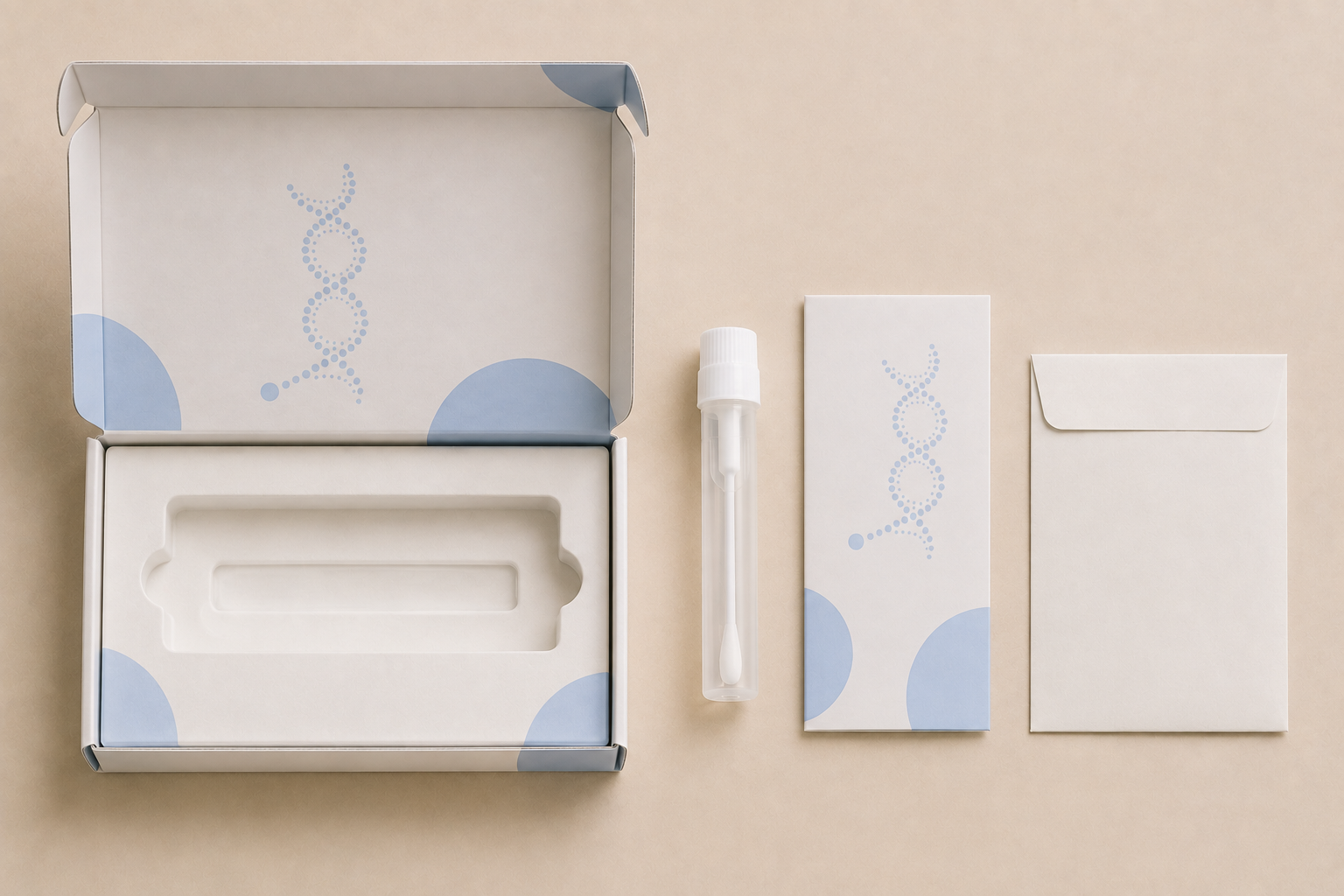
    The collection device. This is either a saliva collection tube or a cheek swab, depending on the company. Saliva kits include a funnel-topped tube with a fill line; swab kits include one or two individually wrapped swabs.

    A stabilizing solution (saliva kits only). Saliva tubes usually have a small reservoir of blue liquid built into the cap. When you seal the tube, this solution mixes with your sample to preserve the DNA during shipping — this is a normal, expected part of the process, not something to be concerned about.

    An activation code or barcode. This unique identifier links your physical sample to your online account. It’s usually printed on a card, on the tube itself, or both.

    Instructions. A printed quick-start guide walking through registration, collection, and return steps. Some companies also print a QR code linking to a video walkthrough.

    A prepaid return package. This typically includes a biohazard bag (a standard precaution for any biological sample, not a sign of something unusual), an outer shipping box or envelope, and a prepaid shipping label already affixed or included separately.

    Sometimes: alcohol wipes or extra materials for cheek swab kits, used to clean the inside of the cheek area before swabbing if specified in the instructions.

    What You Actually Need to Send Back

    This trips people up more than it should: you’re only sending back the sealed sample tube or swab, packaged in the provided biohazard bag and shipping materials — nothing else. You keep the instructions, the outer box the kit arrived in, and any promotional materials.

    Some kits ask you to write your activation code on the outer shipping label or include a card with the code inside the return package, so double-check your specific instructions here, since this step varies by company and missing it can cause processing delays.

    Step-by-Step: What the Return Process Actually Looks Like

    1. Register your kit online first. Before you even open the collection materials, activate your kit using the barcode or activation code through the company’s website. This step cannot be skipped or done later — the lab cannot process an unregistered sample.

    2. Follow the pre-collection instructions. For saliva kits, this usually means avoiding food, drink (other than water), gum, and smoking for at least 30 minutes beforehand. For swab kits, timing tends to be less strict, but check your specific instructions.

    3. Collect your sample. Saliva kits: spit into the tube until you reach the fill line, then seal the cap, which releases the stabilizing solution. Swab kits: swab the inside of each cheek for the specified time (often 30-60 seconds per side).

    4. Seal the sample in the provided biohazard bag. This is standard practice for shipping any biological sample and doesn’t require any special handling beyond following the printed instructions.

    5. Package it in the return shipping materials. Place the bagged sample into the return envelope or box, and confirm the prepaid shipping label is attached and legible.

    6. Drop it in any standard mailbox or post office. Most kits use standard postal services rather than requiring a special drop-off location — check your specific instructions, but this is the case for the majority of major kits.

    7. Track your kit’s status online. Most companies show a status update once your sample is received at the lab, giving you a rough sense of where you are in the timeline even before results are ready.

    Common Return Mistakes to Avoid

    Forgetting to register before mailing. This is the single most common source of processing delays, covered in more detail in our guide on DNA testing mistakes to avoid.

    Sending back the wrong items. Occasionally people mail back extra materials (instruction booklets, the outer box) unnecessarily, which doesn’t cause harm but isn’t needed and can occasionally cause confusion at sorting facilities if the package looks unusual.

    Not sealing the tube completely. For saliva kits, an improperly sealed cap can lead to leakage during transit, which sometimes results in a rejected sample and a replacement kit being sent.

    Losing the activation code before registering. If you misplace the card or can’t find the code before registering online, most companies have a lookup tool using your order number, so don’t panic — just check your original order confirmation email.

    What Happens After You Mail It

    Once the lab receives your package, most companies update your account status accordingly, and processing begins. From here, it’s purely a waiting game — turnaround time varies significantly by company, from as fast as two to three weeks with some wellness-focused kits, up to six to eight weeks or longer with more detail-heavy ancestry kits.

    Frequently Asked Questions

    Do I need special packaging to mail back a DNA sample? No. The kit includes everything required — a biohazard bag, return packaging, and a prepaid shipping label. Standard mail services and mailboxes are used for the vast majority of kits.

    What if I forgot to register my kit before sending it? Register online as soon as you realize, and contact customer support — some companies can still match an unregistered sample to your account manually, though this can add delays.

    Can I use a kit past its “use by” date if I still have an old one lying around? It depends on the company and how the stabilizing solution has held up. Contact customer support to check, since results from a degraded sample can sometimes come back inconclusive.

    The Bottom Line

    The actual mechanics of sending back a DNA test are simpler than they look from the outside — register first, follow the collection instructions carefully, and send back only what’s specified. Most delays and complications come from skipping the registration step or rushing the collection process, both of which are entirely avoidable with a few extra minutes of care.

  • 8 DNA Testing Mistakes People Make Before They Even Get Results

    8 DNA Testing Mistakes People Make Before They Even Get Results

    Affiliate Disclosure: This post contains affiliate links. If you buy through one of them, we may earn a small commission — at no extra cost to you. We only recommend kits we’ve actually researched and would suggest to a friend.

    Most Mistakes Happen Before the Lab Ever Sees Your Sample

    A lot of DNA testing frustration doesn’t come from bad luck or a flawed company — it comes from a handful of avoidable missteps that happen well before results ever show up. Some cost you weeks of extra waiting. Others just lead to disappointment based on expectations the test was never going to meet in the first place.

    Here’s what actually trips people up, based on the patterns that show up again and again.

    1. Not Registering the Kit Before Collecting Your Sample

    This is the single most common delay, and it’s entirely avoidable. Almost every company requires you to create an account and activate your kit’s unique barcode online before you collect your sample. Skip this step, and the lab has no way to match your sample to your account once it arrives — leading to processing delays or, in some cases, a request to send a new sample entirely.

    The fix: Register online the moment the kit arrives, before you even open the collection tube.

    2. Eating, Drinking, or Smoking Too Close to Collection

    For saliva-based kits especially, food particles and other contaminants can interfere with sample quality, sometimes leading to a rejected sample and a replacement kit — adding weeks to your timeline.

    The fix: Most companies recommend avoiding food, drink (other than water), gum, and smoking for at least 30 minutes before collection. Check your specific kit’s instructions, since exact timing varies.

    3. Choosing a Kit Based on Price Alone, Without Checking Database Strength

    The cheapest kit isn’t always the best value if your ancestry falls outside that company’s strongest reference regions. A budget-friendly test with a database that barely covers your background will leave you with a vague, unsatisfying ethnicity estimate regardless of price.

    The fix: Match the kit to your known or suspected ancestry before comparing prices — our comparison of the major DNA testing kits breaks down which companies are strongest for which regions.

    4. Expecting Ancestry Percentages to Be Fixed, Permanent Facts

    A lot of first-time confusion (and occasional frustration) comes from ethnicity percentages shifting after a company updates its reference database. This is normal and doesn’t mean the original test was wrong — but it catches people off guard if they weren’t expecting it.

    The fix: Go in understanding that ethnicity estimates are best-guess calculations based on current reference data, not permanent, unchangeable facts.

    5. Not Thinking Through Unexpected Results Beforehand

    This is less a technical mistake and more an emotional preparation gap. DNA testing can occasionally surface unexpected information — an unknown biological relative, a surprising gap in a family story, or an ethnicity result that doesn’t match family lore. People who haven’t considered this possibility beforehand are sometimes caught off guard in a way that’s harder to process than it needs to be.

    The fix: Before testing, spend a few minutes genuinely considering how you’d want to handle an unexpected result, rather than assuming everything will simply confirm what you already know.

    6. Ignoring the Privacy Policy Until After Testing

    Consent settings around data sharing, relative matching visibility, and law enforcement access vary meaningfully between companies. Some people only look into these details after testing, when it’s harder to make an informed choice about settings they’ve already agreed to by default.

    The fix: Read the consent options during sign-up, not after. Most companies let you adjust settings like relative-matching visibility, and it’s easier to set these up correctly from the start.

    7. Buying a Combo Kit Without Actually Wanting Both Features

    Combo kits like 23andMe bundle ancestry and health features together, but the price reflects that bundling. If you only care about one side of that equation, you may be paying for depth you’ll never use, when a specialized kit in just the category you want would have served you better and often cost less.

    The fix: Get clear on whether you actually want ancestry, health insights, or genuinely both before choosing between a specialized kit and a combo option.

    8. Assuming a Low Centimorgan Match Is a Confirmed Relative

    Distant matches (particularly under 20 centimorgans) sit in a genuinely uncertain zone. Treating every match on your list as a confirmed relative, rather than a hypothesis worth investigating further, can lead to confusion or incorrect assumptions about your family tree.

    The fix: Understand what your match numbers actually indicate — our guide on what a centimorgan actually measures breaks down how to interpret match strength more accurately.

    A Quick Pre-Testing Checklist

    Before you mail your sample back, it’s worth confirming: your kit is registered and activated, you’ve followed the pre-collection instructions (no food, drink, or smoking beforehand for saliva kits), you understand roughly what timeline to expect, and you’ve thought at least briefly about how you’d handle an unexpected result if one comes up.

    Frequently Asked Questions

    What’s the most common reason DNA test results get delayed? Failing to register the kit before mailing back the sample is the most frequent avoidable delay, since the lab can’t process an unregistered sample.

    Can I fix a rejected sample without buying a whole new kit? Usually, yes — most companies send a replacement collection tube at no extra cost if your first sample was rejected due to insufficient quantity or contamination, though this does add time to your overall wait.

    Is it normal for ethnicity results to change after testing? Yes, this is expected as companies update and refine their reference databases over time, and it doesn’t indicate an error in your original test.

    The Bottom Line

    Most DNA testing disappointment traces back to one of these avoidable missteps rather than the test itself being flawed. Register your kit properly, choose based on your actual ancestry and goals rather than price alone, and go in with realistic expectations about what the results will and won’t tell you — and the whole experience becomes considerably smoother.

  • AncestryDNA vs. DNApower: Ancestry Giant Meets Wellness Specialist

    AncestryDNA vs. DNApower: Ancestry Giant Meets Wellness Specialist

    Affiliate Disclosure: This post contains affiliate links. If you buy through one of them, we may earn a small commission — at no extra cost to you. We only recommend kits we’ve actually researched and would suggest to a friend.

    Two Kits, Two Completely Different Jobs

    If you’ve found yourself comparing these two, there’s a good chance you’re actually deciding between two different types of DNA test, not just two brands. AncestryDNA is built for genealogy — tracing your family tree, finding relatives, understanding your ethnic background. DNApower is built for wellness — understanding what your genes suggest about diet, fitness, and lifestyle.

    They’re not really competitors. But if you’re weighing which one to spend your money on first, here’s how they actually differ.

    What AncestryDNA Actually Does

    AncestryDNA gives you an ethnicity breakdown, a list of DNA matches (other testers who share your DNA), and — its biggest strength — direct integration with historical records like census data, immigration documents, and military records. It has the largest consumer DNA database of any company, which means the best odds of finding real relatives.

    If your goal is understanding where your family came from, or actually building out a documented family tree, this is exactly what AncestryDNA is designed for.

    What DNApower Actually Does

    DNApower has no ancestry component at all — no ethnicity percentages, no relative matching, no family tree. Instead, it analyzes genetic markers related to nutrition, exercise response, and lifestyle traits, like how your body processes caffeine or carbohydrates.

    Higher-tier packages include a consultation call with a health professional, which helps translate the raw genetic findings into something you can actually act on day to day.

    Turnaround Time

    DNApower is notably faster — typically two to three weeks. AncestryDNA usually takes three to four weeks, sometimes longer during peak gifting season in December and January. If you’re impatient and leaning toward wellness insights anyway, DNApower’s speed is a nice bonus on top of its actual focus.

    Price

    The two aren’t directly comparable dollar-for-dollar since they cover different ground, but roughly speaking: AncestryDNA’s base kit is mid-range, with costs climbing if you add the historical records subscription. DNApower’s pricing scales with how many report categories and add-ons you select, including the optional consultation call, so the total can vary more depending on how deep you want to go.

    Data and Privacy

    AncestryDNA’s privacy considerations mostly center on ancestry-related data — your ethnicity information and DNA matches, which some people are more cautious about due to the chance of discovering unexpected relatives. DNApower’s data is narrower and health-focused; the company states it doesn’t sell genetic data to insurance companies or third parties, with lab processing through a CLIA-certified facility.

    Neither company’s practices are unusual for the industry, but it’s worth reading the specific policy relevant to the type of data each kit actually collects.

    How the Kits Feel Once They Arrive

    The experience of using each kit reflects its different purpose. AncestryDNA’s saliva collection takes a few minutes, and once results are ready, you’re dropped into a dashboard built for exploration — matches to browse, hints to follow, a tree to slowly build out over weeks or months. It’s less a one-time report and more an ongoing research project.

    DNApower’s cheek swab is similarly quick, but what comes after is more compact. You get a detailed report organized by category, and if you’ve chosen a higher tier, a scheduled call to walk through what it actually means for your daily choices. It’s designed to be actionable relatively quickly, rather than something you keep returning to over time.

    So, Which One Should You Actually Get?

    Choose AncestryDNA if:

    • You want to trace your family history or find new relatives
    • You’re interested in connecting DNA results to actual historical documents
    • Ancestry, not health or wellness, is your primary curiosity

    Choose DNApower if:

    • Ancestry isn’t your focus at all — you want wellness-related genetic insights
    • You want a faster turnaround and value having a consultation to interpret results
    • You’re specifically interested in diet, fitness, or lifestyle-related genetic markers

    Is There Any Overlap Between Them?

    Not really, and that’s actually a point in favor of getting both if you’re curious about each category. Since AncestryDNA and DNApower analyze essentially non-overlapping aspects of your genetics, there’s no redundancy in testing with both — unlike choosing between two ancestry-focused kits, where you’d be paying twice for similar information.

    If budget allows, some people order both around the same time: DNApower’s faster turnaround means those results typically land first, while the AncestryDNA kit is still being processed or you’re waiting to build out matches and connect records over the following weeks. There’s no technical reason the two orders would interfere with each other, since they’re processed by entirely separate labs and systems.

    Still Deciding Which Category You Actually Want?

    If you’re not sure whether ancestry or wellness insights matter more to you, our breakdown of ancestry-focused versus health-focused DNA tests walks through how to think about that choice before picking a specific brand.

    Frequently Asked Questions

    Can AncestryDNA tell me anything about my health? Only in a very limited sense — it includes light trait reports (like whether you likely have a sweet tooth), but nothing close to the depth of a dedicated wellness test like DNApower.

    Is DNApower a replacement for a genealogy test? No. DNApower has no ancestry, ethnicity, or relative-matching features whatsoever — it’s built entirely around wellness-related genetic markers.

    Which one is better value for the money? It depends entirely on what you’re trying to learn. Comparing price alone isn’t meaningful here since the two kits answer completely different questions.

    The Bottom Line

    This isn’t really a competition — it’s a fork in the road. Decide first whether you’re chasing your family history or wellness insights, and the choice between AncestryDNA and DNApower becomes far more obvious than trying to weigh their features against each other directly.

    👉 Check current DNApower pricing

  • MyHeritage DNA vs. DNApower: Two Completely Different Kinds of DNA Test

    MyHeritage DNA vs. DNApower: Two Completely Different Kinds of DNA Test

    Affiliate Disclosure: This post contains affiliate links. If you buy through one of them, we may earn a small commission — at no extra cost to you. We only recommend kits we’ve actually researched and would suggest to a friend.

    Not Really a Fair Fight — And That’s the Point

    Unlike most head-to-head comparisons on this site, this one isn’t really about which kit is “better.” MyHeritage DNA and DNApower aren’t competing for the same customer — they’re answering two entirely different questions. One traces where your family came from. The other looks at what your genes suggest about your diet, fitness, and daily wellness.

    If you’ve landed on this comparison, there’s a good chance you’re actually trying to figure out which type of test you want, not just which brand. So let’s break down both, honestly.

    What MyHeritage DNA Actually Does

    MyHeritage is an ancestry-focused kit. You get an ethnicity breakdown by region, a list of DNA matches (other testers who share DNA with you), and family tree-building tools that connect your matches to a documented genealogy.

    It’s particularly strong for European and Jewish ancestry specifically, thanks to the depth of its reference database in those regions. If your goal is understanding where your family came from, or finding relatives you didn’t know existed, this is squarely what MyHeritage is built for.

    What DNApower Actually Does

    DNApower skips ancestry entirely. There’s no ethnicity breakdown, no relative matching, no family tree. Instead, it analyzes genetic markers tied to nutrition, fitness response, and lifestyle-related traits — things like carbohydrate sensitivity, caffeine metabolism, and how your body responds to exercise.

    Higher-tier packages also include a consultation call with a health professional to walk through what the results actually mean for your day-to-day choices, which is a meaningfully different experience than opening a static PDF report.

    Turnaround Time

    This is one of the few areas where a direct comparison actually makes sense. DNApower is significantly faster, typically returning results in two to three weeks. MyHeritage takes three to four weeks on average, sometimes longer during peak season. If speed matters to you regardless of which category you’re after, DNApower has the edge.

    Price

    Both companies price competitively within their respective categories, but they’re not really comparable dollar-for-dollar since you’re paying for different things. MyHeritage’s base kit is one of the more affordable ancestry tests on the market and goes on sale frequently. DNApower’s pricing scales with how many report categories and add-ons (including the consultation call) you choose, so the total cost depends heavily on how deep you want to go.

    Data and Privacy Approach

    Both companies are reasonably transparent about data handling, though the context differs. MyHeritage’s privacy considerations center mostly around ancestry-related data — ethnicity estimates and relative matching, which some people are more cautious about due to the possibility of surfacing unexpected family connections.

    DNApower’s data is more narrowly health-related, and the company states clearly that it doesn’t sell genetic data to insurance companies or third parties, with processing through a CLIA-certified lab. Neither company’s practices are dramatically different from typical industry standards, but it’s worth reading each policy for the specific type of data you’d be sharing.

    How the Testing Process Differs

    The two also feel different from the moment the kit arrives. MyHeritage uses a cheek swab — register online, swab both cheeks for a few seconds each, seal, and mail it back. Once results are ready, everything lives in a single dashboard alongside your family tree, if you’ve started building one.

    DNApower also uses a cheek swab, but the experience afterward diverges. Because the higher-tier packages include a consultation call, getting your results isn’t necessarily the end of the process — you may be scheduling time with a health consultant afterward to actually walk through what the findings mean for your daily habits, rather than just reading a report on your own.

    So, Which One Should You Actually Get?

    Choose MyHeritage DNA if:

    • You want to know your ethnic background or build a family tree
    • You’re hoping to find new relatives
    • Your ancestry is European, Jewish, or Eastern European specifically

    Choose DNApower if:

    • Ancestry doesn’t interest you at all — you want wellness insights specifically
    • You want a fast turnaround and value having a consultation call to interpret results
    • You’re focused on diet, fitness, or lifestyle-related genetic markers

    Can You Get Both?

    Yes, and this is actually one of the more sensible reasons to consider two separate kits rather than a single combo product. Since MyHeritage and DNApower analyze completely different aspects of your genetics, there’s no overlap or redundancy — testing with both gives you a genuinely fuller picture than either one alone, without paying for features you won’t use in a combo kit like 23andMe.

    If You’re Still Deciding Between Categories

    If you’re genuinely torn between wanting ancestry information and wellness insights, it’s worth reading our breakdown of ancestry-focused versus health-focused DNA tests before committing to either kit specifically.

    Frequently Asked Questions

    Does MyHeritage DNA offer any wellness or health features? Health reporting exists as a limited add-on, but it’s not MyHeritage’s core focus or strength — DNApower’s wellness reports go considerably deeper in this specific area.

    Does DNApower offer any ancestry features? No. DNApower is exclusively focused on wellness-related genetic markers, with no ethnicity breakdown or relative-matching features at all.

    Is it worth buying both kits instead of a combo test like 23andMe? It can be, particularly if you want more depth in each category than a combo kit typically provides. The tradeoff is cost and managing two separate accounts and processing timelines.

    The Bottom Line

    This comparison isn’t really about picking a winner — it’s about recognizing that MyHeritage DNA and DNApower solve two different problems entirely. Get clear on whether you’re chasing ancestry answers or wellness insights first, and the right kit becomes obvious from there.

    👉 Check current DNApower pricing

  • AncestryDNA vs. Living DNA: Which One Should You Actually Get?

    AncestryDNA vs. Living DNA: Which One Should You Actually Get?

    Affiliate Disclosure: This post contains affiliate links. If you buy through one of them, we may earn a small commission — at no extra cost to you. We only recommend kits we’ve actually researched and would suggest to a friend.

    Massive Database vs. Microscopic Detail

    These two kits represent opposite philosophies. AncestryDNA goes wide — the largest consumer DNA database on the market, built to maximize your odds of finding relatives and connecting to historical records. Living DNA goes deep — a smaller database, but regional detail within the British Isles that few competitors even attempt to match.

    Neither approach is wrong. They’re just optimized for different goals, and figuring out which one actually fits you is what this comparison is for.

    Who Should Look Elsewhere

    If your ancestry sits well outside the UK, Ireland, Western Europe, or North America, both of these kits will likely disappoint you to some degree — Living DNA especially, since its whole value proposition is regional depth for a specific part of the world.

    If you’re chasing health insights specifically, neither kit is designed for that as its primary function.

    Otherwise, here’s the real comparison.

    Database Size: No Contest

    AncestryDNA has the largest database of any consumer DNA testing company, by a wide margin. Living DNA’s database is considerably smaller in comparison.

    This matters most for relative matching. More people in the database means dramatically higher odds of finding second cousins, distant relatives, and unexpected family connections. If discovering new relatives is a major part of why you’re testing, this single factor probably decides the comparison on its own.

    Regional Detail: Living DNA’s Entire Reason to Exist

    Here’s where the comparison flips completely. AncestryDNA’s ethnicity breakdown is solid and reasonably detailed for its size, but it generally reports at the level of larger regions — “England & Northwestern Europe,” for instance — rather than granular sub-regions.

    Living DNA, by contrast, can break the British Isles down into dozens of distinct sub-regions. If your family history runs through a specific part of England, Scotland, Ireland, or Wales, and you want detail specific enough to potentially point toward a particular historical county, Living DNA does something AncestryDNA simply doesn’t attempt at the same resolution.

    What Each Test Actually Analyzes

    AncestryDNA focuses on autosomal DNA — the standard approach most ancestry kits use, covering your broad ethnic makeup and relative matches.

    Living DNA goes further, testing autosomal, Y-DNA, and mitochondrial DNA together in a single kit. This gives you insight into your direct paternal and maternal lines specifically, not just your overall ethnic composition — a meaningful difference if you’re trying to trace a specific line of descent rather than get a general picture.

    Historical Records: AncestryDNA’s Strongest Card

    If your genealogy research plans include digging through census records, immigration documents, and military records, AncestryDNA is significantly ahead here. Its records integration is one of the most extensive available, and DNA matches connect directly into a documented family tree with automatically surfacing research hints.

    Living DNA doesn’t offer a comparable records archive. It’s built specifically as an ancestry testing tool, not a broader genealogy research platform, so if paper-trail research matters to you, this is a real gap.

    Turnaround Time

    AncestryDNA typically returns results in three to four weeks. Living DNA’s stated window is six to eight weeks, sometimes stretching to ten or twelve during busier periods. This is one of the more significant practical differences between the two — if you’re not particularly patient, or you’re testing for a specific occasion, the wait time alone might settle the decision.

    Price

    Both kits sit in a similar mid-range price bracket for the base test, and both run periodic sales. AncestryDNA’s overall cost tends to climb higher if you add the historical records subscription, which Living DNA doesn’t have an equivalent to. Living DNA’s optional wellbeing add-on is a smaller expense by comparison if you choose to add it.

    So, Which One Should You Choose?

    Choose AncestryDNA if:

    • Finding as many potential relatives as possible matters most to you
    • You want to do serious historical research using original documents
    • Your ancestry is broadly Western European, North American, or otherwise well-represented in a large database

    Choose Living DNA if:

    • Your family history is specifically rooted in the UK or Ireland
    • You want granular regional detail, not just a broad ethnicity percentage
    • You’re interested in direct paternal/maternal line analysis (Y-DNA and mitochondrial DNA)
    • You can comfortably wait out a longer turnaround time

    Testing With Both

    Because these two serve different purposes — broad discovery versus deep regional analysis — some people genuinely benefit from testing with both rather than picking one. It’s a bigger investment, but if you have known UK ancestry and also want the widest possible net for finding relatives, the combination covers more ground than either kit alone.

    Comparing Against the Rest of the Field

    If neither of these feels like a perfect fit, our full comparison of the major DNA testing kits covers how MyHeritage DNA, FamilyTreeDNA, and other options stack up as well.

    Frequently Asked Questions

    Is Living DNA worth it if I already tested with AncestryDNA? It can be, particularly if your ancestry includes UK or Irish roots and you want more granular regional detail, or if you’re interested in Y-DNA and mitochondrial line analysis that AncestryDNA doesn’t provide.

    Why does Living DNA take so much longer than AncestryDNA? Living DNA’s more extensive analysis — combining autosomal, Y-DNA, and mitochondrial testing — requires more lab processing time than AncestryDNA’s standard autosomal-only approach.

    Which kit has better historical records? AncestryDNA, by a significant margin. Its records archive is one of the most extensive in the industry, while Living DNA doesn’t offer a comparable historical document database.

    The Bottom Line

    If you want the biggest possible pool of potential relatives and strong historical research tools, AncestryDNA is the stronger overall choice. If your roots are specifically British or Irish and you want detail most competitors can’t match, Living DNA earns its place despite the smaller database and longer wait. The right pick depends less on which company is “better” and more on which type of answer you’re actually looking for.

  • Living DNA vs. MyHeritage DNA: Which One Should You Actually Get?

    Living DNA vs. MyHeritage DNA: Which One Should You Actually Get?

    Affiliate Disclosure: This post contains affiliate links. If you buy through one of them, we may earn a small commission — at no extra cost to you. We only recommend kits we’ve actually researched and would suggest to a friend.

    Two Specialists, Different Corners of Europe

    Neither of these kits is trying to be the biggest name in the room. Both Living DNA and MyHeritage DNA carved out a specific niche instead — deep regional detail rather than sheer database size — which makes comparing them less about “which is better overall” and more about “which specialty actually matches your background.”

    Here’s how they stack up.

    Who Should Look at a Different Kit Entirely

    If your ancestry sits well outside the UK, Ireland, or Europe, both of these kits will feel comparatively thin. A larger, more globally distributed database — like AncestryDNA’s — will likely serve you better.

    If health insights are your main goal, neither of these is built for that. Living DNA offers a separate wellbeing add-on, but it’s not the core product, and MyHeritage’s health reporting is similarly a secondary feature at best.

    Otherwise, let’s get into where each one actually shines.

    Regional Specialty: This Is the Real Decision Point

    This is genuinely the most important factor in choosing between these two, more than price or database size.

    Living DNA specializes in the British Isles. If your family history runs through England, Scotland, Ireland, or Wales, Living DNA’s regional breakdown goes deeper than almost any competitor — pinpointing sub-regions within the UK and Ireland rather than lumping everything into one broad category.

    MyHeritage specializes in continental Europe and Jewish ancestry. If your background points toward Poland, Italy, Germany, or Ashkenazi Jewish heritage specifically, MyHeritage’s reference database is noticeably deeper in these areas than most competitors, including Living DNA.

    If your ancestry overlaps both — say, British on one side of the family and Eastern European on the other — neither kit alone will give you the full picture, and testing with both (or uploading raw data between them) becomes genuinely worth considering.

    Database Size and Relative Matching

    Both companies have smaller overall databases compared to giants like AncestryDNA, but they’re not equal to each other either.

    MyHeritage’s database is meaningfully larger than Living DNA’s, which translates to more potential DNA matches across the board — not just within its specialty regions. If finding new relatives is a real priority alongside regional accuracy, MyHeritage has an edge here simply due to scale.

    What Each Test Actually Analyzes

    This is where Living DNA pulls ahead in a different way. It tests autosomal DNA, Y-DNA, and mitochondrial DNA together in one kit, giving you insight into both your direct paternal and maternal lines. MyHeritage’s standard test focuses on autosomal DNA only, which covers your broader ancestry but doesn’t provide that same direct paternal/maternal line analysis.

    If tracing a specific line of descent matters to you — not just an overall ethnicity picture — Living DNA’s broader testing scope is a genuine advantage, regardless of which regional specialty you need.

    Family Tree Tools

    MyHeritage has the more developed family tree platform of the two, with Smart Matches and Record Matches that surface automatically as your tree grows. It’s built to be a complete genealogy research environment, not just an ethnicity report.

    Living DNA’s tree-building tools are more basic by comparison. It’s a solid ancestry test, but it doesn’t try to compete as a full genealogy research platform the way MyHeritage does.

    Turnaround Time: Not Close

    This is one of the clearest differences between the two. MyHeritage typically returns results in three to four weeks. Living DNA’s stated window is six to eight weeks, and it’s not uncommon for it to stretch closer to ten to twelve weeks during busier periods.

    If you’re testing for a specific occasion or you’re simply impatient, this gap alone might tip the decision toward MyHeritage.

    Price

    MyHeritage DNA is generally the more affordable of the two, with frequent, fairly aggressive sales that push the price down further. Living DNA sits in a similar mid-range bracket normally, though it goes on sale less aggressively than MyHeritage does.

    So, Which One Should You Choose?

    Choose Living DNA if:

    • Your ancestry is specifically rooted in the UK or Ireland
    • You want combined autosomal, Y-DNA, and mitochondrial testing in one kit
    • You’re not in a hurry and can wait out the longer turnaround

    Choose MyHeritage DNA if:

    • Your background is European, Jewish, Italian, or Eastern European
    • You want faster results and a more developed family tree platform
    • You’re working with a tighter budget and want frequent sale pricing

    What If You’re Not Sure Which Region Fits?

    If you’re honestly uncertain where your ancestry concentrates most heavily, a broader database like AncestryDNA might be a more sensible starting point before narrowing in on a regional specialist. Our full comparison of the major DNA testing kits breaks down how all the major options stack up against each other.

    Frequently Asked Questions

    Which is more accurate, Living DNA or MyHeritage DNA? Neither is universally more accurate — each is strongest within its own regional specialty. Living DNA excels for UK and Irish ancestry; MyHeritage excels for European and Jewish ancestry.

    Which one gives faster results? MyHeritage DNA, typically by several weeks. Living DNA’s more detailed analysis takes longer to process, often six to eight weeks or more.

    Can I use both kits for a more complete picture? Yes. If your background spans both specialty regions, testing with both — or uploading raw data from one to the other where supported — can give a more complete picture than either kit alone.

    The Bottom Line

    This comparison really comes down to geography more than any other single factor. Match the kit to where your ancestry actually traces back to, and from there, weigh speed, price, and testing scope based on what matters most to you personally.