タグ: best DNA kits 2026

  • Prenatal DNA Testing: What NIPT Actually Tells You

    Prenatal DNA Testing: What NIPT Actually Tells You

    Affiliate Disclosure: This post contains affiliate links. If you buy through one of them, we may earn a small commission — at no extra cost to you. We only recommend kits we’ve actually researched and would suggest to a friend.

    A Different Category Entirely From Ancestry Kits

    If you’ve been researching consumer DNA kits like AncestryDNA or 23andMe and then started looking into prenatal DNA testing, it’s worth knowing upfront: these are genuinely different categories of testing, run through different processes entirely. Prenatal DNA testing is a clinical medical test, ordered through a healthcare provider, not a mail-order kit you register online yourself.

    Here’s a general overview of what this type of testing actually involves, so you know what to expect and what questions to bring to your doctor.

    What NIPT Actually Is

    Non-invasive prenatal testing (NIPT) analyzes small fragments of fetal DNA that circulate in the mother’s bloodstream during pregnancy. A blood sample is drawn from the mother — no procedure involving the fetus directly — typically starting around the 10th week of pregnancy, and sent to a specialized lab for analysis.

    The “non-invasive” part is significant: unlike procedures such as amniocentesis or chorionic villus sampling (CVS), which involve directly sampling fluid or tissue from around the fetus, NIPT only requires a standard blood draw, carrying none of the procedural risks associated with more invasive testing methods.

    What NIPT Screens For

    NIPT is most commonly used to screen for certain chromosomal conditions, including Down syndrome (trisomy 21), along with a few other trisomy conditions. Depending on the specific test ordered, it can also provide information about fetal sex, typically with high accuracy from early in the second trimester onward.

    It’s worth being precise about terminology here: NIPT is a screening test, not a diagnostic test. It estimates probability based on statistical analysis of the DNA fragments detected, rather than providing a definitive yes-or-no diagnosis. A higher-risk result from NIPT is typically followed up with a diagnostic test (like amniocentesis) if a definitive answer is needed, since screening and diagnostic tests serve different purposes in a prenatal care plan.

    How Accurate Is It, Really?

    For the conditions it’s most established for detecting, like Down syndrome, NIPT has a high detection rate when performed as part of a properly managed pregnancy care plan. That said, accuracy varies somewhat depending on the specific condition being screened for, and false positives and false negatives, while uncommon, do occur.

    This is exactly why a positive or higher-risk NIPT result isn’t treated as a final answer on its own — it’s a signal that prompts further diagnostic testing to confirm or rule out the finding, discussed directly with your OB-GYN or a genetic counselor who can walk through what your specific results mean in the context of your full pregnancy history.

    How This Differs From Consumer Ancestry Kits

    It’s worth being direct about this distinction, since the marketing language around “DNA testing” broadly can blur these categories together in people’s minds. Consumer kits like AncestryDNA or MyHeritage DNA are ordered directly by consumers, processed by consumer-facing labs, and focused on ancestry, ethnicity, or general wellness traits.

    NIPT is ordered through a healthcare provider as part of clinical prenatal care, processed through medical-grade laboratories held to clinical diagnostic standards, and specifically designed to screen for medically relevant conditions during pregnancy. These aren’t interchangeable categories, and a consumer ancestry kit is not a substitute for prenatal screening, nor is NIPT designed to answer ancestry-related questions.

    Questions Worth Bringing to Your Doctor

    If you’re considering NIPT, or your doctor has already recommended it, a few questions are worth raising directly in that conversation: which specific conditions does this particular test screen for, what would happen next if a result comes back higher-risk, and does your insurance cover the test (coverage varies significantly depending on factors like maternal age and other risk indicators).

    Genetic counseling is often available before and after NIPT, particularly if results come back indicating elevated risk for a specific condition — this is generally a valuable resource for understanding what a result actually means for your specific pregnancy, beyond just the numbers on a report.

    What This Doesn’t Cover

    NIPT screens for a specific, limited set of chromosomal conditions — it does not screen for every possible genetic or developmental condition, and a low-risk NIPT result doesn’t guarantee a pregnancy free of any other complications or considerations that a broader prenatal care plan monitors for separately.

    Frequently Asked Questions

    Is NIPT the same as an at-home DNA ancestry test? No. NIPT is a clinical medical screening test ordered through a healthcare provider, processed by medical laboratories, and focused specifically on certain pregnancy-related conditions — a completely different category from consumer ancestry or wellness DNA kits.

    How early in pregnancy can NIPT be done? Typically starting around the 10th week of pregnancy, though your doctor can confirm the appropriate timing for your specific situation.

    Does a positive NIPT result mean the baby definitely has the condition screened for? No. NIPT is a screening test, not a diagnostic one — a higher-risk result is typically followed by a diagnostic test to confirm or rule out the finding, and this should be discussed directly with your doctor or a genetic counselor.

    The Bottom Line

    Prenatal DNA testing through NIPT is a genuinely different category from the consumer ancestry and wellness kits covered elsewhere on this site — it’s a clinical screening tool that belongs in a conversation with your healthcare provider, not something to research and order independently the way you would an ancestry kit. If you’re considering it, your OB-GYN or a genetic counselor is the right starting point for questions specific to your pregnancy.

    If you’re also curious about consumer DNA testing for ancestry or wellness purposes, our comparison of the major DNA testing kits covers those options separately.
  • Dog DNA Tests: What They Actually Tell You (and What They Don’t)

    Dog DNA Tests: What They Actually Tell You (and What They Don’t)

    Affiliate Disclosure: This post contains affiliate links. If you buy through one of them, we may earn a small commission — at no extra cost to you. We only recommend kits we’ve actually researched and would suggest to a friend.

    Your “Definitely a Lab Mix” Might Not Be

    Rescue dogs come with a lot of guesswork attached. The shelter paperwork says “Lab mix,” the vet nods along, and everyone just kind of agrees based on how the dog looks. Dog DNA tests exist to replace that guesswork with an actual answer — and the results genuinely do surprise people more often than you’d expect.

    Here’s how these tests actually work, what they’re good for, and where the limits are.

    How Dog DNA Testing Actually Works

    The process mirrors human ancestry testing closely: a cheek swab sample gets compared against a reference database of known dog breeds. The bigger and more detailed that reference database, the more precise the breed breakdown — same underlying logic as human ancestry kits, just applied to canine genetics instead.

    Most tests report results as a percentage breakdown by breed, sometimes going back multiple generations (great-grandparent level) for mixed breed dogs with more complex ancestry.

    What a Breed Breakdown Actually Tells You

    It explains behavior patterns that seemed confusing before. A dog assumed to be a Lab mix that turns out to have significant Border Collie ancestry suddenly makes a lot more sense if it’s been herding the kids around the yard and needs way more mental stimulation than a typical Lab.

    It can flag breed-related health considerations. Certain breeds carry known predispositions to specific health conditions. Knowing your mixed-breed dog carries meaningful ancestry from a breed prone to a particular condition can be useful context to bring to your vet, even though it’s not a diagnosis.

    It satisfies genuine curiosity. For a lot of owners, this is simply the main draw — finally getting a real answer instead of a shelter’s best guess.

    What It Doesn’t Tell You

    It’s not a substitute for veterinary care or diagnosis. Some tests include health marker screening for specific genetic conditions, but this is different from a full veterinary workup, and any flagged results are worth discussing directly with a vet rather than acting on independently.

    Breed doesn’t determine personality on its own. Breed ancestry influences tendencies, not guarantees. Individual temperament, training, and environment matter enormously alongside genetics — a dog with significant guarding-breed ancestry isn’t automatically going to behave a certain way regardless of how it was raised.

    Results depend on the company’s reference database. Just like human ancestry tests, dog DNA companies vary in how many breeds they include and how deep their reference data goes for less common breeds. A company with a smaller database may report a breed as “unknown mixed ancestry” simply because it lacks sufficient reference samples, not because that ancestry doesn’t exist.

    What to Look for When Choosing a Kit

    Breed database size. More breeds in the reference database generally means more precise results, particularly for less common breeds that smaller databases might miss entirely or lump into a generic “mixed breed” category.

    Whether health screening is included. Some kits focus purely on breed identification; others include screening for specific genetic health markers relevant to certain breeds. Decide which you actually want before comparing prices, since health-inclusive kits typically cost more.

    Turnaround time. Similar to human kits, processing time varies by company — typically two to four weeks, though this can extend during busier periods.

    Sample collection method. Nearly all dog DNA tests use a simple cheek swab, which is generally easy even with a wiggly, uncooperative dog, though a calm moment (like right after a walk) tends to make collection smoother.

    A Few Practical Collection Tips

    Getting a clean sample from a dog is a little different than from a compliant human. Try to collect the swab when your dog hasn’t eaten or had water in the last 30 minutes or so, similar to human sample guidelines, and aim for a calmer moment rather than right after an exciting walk or play session when there’s more saliva and movement to work around.

    If you have multiple dogs, label everything clearly and collect one dog’s sample at a time in a separate space if possible — mixed-up samples between pets is a more common mistake than people expect, especially in a busy multi-dog household.

    Frequently Asked Questions

    How accurate are dog DNA breed tests? For breeds well-represented in a company’s reference database, accuracy is generally solid. Results for rare or less common breeds tend to be less precise, similar to how human ancestry tests vary in accuracy depending on regional database depth.

    Can a dog DNA test diagnose a health condition? No. Some tests screen for genetic markers associated with certain conditions, but this is informational, not diagnostic — any concerning results are worth discussing with a veterinarian rather than treating as a standalone diagnosis.

    Why did my dog’s results change slightly when I retested with a different company? Different companies use different reference databases, so breed percentages can vary somewhat between companies, similar to how human ethnicity estimates differ slightly across ancestry testing brands.

    The Bottom Line

    A dog DNA test won’t tell you everything about your pet, but it often replaces years of guesswork with a genuinely useful answer — one that can explain a confusing behavior pattern, flag a health consideration worth mentioning to your vet, or simply satisfy the curiosity that’s been nagging at you since the day you brought your “definitely a Lab mix” home.

    Curious about what your own DNA might reveal? Check out our comparison of the top human DNA testing kits to see which one fits your goals.

  • DNA Testing for Adoptees: A Practical Guide to Finding Biological Family

    DNA Testing for Adoptees: A Practical Guide to Finding Biological Family

    Affiliate Disclosure: This post contains affiliate links. If you buy through one of them, we may earn a small commission — at no extra cost to you. We only recommend kits we’ve actually researched and would suggest to a friend.

    A Different Kind of Search Than Most People Are Doing

    For most people, a DNA test is a curiosity project — a fun percentage breakdown, maybe a few new third cousins to say hello to. For adoptees, it’s often something much more significant: potentially the first real lead in identifying biological parents, siblings, or an entire side of family history that’s been an unknown for years, sometimes decades.

    This guide focuses specifically on what actually matters for that kind of search — which kits give you the best odds, what to realistically expect, and how to approach it in a way that protects your own wellbeing along the way.

    Why Database Size Matters More Here Than for Almost Any Other Use Case

    For most DNA testing purposes, database size is one factor among several. For an adoptee search, it’s arguably the single most important variable. You can only be matched with people who have also tested with that specific company — so the larger the database, the higher your odds of connecting with a close biological relative.

    This is why AncestryDNA is generally the strongest starting point for this specific goal. Its database is the largest of any consumer DNA testing company, which directly translates to better odds of a close match — a half-sibling, an aunt or uncle, or in some fortunate cases, a parent or full sibling.

    Test With More Than One Company If You Can

    Because matches are limited to each company’s own database, testing with a single company means you’re only searching one pool of potential relatives. Many experienced searchers test with multiple companies, or upload their raw DNA data to additional platforms that accept uploads, to maximize their total search coverage.

    MyHeritage DNA accepts raw data uploads from AncestryDNA and other major companies, which is a budget-friendly way to expand your search without paying for a full second test. GEDmatch, a free third-party tool, is also widely used in adoptee search communities specifically because it lets you compare your raw data across uploads from multiple testing companies at once.

    What “Close Match” Actually Means for Your Search

    Understanding centimorgan ranges becomes especially practical here, since it directly affects how you interpret results. A match in the thousands of centimorgans likely indicates a parent or full sibling. A match in the hundreds might be a half-sibling, aunt, uncle, or grandparent. Matches lower than that require more careful triangulation — cross-referencing shared matches and any family tree information available — to narrow down the actual relationship. Our guide on what a centimorgan actually measures walks through these ranges in more detail.

    Working With What You Find

    Shared matches are often more useful than a single match alone. If a mystery match doesn’t have a family tree built out, looking at who else they match — and how those people connect to each other — can help you triangulate toward an actual identity, even without direct contact.

    Genetic genealogy is a real, specialized skill. For complex searches, particularly ones involving distant matches or minimal family tree information, some adoptees choose to work with a professional search angel or genetic genealogist — often through adoptee-specific search communities — rather than navigating it entirely alone. This isn’t necessary for every search, but it’s worth knowing the option exists if your search hits a wall.

    Preparing Yourself Emotionally Before You Start

    This part matters as much as the technical search strategy, and it’s worth being honest about upfront. An adoptee DNA search can surface information you weren’t expecting — details about circumstances of the adoption, health information, or family situations that are complicated in ways you couldn’t have anticipated. It can also, sometimes, lead to a biological relative who isn’t ready or willing to connect, which can be its own difficult outcome to process.

    Many adoptee search communities strongly recommend having some support in place before you start — whether that’s a therapist familiar with adoption issues, a support group of other adoptees who’ve been through a search, or simply a trusted person you can talk to as things unfold. This isn’t meant to be discouraging; it’s meant to help the process feel more manageable regardless of what you find.

    If You Do Make Contact

    There’s no single right way to approach a first contact with a newly discovered biological relative, and there’s genuinely no need to rush it. Many adoptees take time to plan what they want to say, and some choose to reach out through a neutral intermediary (a search angel, or even a brief introductory message) rather than an immediate, unplanned call. Respecting that the other person may need time to process the contact too — even if you’ve been preparing for this moment for a long time — tends to lead to better long-term outcomes than an unplanned, emotionally intense first interaction.

    Choosing Your First Kit

    Given the priority on database size for this specific goal, AncestryDNA is generally the strongest starting point, with MyHeritage as a strong second test or raw data upload to widen your search further. Our full comparison of the major DNA testing kits covers the details on both if you want to compare further before ordering.

    Frequently Asked Questions

    Which DNA test is best specifically for finding biological family? AncestryDNA is generally recommended first due to its database size, which directly affects your odds of a close match. Testing with multiple companies, or uploading raw data to platforms like GEDmatch, further expands your search.

    How long does an adoptee DNA search typically take? This varies enormously — some searches resolve within weeks of getting results, particularly with a very close match. Others take months or longer, especially when working from more distant matches that require additional research to interpret.

    Is it normal to feel anxious about starting this kind of search? Yes, and it’s worth taking seriously rather than pushing past. Many people find it helpful to have some support in place — whether a therapist, support group, or trusted person — before and during the search process.

    The Bottom Line

    An adoptee DNA search is a genuinely different undertaking than typical ancestry curiosity, both technically and emotionally. Prioritizing database size, considering multiple companies or raw data uploads, and preparing yourself for whatever the results might reveal all meaningfully improve both your odds of success and how manageable the process feels along the way.

  • What’s Actually Inside a DNA Test Kit (and How to Send It Back Correctly)

    What’s Actually Inside a DNA Test Kit (and How to Send It Back Correctly)

    Affiliate Disclosure: This post contains affiliate links. If you buy through one of them, we may earn a small commission — at no extra cost to you. We only recommend kits we’ve actually researched and would suggest to a friend.

    The Box Arrives, and It’s Smaller Than You Expected

    Most people picture something more elaborate before their first kit shows up — some kind of lab equipment, maybe. In reality, it’s a surprisingly small, simple package. Here’s exactly what’s typically inside, what each piece does, and how to make sure your sample actually gets processed without delays.

    What’s Typically in the Box

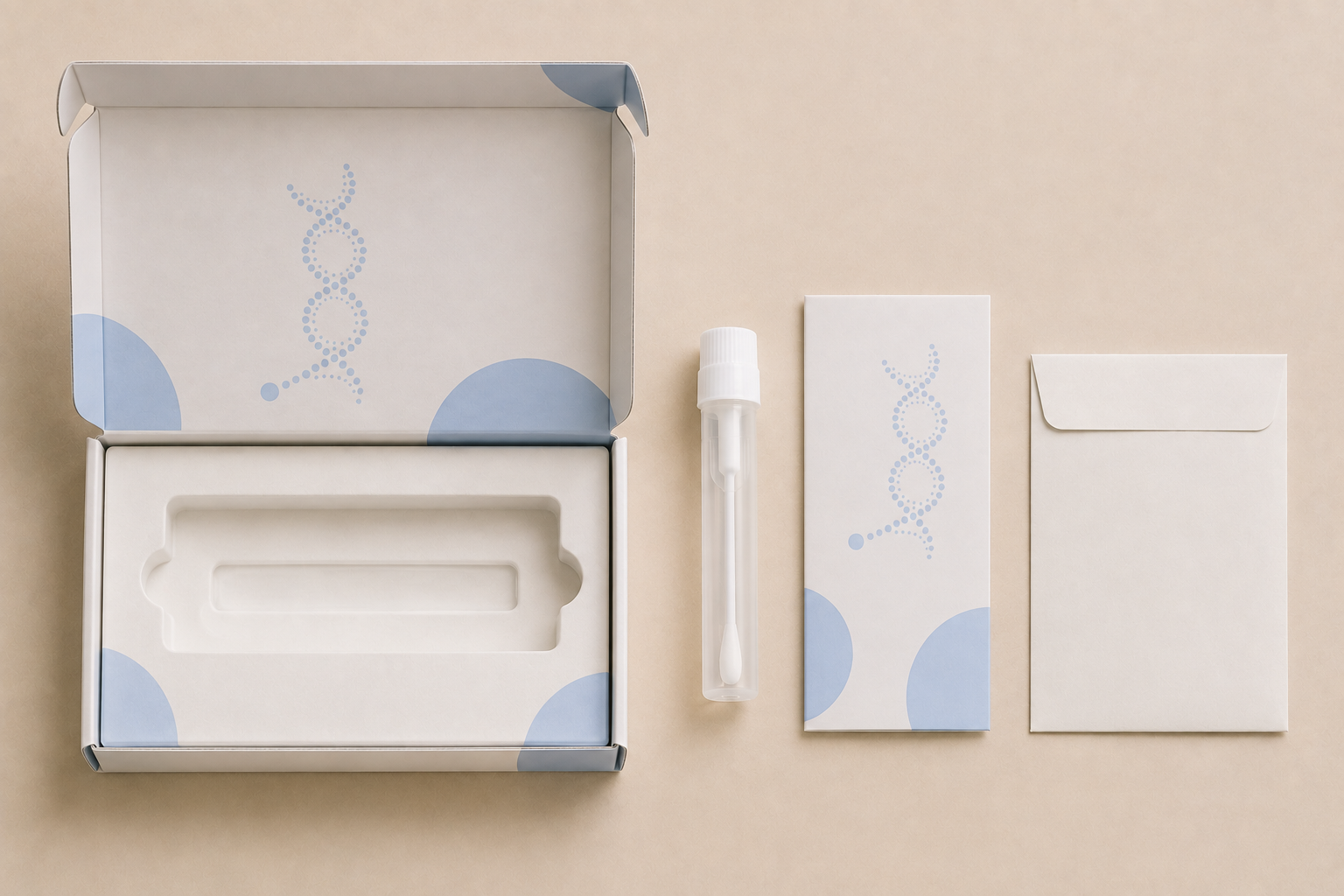
    The collection device. This is either a saliva collection tube or a cheek swab, depending on the company. Saliva kits include a funnel-topped tube with a fill line; swab kits include one or two individually wrapped swabs.

    A stabilizing solution (saliva kits only). Saliva tubes usually have a small reservoir of blue liquid built into the cap. When you seal the tube, this solution mixes with your sample to preserve the DNA during shipping — this is a normal, expected part of the process, not something to be concerned about.

    An activation code or barcode. This unique identifier links your physical sample to your online account. It’s usually printed on a card, on the tube itself, or both.

    Instructions. A printed quick-start guide walking through registration, collection, and return steps. Some companies also print a QR code linking to a video walkthrough.

    A prepaid return package. This typically includes a biohazard bag (a standard precaution for any biological sample, not a sign of something unusual), an outer shipping box or envelope, and a prepaid shipping label already affixed or included separately.

    Sometimes: alcohol wipes or extra materials for cheek swab kits, used to clean the inside of the cheek area before swabbing if specified in the instructions.

    What You Actually Need to Send Back

    This trips people up more than it should: you’re only sending back the sealed sample tube or swab, packaged in the provided biohazard bag and shipping materials — nothing else. You keep the instructions, the outer box the kit arrived in, and any promotional materials.

    Some kits ask you to write your activation code on the outer shipping label or include a card with the code inside the return package, so double-check your specific instructions here, since this step varies by company and missing it can cause processing delays.

    Step-by-Step: What the Return Process Actually Looks Like

    1. Register your kit online first. Before you even open the collection materials, activate your kit using the barcode or activation code through the company’s website. This step cannot be skipped or done later — the lab cannot process an unregistered sample.

    2. Follow the pre-collection instructions. For saliva kits, this usually means avoiding food, drink (other than water), gum, and smoking for at least 30 minutes beforehand. For swab kits, timing tends to be less strict, but check your specific instructions.

    3. Collect your sample. Saliva kits: spit into the tube until you reach the fill line, then seal the cap, which releases the stabilizing solution. Swab kits: swab the inside of each cheek for the specified time (often 30-60 seconds per side).

    4. Seal the sample in the provided biohazard bag. This is standard practice for shipping any biological sample and doesn’t require any special handling beyond following the printed instructions.

    5. Package it in the return shipping materials. Place the bagged sample into the return envelope or box, and confirm the prepaid shipping label is attached and legible.

    6. Drop it in any standard mailbox or post office. Most kits use standard postal services rather than requiring a special drop-off location — check your specific instructions, but this is the case for the majority of major kits.

    7. Track your kit’s status online. Most companies show a status update once your sample is received at the lab, giving you a rough sense of where you are in the timeline even before results are ready.

    Common Return Mistakes to Avoid

    Forgetting to register before mailing. This is the single most common source of processing delays, covered in more detail in our guide on DNA testing mistakes to avoid.

    Sending back the wrong items. Occasionally people mail back extra materials (instruction booklets, the outer box) unnecessarily, which doesn’t cause harm but isn’t needed and can occasionally cause confusion at sorting facilities if the package looks unusual.

    Not sealing the tube completely. For saliva kits, an improperly sealed cap can lead to leakage during transit, which sometimes results in a rejected sample and a replacement kit being sent.

    Losing the activation code before registering. If you misplace the card or can’t find the code before registering online, most companies have a lookup tool using your order number, so don’t panic — just check your original order confirmation email.

    What Happens After You Mail It

    Once the lab receives your package, most companies update your account status accordingly, and processing begins. From here, it’s purely a waiting game — turnaround time varies significantly by company, from as fast as two to three weeks with some wellness-focused kits, up to six to eight weeks or longer with more detail-heavy ancestry kits.

    Frequently Asked Questions

    Do I need special packaging to mail back a DNA sample? No. The kit includes everything required — a biohazard bag, return packaging, and a prepaid shipping label. Standard mail services and mailboxes are used for the vast majority of kits.

    What if I forgot to register my kit before sending it? Register online as soon as you realize, and contact customer support — some companies can still match an unregistered sample to your account manually, though this can add delays.

    Can I use a kit past its “use by” date if I still have an old one lying around? It depends on the company and how the stabilizing solution has held up. Contact customer support to check, since results from a degraded sample can sometimes come back inconclusive.

    The Bottom Line

    The actual mechanics of sending back a DNA test are simpler than they look from the outside — register first, follow the collection instructions carefully, and send back only what’s specified. Most delays and complications come from skipping the registration step or rushing the collection process, both of which are entirely avoidable with a few extra minutes of care.

  • 23andMe Review 2026: Is the Ancestry + Health Combo Worth It?

    23andMe Review 2026: Is the Ancestry + Health Combo Worth It?

    Affiliate Disclosure: This post contains affiliate links. If you buy through one of them, we may earn a small commission — at no extra cost to you. We only recommend kits we’ve actually researched and would suggest to a friend.

    The Kit That Tries to Do Two Jobs at Once

    Most DNA kits pick a lane — ancestry or health, not both. 23andMe is the exception, and it’s built its entire identity around combining the two. That’s an appealing pitch on paper: one kit, one wait, two very different kinds of answers.

    The real question is whether combining them actually works well, or whether you end up with a decent version of two things instead of a great version of either. Here’s the honest breakdown.

    Who Should Look Elsewhere

    A few honest exceptions before we get into it:

    If you want the absolute deepest ancestry database available, AncestryDNA’s sheer size still outperforms 23andMe for relative matching and historical records integration.

    If health insights are your main priority and you want the most detailed wellness-focused report possible, a dedicated kit like DNApower goes considerably deeper into diet, fitness, and lifestyle markers than 23andMe’s health tier does.

    If budget is a major concern, 23andMe’s combo pricing tends to run higher than choosing a single specialized kit in either category.

    Otherwise, here’s what you’re actually getting.

    How the Kit Works

    23andMe uses a saliva sample. You register online, spit into the provided tube, seal it, and mail it back in the prepaid packaging — a straightforward five-minute process similar to most other saliva-based kits.

    Results typically take three to five weeks, occasionally longer during peak season. Once ready, both your ancestry composition and health reports (if you purchased the higher tier) appear in the same dashboard, alongside trait reports covering things like predicted physical characteristics.

    What 23andMe Actually Gets Right

    The combo genuinely saves you from managing two kits

    If you want a reasonable amount of both ancestry and health information without the hassle of two separate accounts, two separate wait times, and two separate dashboards, 23andMe solves that logistical problem better than piecing together two specialized kits yourself.

    Health reports are genuinely useful, within limits

    The Health + Ancestry tier includes reports on carrier status for certain inherited conditions, along with genetic predisposition reports for things like specific health risks. These aren’t diagnostic-grade, but they’re presented clearly, with context about what the findings do and don’t mean — a meaningfully more careful presentation than some wellness-focused competitors offer.

    The interface is clean and beginner-friendly

    Whether you’re looking at ancestry composition, DNA matches, or health reports, the dashboard doesn’t require any specialized knowledge to navigate. This matters for a kit trying to serve two different audiences (ancestry enthusiasts and health-curious users) without overwhelming either one.

    Trait reports add a fun, low-stakes layer

    Beyond the core ancestry and health data, 23andMe includes trait reports covering things like predicted eye color or whether you’re likely to have a sweet tooth. These aren’t medical-grade, but they’re a genuinely entertaining addition that rounds out the experience.

    Where It Falls Short

    Ancestry depth doesn’t match dedicated ancestry kits

    The ethnicity breakdown and database, while solid, don’t reach the same scale as AncestryDNA’s, and historical records integration isn’t part of 23andMe’s offering at all. If genealogy research is your main goal, this is a real gap.

    Health insights don’t reach the depth of dedicated wellness kits

    While genuinely useful, the health reporting here is broader and less granular than what a specialized wellness kit like DNApower provides for diet, fitness, and lifestyle-related traits specifically.

    Pricing reflects the combo, for better or worse

    The Health + Ancestry tier costs more than either a standalone ancestry kit or a standalone wellness kit typically would. You’re paying for the convenience of combination, not necessarily for the deepest version of either feature.

    Privacy has been a recurring topic of discussion

    23andMe’s data handling practices have drawn more public conversation over the years than some competitors, partly due to the company’s history and scale. It’s worth reading the current privacy policy directly before testing, rather than relying on general reputation either way.

    What You’re Actually Paying For

    23andMe offers tiered pricing: an Ancestry-only option at a lower price point, and the Health + Ancestry tier at a meaningfully higher cost that unlocks the health and carrier status reports. Sales are fairly frequent, particularly around major holidays, which can narrow the price gap between tiers somewhat.

    So, Is It Worth It?

    If you genuinely want both ancestry and health information and don’t want to manage two separate kits, yes — 23andMe handles that combination better than trying to bolt two specialized products together yourself.

    If you have a strong preference for one category over the other — deep genealogy research, or detailed wellness insights specifically — a dedicated kit in that category will likely serve you better and may cost less.

    Final Take

    23andMe’s core strength is convenience: a reasonably good version of two different things in one purchase, one wait, one dashboard. It’s not the deepest option in either category, but for someone who wants a taste of both without picking a lane, it does exactly what it promises.

    Frequently Asked Questions

    Is 23andMe more accurate than AncestryDNA? Neither is more accurate in a general sense — 23andMe’s ancestry database is solid but smaller than AncestryDNA’s, which affects match volume more than the accuracy of the underlying ethnicity calculation.

    Do I need the Health + Ancestry tier, or is Ancestry-only enough? It depends on your goals. If health insights aren’t a priority, the Ancestry-only tier is a more affordable option that still covers ethnicity estimates and relative matching.

    Are 23andMe’s health reports a substitute for medical genetic testing? No. They’re informational and not diagnostic-grade — any specific health concerns raised by the results are worth discussing with a doctor rather than treating as a medical diagnosis.

    Comparing 23andMe to the Rest of the Field

    If you’re still deciding between 23andMe and a more specialized option, our full comparison of the major DNA testing kits lays out how it stacks up against dedicated ancestry and wellness kits.

  • 8 DNA Testing Mistakes People Make Before They Even Get Results

    8 DNA Testing Mistakes People Make Before They Even Get Results

    Affiliate Disclosure: This post contains affiliate links. If you buy through one of them, we may earn a small commission — at no extra cost to you. We only recommend kits we’ve actually researched and would suggest to a friend.

    Most Mistakes Happen Before the Lab Ever Sees Your Sample

    A lot of DNA testing frustration doesn’t come from bad luck or a flawed company — it comes from a handful of avoidable missteps that happen well before results ever show up. Some cost you weeks of extra waiting. Others just lead to disappointment based on expectations the test was never going to meet in the first place.

    Here’s what actually trips people up, based on the patterns that show up again and again.

    1. Not Registering the Kit Before Collecting Your Sample

    This is the single most common delay, and it’s entirely avoidable. Almost every company requires you to create an account and activate your kit’s unique barcode online before you collect your sample. Skip this step, and the lab has no way to match your sample to your account once it arrives — leading to processing delays or, in some cases, a request to send a new sample entirely.

    The fix: Register online the moment the kit arrives, before you even open the collection tube.

    2. Eating, Drinking, or Smoking Too Close to Collection

    For saliva-based kits especially, food particles and other contaminants can interfere with sample quality, sometimes leading to a rejected sample and a replacement kit — adding weeks to your timeline.

    The fix: Most companies recommend avoiding food, drink (other than water), gum, and smoking for at least 30 minutes before collection. Check your specific kit’s instructions, since exact timing varies.

    3. Choosing a Kit Based on Price Alone, Without Checking Database Strength

    The cheapest kit isn’t always the best value if your ancestry falls outside that company’s strongest reference regions. A budget-friendly test with a database that barely covers your background will leave you with a vague, unsatisfying ethnicity estimate regardless of price.

    The fix: Match the kit to your known or suspected ancestry before comparing prices — our comparison of the major DNA testing kits breaks down which companies are strongest for which regions.

    4. Expecting Ancestry Percentages to Be Fixed, Permanent Facts

    A lot of first-time confusion (and occasional frustration) comes from ethnicity percentages shifting after a company updates its reference database. This is normal and doesn’t mean the original test was wrong — but it catches people off guard if they weren’t expecting it.

    The fix: Go in understanding that ethnicity estimates are best-guess calculations based on current reference data, not permanent, unchangeable facts.

    5. Not Thinking Through Unexpected Results Beforehand

    This is less a technical mistake and more an emotional preparation gap. DNA testing can occasionally surface unexpected information — an unknown biological relative, a surprising gap in a family story, or an ethnicity result that doesn’t match family lore. People who haven’t considered this possibility beforehand are sometimes caught off guard in a way that’s harder to process than it needs to be.

    The fix: Before testing, spend a few minutes genuinely considering how you’d want to handle an unexpected result, rather than assuming everything will simply confirm what you already know.

    6. Ignoring the Privacy Policy Until After Testing

    Consent settings around data sharing, relative matching visibility, and law enforcement access vary meaningfully between companies. Some people only look into these details after testing, when it’s harder to make an informed choice about settings they’ve already agreed to by default.

    The fix: Read the consent options during sign-up, not after. Most companies let you adjust settings like relative-matching visibility, and it’s easier to set these up correctly from the start.

    7. Buying a Combo Kit Without Actually Wanting Both Features

    Combo kits like 23andMe bundle ancestry and health features together, but the price reflects that bundling. If you only care about one side of that equation, you may be paying for depth you’ll never use, when a specialized kit in just the category you want would have served you better and often cost less.

    The fix: Get clear on whether you actually want ancestry, health insights, or genuinely both before choosing between a specialized kit and a combo option.

    8. Assuming a Low Centimorgan Match Is a Confirmed Relative

    Distant matches (particularly under 20 centimorgans) sit in a genuinely uncertain zone. Treating every match on your list as a confirmed relative, rather than a hypothesis worth investigating further, can lead to confusion or incorrect assumptions about your family tree.

    The fix: Understand what your match numbers actually indicate — our guide on what a centimorgan actually measures breaks down how to interpret match strength more accurately.

    A Quick Pre-Testing Checklist

    Before you mail your sample back, it’s worth confirming: your kit is registered and activated, you’ve followed the pre-collection instructions (no food, drink, or smoking beforehand for saliva kits), you understand roughly what timeline to expect, and you’ve thought at least briefly about how you’d handle an unexpected result if one comes up.

    Frequently Asked Questions

    What’s the most common reason DNA test results get delayed? Failing to register the kit before mailing back the sample is the most frequent avoidable delay, since the lab can’t process an unregistered sample.

    Can I fix a rejected sample without buying a whole new kit? Usually, yes — most companies send a replacement collection tube at no extra cost if your first sample was rejected due to insufficient quantity or contamination, though this does add time to your overall wait.

    Is it normal for ethnicity results to change after testing? Yes, this is expected as companies update and refine their reference databases over time, and it doesn’t indicate an error in your original test.

    The Bottom Line

    Most DNA testing disappointment traces back to one of these avoidable missteps rather than the test itself being flawed. Register your kit properly, choose based on your actual ancestry and goals rather than price alone, and go in with realistic expectations about what the results will and won’t tell you — and the whole experience becomes considerably smoother.

  • The Fastest DNA Testing Kits (When You Don’t Want to Wait Two Months)

    The Fastest DNA Testing Kits (When You Don’t Want to Wait Two Months)

    Affiliate Disclosure: This post contains affiliate links. If you buy through one of them, we may earn a small commission — at no extra cost to you. We only recommend kits we’ve actually researched and would suggest to a friend.

    When Six Weeks Feels Like Forever

    Most DNA testing timelines were clearly designed by people who’ve never actually been waiting on one. Six to eight weeks is standard across a lot of the industry, and if you’re testing for a specific reason — curiosity that’s genuinely eating at you, a milestone birthday, a family gathering where you’d love to share results — that wait can feel unreasonably long.

    The good news: turnaround time varies more than most people realize, and it’s rarely mentioned as prominently as price or database size. Here’s what actually moves faster, and why.

    Why Some Kits Take Longer Than Others

    Lab processing complexity. Kits analyzing more genetic markers, or running multiple types of analysis (autosomal plus Y-DNA and mitochondrial, for instance), naturally take longer to process than a more narrowly focused test.

    Seasonal demand. Nearly every DNA testing company sees a massive order spike around the December holidays, since kits are a popular gift. Labs get backed up, and stated turnaround times often stretch noticeably during January and February as a result.

    Report depth. Companies that pair your results with a written report, or in some cases a consultation call, need extra time on the back end after the lab work itself is done.

    Fastest to Slowest: How the Major Kits Compare

    DNApower — typically 2 to 3 weeks

    This is the fastest option among the mainstream kits, and it’s not particularly close. DNApower’s focus on wellness-related genetic markers, rather than a broad ancestry database with extensive relative-matching, means less back-end processing overall, which translates directly into a shorter wait.

    If speed is your top priority and you’re specifically interested in wellness insights rather than ancestry, this is the clearest choice.

    AncestryDNA — typically 3 to 4 weeks

    For an ancestry-focused kit, this is solidly on the faster end. AncestryDNA’s massive testing volume means its lab infrastructure is built to process samples efficiently, even during busier periods, though January backlogs can still push this toward the five-week mark.

    MyHeritage DNA — typically 3 to 4 weeks

    Similar timeline to AncestryDNA, and sometimes slightly faster outside of peak season. MyHeritage doesn’t publicly emphasize speed as a selling point, but in practice, it’s competitive with the other faster-turnaround ancestry kits.

    FamilyTreeDNA — typically 4 to 6 weeks

    A bit slower, partly because the standard test often includes more comprehensive analysis for genealogy purposes, and the company caters to a research-focused audience less concerned with rapid turnaround.

    Living DNA — typically 6 to 8 weeks (sometimes longer)

    The slowest of the major kits, and by a meaningful margin. The tradeoff is depth — Living DNA’s detailed regional analysis and combined autosomal, Y-DNA, and mitochondrial testing require more extensive lab work, which extends the timeline. If you’re choosing Living DNA specifically for its detail, budget extra patience to match.

    How to Actually Speed Up Your Results (Within Reason)

    Order outside of peak season. Avoiding late November through January can shave real time off your wait, since you’re not competing with a flood of holiday-gifted kits all hitting the lab at once.

    Register your kit immediately. A surprising number of delays come from people mailing back an unregistered sample. The lab can’t begin processing until your kit is activated online, so do this the moment it arrives, before you even collect your sample.

    Double-check your sample meets requirements. Insufficient saliva volume or contamination (from eating, drinking, or smoking too close to collection) is one of the most common reasons a sample gets rejected and a replacement kit has to be sent — which can add several weeks to your total timeline.

    Choose a swab-based kit if you tend to struggle with saliva samples. A rejected saliva sample due to insufficient volume is a genuinely common, avoidable delay. If you know spitting into a tube on command isn’t your strong suit, a cheek swab kit sidesteps that risk entirely.

    Is Faster Always Better?

    Not necessarily, and it’s worth weighing against what you’re actually looking for. DNApower’s speed comes from a narrower focus — you’re trading ancestry depth for a quick wellness snapshot. Living DNA’s slower timeline exists specifically because it’s doing more thorough regional analysis than most competitors. Speed is one factor among several, not the only one worth optimizing for.

    Comparing Speed Against Everything Else

    If turnaround time is just one piece of your decision, our full comparison of the major DNA testing kits lays out pricing, database size, and features side by side, so you can weigh speed against what else matters to you.

    Frequently Asked Questions

    What’s the fastest DNA test kit currently available? DNApower typically has the quickest turnaround among mainstream kits, usually two to three weeks, though it’s a wellness-focused test rather than an ancestry kit.

    Why do DNA test results take longer in January? Holiday gifting causes a major spike in orders through December, which backs up lab processing well into the new year for most companies.

    Can I pay extra for faster processing? Some companies offer expedited or priority processing as a paid add-on, though this isn’t universal — check the specific kit’s options at checkout if speed is a priority.

    The Bottom Line

    If you genuinely can’t stand the wait, DNApower is the clear speed leader, with AncestryDNA and MyHeritage DNA as solid middle-ground options for ancestry-focused testing. Just remember that the fastest kit isn’t automatically the best fit — match your choice to what you’re actually trying to learn, and treat speed as a tiebreaker rather than the main event.

  • AncestryDNA vs. MyHeritage DNA: Which One Should You Actually Get?

    AncestryDNA vs. MyHeritage DNA: Which One Should You Actually Get?

    Affiliate Disclosure: This post contains affiliate links. If you buy through one of them, we may earn a small commission — at no extra cost to you. We only recommend kits we’ve actually researched and would suggest to a friend.

    Two of the Biggest Names, One Decision to Make

    If you’ve narrowed your search down to these two, you’re not alone. AncestryDNA and MyHeritage DNA are two of the most recommended kits in the genealogy space, and on the surface, they look like they do the same thing — ethnicity estimates, DNA matches, family tree tools. Look closer, though, and they’re built for genuinely different strengths.

    Here’s how they actually compare, side by side.

    Who Should Skip This Comparison Entirely

    If health insights are your main goal, neither of these is really built for that — you’d get more value from a dedicated health-focused kit or a combo option like 23andMe.

    If you already know your ancestry is heavily concentrated outside the US, UK, Canada, Australia, or Europe, both of these databases will feel comparatively thin for your background, and it’s worth researching region-specific alternatives instead.

    Otherwise, let’s get into the actual comparison.

    Database Size: AncestryDNA Wins by a Wide Margin

    This is the single biggest differentiator between the two. AncestryDNA has the largest consumer DNA database of any company on the market. MyHeritage’s database is substantial, but noticeably smaller overall.

    What this means practically: if your main goal is finding new relatives — second cousins, distant branches of the family you never knew existed — AncestryDNA gives you meaningfully better odds simply because more people have tested there.

    The exception is regional strength. MyHeritage’s database, while smaller overall, is unusually deep for specific populations — particularly European and Ashkenazi Jewish ancestry — where it can actually out-perform AncestryDNA in terms of match relevance and regional detail.

    Ethnicity Estimate Detail

    Both companies provide a percentage-based ethnicity breakdown, but the regional granularity differs depending on your background.

    For users with predominantly US, UK, or broadly Western European ancestry, AncestryDNA’s estimate tends to be reliable and reasonably detailed, backed by its larger reference panel.

    For users with Jewish, Italian, Polish, or other specific European backgrounds, MyHeritage frequently provides sharper regional detail, a direct result of where the company built its early user base.

    Neither company is more “accurate” in some universal sense — they’re each strongest where their reference data is deepest.

    Historical Records: AncestryDNA’s Clear Advantage

    If you plan to actually build out a family tree using historical documentation — census records, immigration papers, military records — AncestryDNA is significantly ahead here. Its records integration is one of the most extensive in the industry, and DNA matches connect directly to documented family trees, surfacing research “hints” automatically.

    MyHeritage also offers historical records access through its own subscription, and it’s genuinely useful, particularly for European records. But in terms of sheer volume and depth, especially for US-based research, AncestryDNA has the stronger archive.

    Price Comparison

    MyHeritage DNA is consistently the more affordable option for the base kit, and it goes on sale frequently, often dropping well below its already competitive starting price.

    AncestryDNA’s base kit is also regularly discounted, particularly during major sale periods, and can end up similarly priced to MyHeritage during a promotion. Where AncestryDNA tends to cost more overall is the historical records subscription, which unlocks its most powerful features but isn’t included in the base kit price.

    If budget is the deciding factor and you don’t plan to subscribe to records access, MyHeritage is generally the cheaper path to a solid ancestry test.

    Family Tree Tools

    Both platforms let you build a family tree and connect DNA matches to it, but the experience feels slightly different.

    MyHeritage integrates the tree-building experience tightly with DNA matching — Smart Matches and Record Matches surface automatically as your tree grows, creating a fairly seamless research flow.

    AncestryDNA’s tree tools are also strong, and the “hints” system (leaf icons suggesting possible record matches) is one of the more well-known features in the genealogy space. Both are genuinely well-built; the choice here often comes down to personal preference for interface style rather than one being objectively better.

    Turnaround Time

    Both companies report similar processing windows, typically three to four weeks from when the lab receives your sample. Neither is notably faster than the other in normal circumstances, though both can slow down during peak gifting seasons like December and January.

    So, Which One Should You Choose?

    Choose AncestryDNA if:

    • Finding as many potential relatives as possible is your top priority
    • Your ancestry is primarily US, UK, Canadian, or broadly Western European
    • You want to do serious historical research using original documents

    Choose MyHeritage DNA if:

    • Your background is European, Jewish, Italian, or Eastern European specifically
    • You’re working with a tighter budget and want strong value on the base kit
    • You want a more affordable entry point with solid family tree tools included

    Can You Just Test With Both?

    Yes, and it’s a genuinely common approach among more experienced genealogy researchers. Since each company only matches you against its own database, testing with both — or uploading your raw data from one company to the other — can surface a wider set of relatives than either company alone.

    MyHeritage in particular accepts raw DNA data uploads from AncestryDNA and other major competitors, which is a budget-friendly way to access their matching database without paying for a second full test.

    See How They Compare to the Rest of the Field

    If you’re not fully set on either of these two, our full comparison of the major DNA testing kits covers how they stack up against Living DNA, FamilyTreeDNA, and other options.

    Frequently Asked Questions

    Is AncestryDNA or MyHeritage DNA more accurate? Neither is universally more accurate — each performs best where its reference database is deepest. AncestryDNA tends to be stronger for US, UK, and broadly Western European ancestry, while MyHeritage often provides sharper detail for European and Jewish ancestry specifically.

    Can I upload my AncestryDNA results to MyHeritage? Yes. MyHeritage accepts raw DNA data uploads from AncestryDNA and several other major testing companies, letting you access its match database without buying a second kit.

    Which one is cheaper? MyHeritage DNA’s base kit is typically the more affordable option and goes on sale frequently. AncestryDNA’s base kit is also often discounted, though its historical records subscription adds to the overall cost if you use it.

    The Bottom Line

    There’s no single winner here — the right choice depends on where your ancestry actually traces back to, and whether database size or regional precision matters more for your specific research goals. If in doubt, MyHeritage’s lower cost makes it a reasonable low-risk starting point, with AncestryDNA as a strong second test if you want to expand your match pool later.

  • The Cheapest DNA Testing Kits That Are Actually Worth Buying

    The Cheapest DNA Testing Kits That Are Actually Worth Buying

    Affiliate Disclosure: This post contains affiliate links. If you buy through one of them, we may earn a small commission — at no extra cost to you. We only recommend kits we’ve actually researched and would suggest to a friend.

    Cheap Doesn’t Have to Mean “Cutting Corners” Here

    There’s a specific kind of anxiety that comes with buying the cheapest option in any category — that nagging feeling you’re about to regret it. DNA testing is a little different from most budget-purchase categories, though, because the core lab process is fundamentally similar across companies. You’re not usually sacrificing accuracy by choosing a cheaper kit; you’re mostly trading away extra features, database size, or add-ons.

    That distinction matters. Here’s how to actually save money on a DNA test without ending up with a genuinely worse product.

    Why Prices Vary So Much in the First Place

    Before comparing specific kits, it helps to understand what you’re actually paying for beyond the lab work itself.

    Database size and matching features. Companies with larger databases generally charge more, partly because building and maintaining that infrastructure costs more, and partly because the larger pool of potential relative matches is a genuine value-add.

    Historical records access. For genealogy-focused kits, the base test is often cheap, but full access to census records, immigration documents, and similar archives requires a separate, often pricier subscription.

    Health and wellness add-ons. Any kit that includes health-related reporting on top of ancestry data tends to cost more, since it involves additional analysis beyond the standard ethnicity breakdown.

    Turnaround speed. Faster processing sometimes comes at a premium, though this isn’t universal — some of the quicker kits are also among the more affordably priced.

    Where the Real Savings Are

    MyHeritage DNA is consistently one of the most affordable entry points

    Compared to AncestryDNA or 23andMe, MyHeritage DNA tends to sit at a noticeably lower price point for the base kit, and it goes on sale frequently enough that patient shoppers rarely pay full price. If your ancestry background leans European or Jewish, you’re also getting some of the sharpest regional detail available at this price tier — a rare case where “cheaper” doesn’t mean “less specific” for the right audience.

    DNApower offers solid value if wellness is your goal

    For health and wellness-focused testing specifically, DNApower is competitively priced against the alternative — paying extra for 23andMe’s combo ancestry-plus-health tier when you don’t actually want the ancestry portion. If wellness insights are genuinely your goal, skipping the combo kit in favor of a dedicated wellness test can be the smarter budget move, not just the cheaper one.

    AncestryDNA’s base kit is often cheaper than expected — the subscription is where costs climb

    A lot of people assume AncestryDNA is expensive across the board, but the standalone DNA kit itself is frequently discounted, especially around major sales periods. The real cost increase comes from the historical records subscription, which is entirely optional if you just want the ethnicity breakdown and match list.

    How to Time Your Purchase for the Best Price

    Watch for major sale periods. DNA testing companies tend to run their steepest discounts around late November through the end of December, plus smaller promotions around Mother’s Day, Father’s Day, and DNA Day (April 25th, an industry-specific promotional date most companies observe).

    Sign up for email alerts before you plan to buy. Many companies send subscriber-only discount codes that aren’t publicly advertised on the main product page.

    Compare bundle pricing against solo pricing. Sometimes buying two kits together (for yourself and a family member) unlocks a lower per-kit price than buying one at a time — worth checking if anyone else in your circle has been considering testing too.

    What Not to Cut Corners On

    Even on a budget, a couple of things are worth not compromising on.

    Avoid unfamiliar, unverified brands purely because they’re cheap. A DNA testing company you’ve never heard of, with no visible privacy policy or lab accreditation information, isn’t a real bargain — it’s a risk with your genetic data attached to it.

    Don’t skip reading the privacy policy just because the price is low. Cheaper kits aren’t inherently worse about data handling, but it’s still worth the five minutes to check before you commit, regardless of price point.

    Comparing the Full Lineup

    If you want to see how pricing stacks up against database size, features, and turnaround time across all the major options, our full comparison of the leading DNA testing kits lays it out side by side.

    Frequently Asked Questions

    Is a cheaper DNA test less accurate? Generally no — the core genetic testing process is fundamentally similar across reputable companies. Price differences usually reflect database size, added features, or subscription add-ons rather than the accuracy of the raw genetic reading itself.

    When do DNA testing kits go on sale most often? Late November through December tends to bring the steepest discounts, with smaller promotions around spring holidays and DNA Day in April.

    Is it worth buying a DNA kit from an unfamiliar, very cheap brand? Be cautious. Look for a clear privacy policy, transparent lab accreditation, and some public track record before trusting an unfamiliar company with your genetic data, regardless of how low the price is.

    The Bottom Line

    Saving money on a DNA test doesn’t usually mean settling for worse science — it means being deliberate about which extras (subscriptions, combo features, faster turnaround) you actually need versus which ones you’re paying for without using. Time your purchase around a sale, pick the kit that matches your actual goal, and you can get a genuinely solid test without overpaying for features you won’t touch.

  • Ancestry DNA Test vs. Health DNA Test: Which One Do You Actually Need?

    Ancestry DNA Test vs. Health DNA Test: Which One Do You Actually Need?

    Affiliate Disclosure: This post contains affiliate links. If you buy through one of them, we may earn a small commission — at no extra cost to you. We only recommend kits we’ve actually researched and would suggest to a friend.

    Same Tube, Very Different Questions

    Here’s something that trips people up before they even order: not every DNA test is trying to answer the same question. Some are built to tell you where your ancestors came from. Others are built to tell you about your genetic tendencies around diet, fitness, or health risk. A few try to do both.

    Picking the wrong type isn’t a disaster — you’ll still get real, accurate genetic data back — but you might end up with a report that doesn’t actually answer what you were curious about in the first place. Here’s how to tell these apart before you buy.

    What Ancestry-Focused Tests Actually Measure

    Ancestry kits compare your DNA against a reference database of people with documented family backgrounds from specific regions. The output is an ethnicity estimate — a percentage breakdown by geography — plus a list of DNA matches, meaning other people in that company’s database who share enough DNA with you to likely be relatives.

    This is the category that includes AncestryDNA, MyHeritage DNA, Living DNA, and FamilyTreeDNA. Each one’s strength depends heavily on where its reference database is deepest — AncestryDNA’s is broadest overall, while Living DNA specializes in fine-grained detail within the British Isles, and MyHeritage leans strong for European and Jewish ancestry specifically.

    If your goal is building a family tree, finding unknown relatives, or understanding your ethnic background in more detail, this is the category you want.

    What Health-Focused Tests Actually Measure

    Health and wellness kits look at specific, well-studied genetic markers tied to things like nutrient metabolism, exercise response, or in some cases, carrier status for certain inherited conditions. Instead of an ethnicity map, you get a report organized around categories like diet, fitness, or specific health predispositions.

    DNApower falls into this category, focused specifically on wellness-related traits — nutrition, fitness, and lifestyle markers — with a faster turnaround than most ancestry-focused kits. 23andMe sits in a slightly different spot, offering health predisposition reports as an add-on layered on top of its ancestry features.

    It’s worth being clear-eyed about what this category is and isn’t. These reports aren’t medical diagnoses. They’re a data point — sometimes a genuinely useful one — that’s best discussed with a doctor or dietitian rather than acted on alone.

    The Kits That Try to Do Both

    23andMe is the main example here, combining ancestry composition with health and trait reports in one kit, at a higher tier and price point than either category alone.

    The tradeoff with combo kits is usually depth. You’re getting a reasonably good version of both categories rather than the most specialized version of either. If you want the absolute best ancestry detail available, a dedicated ancestry kit will likely out-perform the ancestry portion of a combo kit. Same logic applies on the health side.

    A Simple Way to Decide

    Ask yourself which question you actually want answered first:

    “Where did my family come from, and who else am I related to?” → Ancestry-focused kit (AncestryDNA, MyHeritage DNA, Living DNA, or FamilyTreeDNA depending on your specific background)

    “What do my genes suggest about my health, diet, or fitness?” → Health-focused kit (DNApower)

    “I want a taste of both, and I don’t mind paying more for it” → Combo kit (23andMe)

    If you’re genuinely torn between the two, it often comes down to which question you’d be more disappointed to leave unanswered. That’s usually a clearer signal than trying to weigh feature lists against each other.

    Can You Get Both Without Buying a Combo Kit?

    Yes — this is a detail a lot of first-timers miss. Since ancestry and health-focused companies use different reference databases and testing panels, nothing stops you from testing with one ancestry-focused company and one health-focused company separately.

    This approach sometimes works out cheaper than a single all-in-one combo kit, and it lets you pick the specialist in each category rather than settling for a single company’s version of both. The downside is managing two separate accounts and two separate wait times, which is a fair tradeoff for some people and not worth the hassle for others.

    Comparing Your Options Side by Side

    If you’ve settled on which category fits your goal, the next step is comparing specific brands within it. Our full comparison of the major DNA testing kits breaks down pricing, database size, and turnaround time across both ancestry and health-focused options.

    Frequently Asked Questions

    Can an ancestry DNA test also tell me about my health? Not in any meaningful clinical sense. Most ancestry-focused kits include light trait reports (like whether you have a genetic predisposition toward a sweet tooth), but this is different from the depth of a dedicated health-focused test.

    Is a combo kit like 23andMe worth the extra cost? It depends on how much you value convenience versus depth. If you want a solid taste of both categories in one purchase, yes. If you want the most detailed version of either category specifically, a specialized kit will likely serve you better.

    Do I need a doctor’s involvement for a health-focused DNA test? Not to purchase or take one, but any specific health-related findings are worth discussing with a doctor or dietitian rather than acting on independently, since these reports are one data point among many, not a diagnosis.

    The Bottom Line

    The real decision isn’t “which brand is best” — it’s “which question am I actually trying to answer.” Get clear on that first, and choosing between ancestry-focused, health-focused, or combo kits becomes a lot more straightforward.