タグ: circadian rhythm genetics

  • Why Your Travel Companion Bounces Back From Jet Lag and You Don’t

    Why Your Travel Companion Bounces Back From Jet Lag and You Don’t

    Affiliate Disclosure: This post contains affiliate links. If you buy through one of them, we may earn a small commission — at no extra cost to you. We only recommend kits we’ve actually researched and would suggest to a friend.

    Same Flight, Same Time Zone Shift, Completely Different Recovery

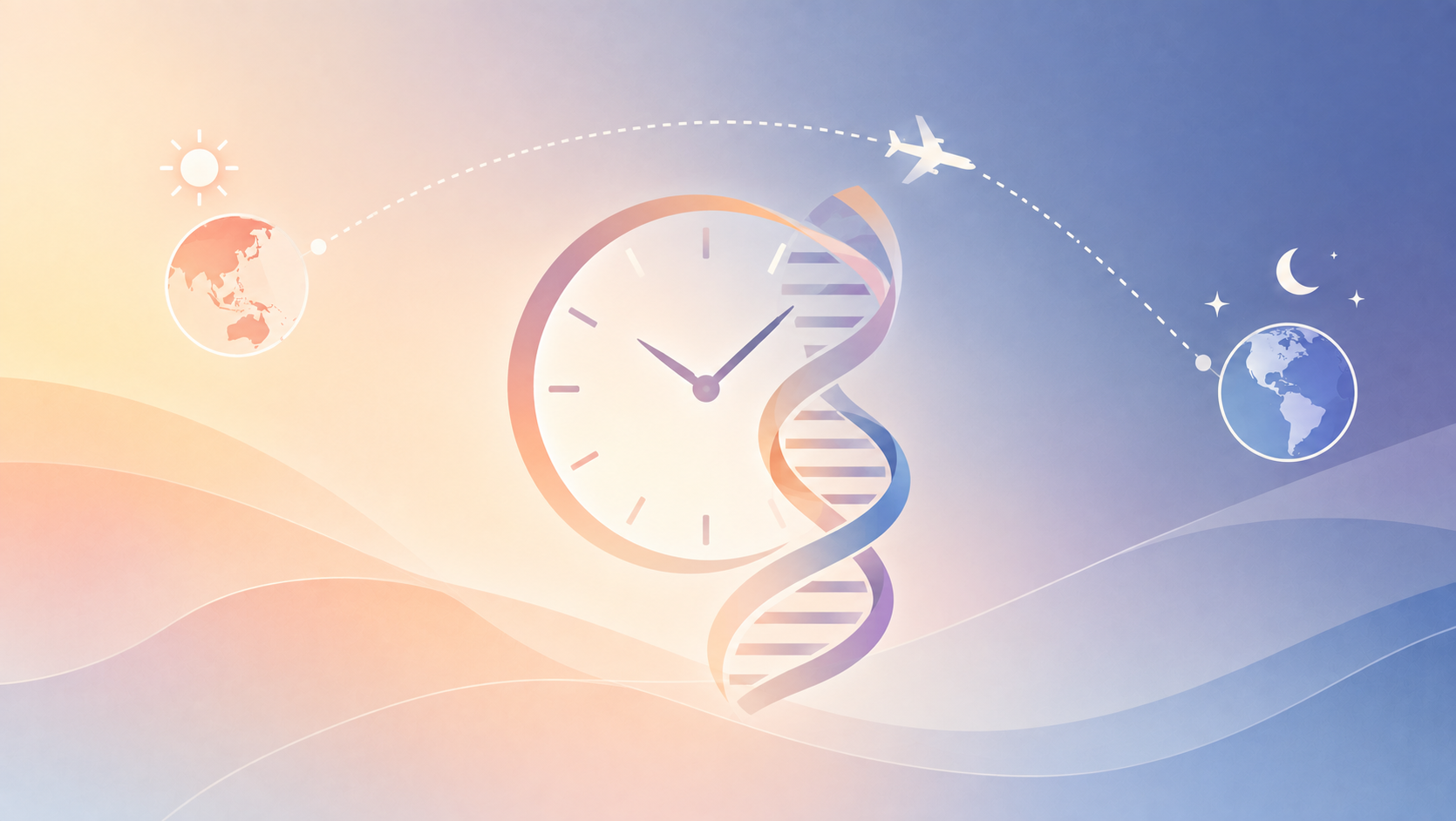
    Two people take the exact same long-haul flight, crossing the exact same number of time zones, and land at the exact same time. Three days later, one of them is fully adjusted and sleeping normally, while the other is still wide awake at 3 AM and exhausted by early afternoon. Travel style and in-flight habits play some role, but how quickly your body’s internal clock actually re-synchronizes after crossing time zones has a real genetic basis, separate from whether you’re naturally more of a morning or evening person to begin with.

    This is a different question from chronotype, which is about your natural preferred sleep-wake timing day to day. Jet lag recovery is about something more specific: how efficiently your circadian system can re-adjust itself once that timing gets abruptly disrupted by travel — a genuinely separate biological process, even though both involve the same underlying circadian clock machinery.

    The Genetics Behind Circadian Flexibility

    PER2 and PER3 gene variants. These “period” genes are core components of the molecular circadian clock inside nearly every cell in your body. Beyond influencing baseline chronotype, certain variants are associated with how quickly this internal clock can be reset by new light and darkness cues after travel — essentially how “flexible” or “rigid” someone’s circadian machinery is when it needs to re-synchronize.

    CLOCK and BMAL1 gene interactions. These genes work together as part of the core feedback loop that keeps circadian rhythm running on an approximately 24-hour cycle. Genetic variation in how this loop responds to external resetting cues (primarily light) affects how many days it takes someone’s body to fully adjust to a new time zone.

    Melatonin receptor gene variants. Since melatonin plays a central role in signaling circadian timing shifts, genetic variation in melatonin receptor sensitivity affects how strongly someone’s body responds to the natural (or supplemented) melatonin signal that helps re-align sleep timing after a time zone change.

    Why Direction of Travel Seems to Matter More for Some People

    Many travelers notice that jet lag feels worse flying in one direction than the other — typically eastward travel (which requires falling asleep earlier than usual) feeling harder than westward travel (which requires staying awake later, generally easier for most circadian systems to accommodate). This asymmetry has both a universal biological basis and a genetic component to its severity: people with certain circadian gene variants show a more pronounced difference between how easily they adjust eastward versus westward, while others experience comparably difficult adjustment regardless of direction.

    This Connects to More Than Just Travel

    The same circadian flexibility genetics relevant to jet lag also plays a role in how well someone tolerates shift work and irregular schedules more broadly — both situations that require the internal clock to adjust to misaligned light and activity cues. This overlaps with the stress resilience genetics covered elsewhere in this series, since the chronic circadian disruption involved in both frequent travel and shift work has been associated with elevated stress markers over time, independent of sleep deprivation alone.

    What Genetics Doesn’t Fully Determine

    Light exposure timing, strategic use of melatonin supplementation, sleep scheduling before and during travel, and overall sleep debt going into a trip all meaningfully affect how jet lag actually plays out, regardless of underlying genetic circadian flexibility. Someone with genetics favoring slower circadian re-adjustment can still recover meaningfully faster with deliberate light exposure strategies, while someone with more flexible circadian genetics can still experience rough jet lag if they travel already sleep-deprived or fail to manage light exposure at all.

    Where a DNA Test Fits Into This

    This falls under wellness-focused genetic testing, distinct from ancestry-focused kits. A test like DNApower includes circadian rhythm and sleep-related genetic markers as part of its broader wellness report, offering context on tendencies like circadian flexibility alongside the chronotype and stress-related genetics covered elsewhere in this series.

    Practical Steps If You Recover Slowly From Jet Lag

    A few strategies tend to help regardless of the exact underlying genetic mechanism: gradually shifting your sleep schedule by an hour or so per day in the days before a major trip, rather than adjusting all at once upon arrival; seeking bright light exposure at the right time of day for your destination’s schedule (morning light when adjusting to an earlier time zone, evening light for a later one) since light is the single strongest cue for resetting circadian timing; and being especially deliberate about eastward travel specifically, since it tends to be the harder direction for most circadian systems to accommodate.

    Frequently Asked Questions

    Does having a “flexible” circadian system mean I won’t get jet lag at all? Not entirely — most people experience some degree of jet lag after crossing several time zones, but genetics can meaningfully affect how many days full adjustment takes, from a couple of days to a week or more for the same trip.

    Is jet lag recovery the same thing as chronotype? No. Chronotype is your natural preferred sleep-wake timing day to day, while jet lag recovery is about how quickly your circadian system can re-adjust once that timing is disrupted by travel — related systems, but genuinely separate traits.

    Can melatonin supplements help regardless of my genetics? Generally yes, when timed correctly for your travel direction and destination, though genetic variation in melatonin receptor sensitivity may affect how strongly any individual person responds to a given dose.

    The Bottom Line

    If jet lag consistently hits you harder and lasts longer than it seems to for your travel companions, despite similar effort to manage it, genetics is a real part of that story — separate from whether you’re a natural morning or evening person to begin with. Understanding your own tendency can help you prioritize the strategies, like proactive light exposure and pre-trip schedule shifting, most likely to actually make a difference for your specific circadian biology.

    If you’re curious about your own genetic tendencies around circadian rhythm and sleep, DNApower’s wellness panel is a reasonable place to start.

  • Why the Same Stressful Situation Hits People So Differently

    Why the Same Stressful Situation Hits People So Differently

    Affiliate Disclosure: This post contains affiliate links. If you buy through one of them, we may earn a small commission — at no extra cost to you. We only recommend kits we’ve actually researched and would suggest to a friend.

    One Deadline, Two Completely Different Reactions

    Put two people in the exact same stressful situation — a tight work deadline, a delayed flight, a tense conversation — and you’ll often see genuinely different physical and emotional responses. One person’s heart rate barely moves. The other feels it in their chest for hours afterward. This isn’t just about “handling things better.” A meaningful part of it is genetic, and understanding that distinction can change how you approach managing stress day to day.

    The Biology Behind Stress Response

    When you encounter a stressor, your body releases cortisol — often called the “stress hormone” — as part of your fight-or-flight response. How quickly your cortisol rises, how high it peaks, and critically, how efficiently your body clears it afterward, varies significantly based on genetic factors.

    Genes involved in this process affect things like cortisol receptor sensitivity and how efficiently stress hormones are metabolized and cleared from your system. Someone with a genetic tendency toward slower cortisol clearance may experience a stressful event’s physical effects — elevated heart rate, tension, difficulty settling down — for considerably longer after the triggering event has passed, compared to someone whose body processes and clears cortisol more efficiently.

    Why This Matters Beyond Just Feeling Stressed

    It affects how quickly you actually recover, not just how intensely you react. Two people might have a similar initial stress spike, but the person with slower cortisol clearance stays in a physiologically stressed state longer, which compounds if stressful events happen close together throughout the day.

    It influences sleep quality after stressful days. Elevated cortisol that hasn’t fully cleared by bedtime can interfere with falling asleep or staying asleep, which is part of why a stressful day sometimes leads to a rough night even when nothing stressful is actively happening anymore.

    It’s linked to differences in anxiety-proneness. Some of the same genetic variants associated with cortisol regulation are also studied in relation to general anxiety tendencies, though this is an area of ongoing research rather than a settled, simple cause-and-effect relationship.

    What Genetics Doesn’t Fully Explain

    It’s worth being direct here: genetics is one contributing factor among many, not a complete explanation for anyone’s stress levels or anxiety. Life circumstances, sleep quality, physical health, past experiences, and coping strategies all play substantial roles that genetics alone doesn’t capture. A genetic tendency toward slower cortisol clearance doesn’t mean stress management techniques won’t work for you — it may just mean you benefit more from proactively managing stress rather than assuming it’ll resolve quickly on its own.

    How a DNA Test Fits Into This

    This falls under the same wellness-focused genetic testing category as other lifestyle markers, distinct from ancestry-focused kits. A test like DNApower includes stress-response and cortisol-related genetic markers as part of its broader wellness report, offering insight into tendencies that might explain why stress seems to affect you more intensely or for longer than it seems to affect people around you.

    Understanding a genetic tendency here isn’t about excusing stress reactions — it’s about recognizing that if you’re someone whose body holds onto stress hormones longer, proactive recovery strategies may matter more for you specifically than generic stress advice built for an average response pattern.

    Practical Approaches Based on Slower Cortisol Clearance

    If your results (or your own observed pattern) suggest you tend to stay physiologically stressed longer after a triggering event, building in deliberate recovery time between stressful commitments — rather than stacking them back-to-back — tends to matter more for you than it might for someone whose body resets more quickly.

    Activities that actively support cortisol regulation, like structured relaxation practices, physical movement, or consistent sleep timing, may produce more noticeable benefit for slower clearers specifically, simply because there’s more accumulated stress hormone to actively work through rather than waiting for it to dissipate on its own.

    When to Talk to a Professional Instead

    Genetic tendencies toward slower stress recovery are a useful piece of context, but persistent, significant anxiety or stress that’s affecting your daily functioning is worth discussing with a doctor or therapist directly, rather than something to address solely through lifestyle adjustments based on a genetic report. A genetic marker is context for a conversation with a professional, not a substitute for one.

    Frequently Asked Questions

    Does a genetic tendency toward slower cortisol clearance mean I’ll always be more anxious? Not necessarily. It’s one contributing factor among many — life circumstances, coping strategies, and overall health all play significant roles that genetics alone doesn’t determine.

    Can I change how my body processes cortisol? The underlying genetic tendency stays consistent, but lifestyle factors like consistent sleep, physical activity, and stress management practices can meaningfully affect how well you manage the practical impact of that tendency.

    Is stress-response genetic testing the same as a mental health diagnosis? No. It identifies genetic tendencies related to physical stress hormone processing, which is different from a clinical mental health diagnosis — persistent anxiety or stress concerns are worth discussing directly with a doctor or therapist.

    The Bottom Line

    If stressful situations seem to affect you more intensely or for longer than they affect people around you, there may be a real, identifiable genetic reason behind it — not a sign you’re managing things poorly. Understanding your tendency toward stress hormone processing can help you build recovery strategies that actually match your biology, rather than measuring yourself against someone else’s genetically easier reset.

    👉 Check current DNApower pricing

  • Why Some People Are Wired for Late Nights (and Others Aren’t)

    Why Some People Are Wired for Late Nights (and Others Aren’t)

    Affiliate Disclosure: This post contains affiliate links. If you buy through one of them, we may earn a small commission — at no extra cost to you. We only recommend kits we’ve actually researched and would suggest to a friend.

    The Friend Who’s Up at 6 AM Without Trying

    You know the type — genuinely cheerful before 7 AM, in bed by 9:30, no apparent effort involved. Meanwhile you’re wide awake at midnight no matter how early you tried to start winding down, and mornings feel like a personal attack regardless of how much sleep you got. This isn’t just a habit difference. A real chunk of it comes down to genetics, specifically something called your chronotype.

    What a Chronotype Actually Is

    Your chronotype is your body’s natural, genetically-influenced tendency toward being more alert at certain times of day — commonly described as being a “morning person” or “night owl,” though the reality is more of a spectrum than two fixed categories. This isn’t just preference or willpower; it’s tied to variations in genes that regulate your circadian rhythm, the internal clock that governs your sleep-wake cycle.

    A well-studied gene in this area is PER3, along with several other clock-related genes, which influence how your body’s internal timing naturally aligns relative to the standard 24-hour day. People with certain variants tend to naturally feel alert and sleepy earlier in the day; others are genetically wired toward a later cycle entirely.

    Why This Matters Beyond Just Feeling Sleepy at the Wrong Time

    Trying to force a mismatched schedule has real costs. A genetic night owl forcing themselves into an early-morning routine isn’t just uncomfortable — research links chronic circadian misalignment (working against your natural chronotype) to effects on mood, cognitive performance, and even metabolic health over time.

    It explains why generic sleep advice sometimes doesn’t work. Standard sleep hygiene tips assume a fairly average chronotype. If you’re a genetic outlier in either direction, following advice built for the middle of the bell curve can feel like fighting your own biology rather than working with it.

    It affects more than sleep timing alone. Chronotype has been associated with differences in appetite timing, exercise performance at different times of day, and even alertness patterns for cognitive tasks — your genetically “best” time of day for focused work may genuinely differ from someone else’s.

    Other Sleep-Related Genetic Factors Worth Knowing

    Caffeine sensitivity interacts with sleep more than people realize. As covered in our piece on caffeine sensitivity and genetics, slow caffeine metabolizers can have afternoon coffee still meaningfully affecting their sleep quality hours later, even without noticing an obvious jittery feeling at the time.

    Sleep duration needs vary genetically too. While most adults are advised to aim for a similar general range, some genetic variants are associated with needing meaningfully less or more sleep than average to feel fully rested — a difference that’s real, not just a personal excuse for staying up late or sleeping in.

    Some people are more prone to disrupted sleep architecture. Certain genetic factors influence how easily someone moves through sleep stages, which can affect sleep quality even when total time asleep looks adequate on paper.

    What Genetics Doesn’t Excuse

    None of this is a free pass to ignore sleep hygiene fundamentals. Even a genetic night owl benefits from a consistent sleep schedule, a dark and cool sleeping environment, and limiting screen exposure before bed — the fundamentals still matter regardless of chronotype. What genetics changes is more the timing that works best for your body, not whether the basics of good sleep practice apply to you at all.

    How a DNA Test Fits Into This

    This falls under the same category of wellness-focused genetic testing as diet and fitness markers, distinct from ancestry-focused kits. A test like DNApower includes sleep and lifestyle-related genetic markers as part of its broader wellness report, which can offer insight into tendencies like chronotype leanings alongside related factors like caffeine sensitivity.

    Rather than fighting an early schedule for years assuming you just need more discipline, understanding a genetic tendency toward a later chronotype can shift the approach entirely — toward working with your natural timing where your schedule allows, rather than treating every late night as a personal failing.

    Practical Adjustments Based on Chronotype

    If you lean toward a later chronotype and have some schedule flexibility, shifting demanding cognitive work to your naturally more alert hours (even if that’s later afternoon or evening) tends to produce better results than forcing focus during your genetically low-alertness morning window.

    If early mornings are non-negotiable due to work or family obligations regardless of your natural chronotype, gradually shifting your sleep schedule earlier in small increments, combined with morning light exposure, tends to work better than an abrupt change — though it’s worth acknowledging this will likely always feel somewhat like working against your biology rather than with it.

    Frequently Asked Questions

    Can I change my chronotype permanently through habit alone? Not entirely — your underlying genetic tendency stays fairly stable, though gradual schedule shifts and consistent light exposure can shift your practical sleep-wake timing somewhat within your genetic range.

    Is being a night owl unhealthy? Not inherently — the health effects associated with circadian misalignment come more from fighting against your natural chronotype long-term (like a genetic night owl forced into very early shifts) than from having a later chronotype itself.

    Does a DNA test tell me exactly what time I should go to bed? Not precisely — it identifies genetic tendencies that can inform your approach, best used as a starting point alongside your own observation of when you naturally feel most alert and most tired.

    The Bottom Line

    If you’ve spent years assuming your sleep struggles were a discipline problem, genetics may be a real part of the explanation — not an excuse to abandon good sleep habits, but useful context for working with your natural timing instead of constantly fighting it.

    👉 Check current DNApower pricing