Affiliate Disclosure: This post contains affiliate links. If you buy through one of them, we may earn a small commission — at no extra cost to you. We only recommend kits we’ve actually researched and would suggest to a friend.
Two Specialists, Different Corners of Europe
Neither of these kits is trying to be the biggest name in the room. Both Living DNA and MyHeritage DNA carved out a specific niche instead — deep regional detail rather than sheer database size — which makes comparing them less about “which is better overall” and more about “which specialty actually matches your background.”
Here’s how they stack up.
Who Should Look at a Different Kit Entirely
If your ancestry sits well outside the UK, Ireland, or Europe, both of these kits will feel comparatively thin. A larger, more globally distributed database — like AncestryDNA’s — will likely serve you better.
If health insights are your main goal, neither of these is built for that. Living DNA offers a separate wellbeing add-on, but it’s not the core product, and MyHeritage’s health reporting is similarly a secondary feature at best.
Otherwise, let’s get into where each one actually shines.
Regional Specialty: This Is the Real Decision Point
This is genuinely the most important factor in choosing between these two, more than price or database size.
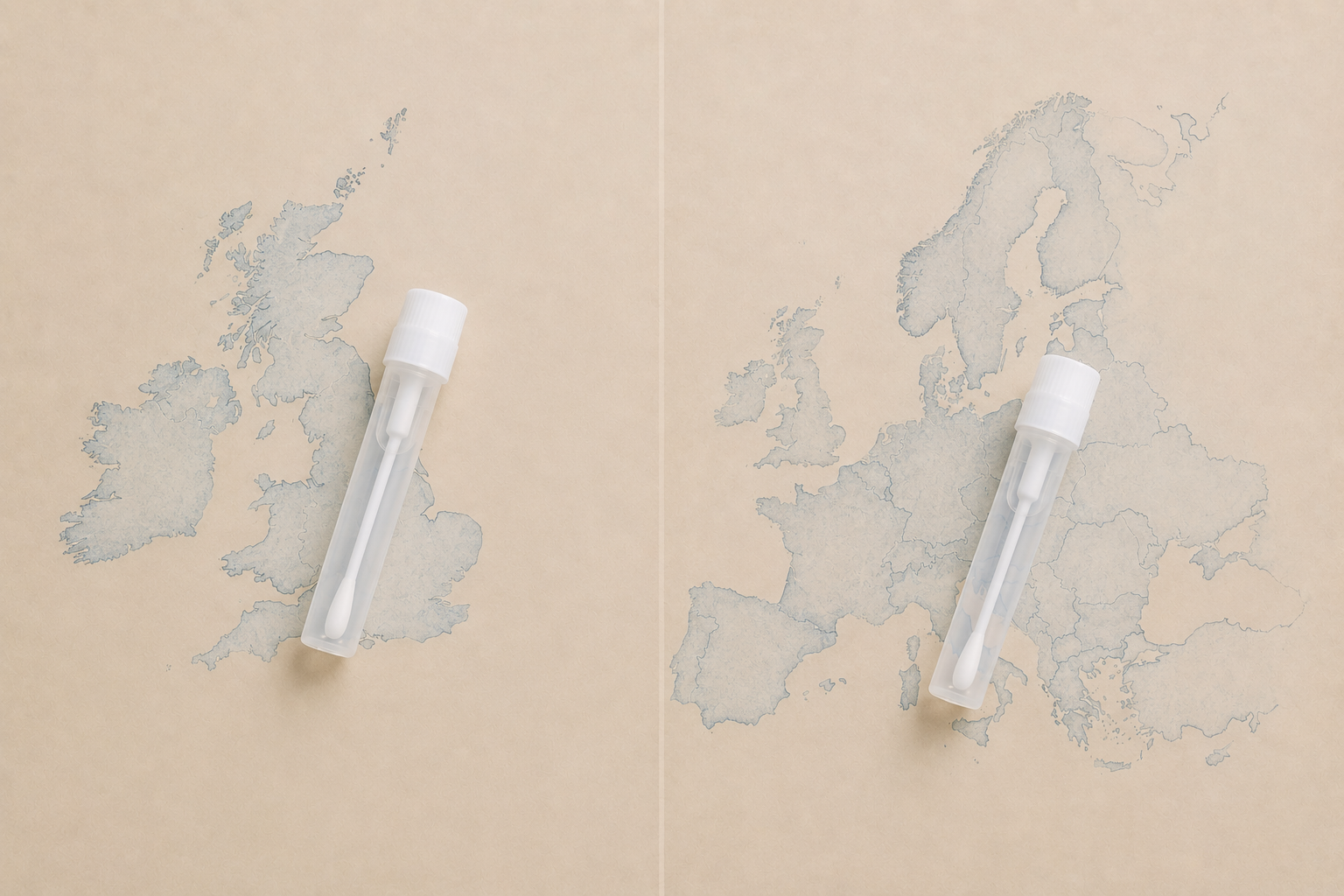
Living DNA specializes in the British Isles. If your family history runs through England, Scotland, Ireland, or Wales, Living DNA’s regional breakdown goes deeper than almost any competitor — pinpointing sub-regions within the UK and Ireland rather than lumping everything into one broad category.
MyHeritage specializes in continental Europe and Jewish ancestry. If your background points toward Poland, Italy, Germany, or Ashkenazi Jewish heritage specifically, MyHeritage’s reference database is noticeably deeper in these areas than most competitors, including Living DNA.
If your ancestry overlaps both — say, British on one side of the family and Eastern European on the other — neither kit alone will give you the full picture, and testing with both (or uploading raw data between them) becomes genuinely worth considering.
Database Size and Relative Matching
Both companies have smaller overall databases compared to giants like AncestryDNA, but they’re not equal to each other either.
MyHeritage’s database is meaningfully larger than Living DNA’s, which translates to more potential DNA matches across the board — not just within its specialty regions. If finding new relatives is a real priority alongside regional accuracy, MyHeritage has an edge here simply due to scale.
What Each Test Actually Analyzes
This is where Living DNA pulls ahead in a different way. It tests autosomal DNA, Y-DNA, and mitochondrial DNA together in one kit, giving you insight into both your direct paternal and maternal lines. MyHeritage’s standard test focuses on autosomal DNA only, which covers your broader ancestry but doesn’t provide that same direct paternal/maternal line analysis.
If tracing a specific line of descent matters to you — not just an overall ethnicity picture — Living DNA’s broader testing scope is a genuine advantage, regardless of which regional specialty you need.
Family Tree Tools
MyHeritage has the more developed family tree platform of the two, with Smart Matches and Record Matches that surface automatically as your tree grows. It’s built to be a complete genealogy research environment, not just an ethnicity report.
Living DNA’s tree-building tools are more basic by comparison. It’s a solid ancestry test, but it doesn’t try to compete as a full genealogy research platform the way MyHeritage does.
Turnaround Time: Not Close
This is one of the clearest differences between the two. MyHeritage typically returns results in three to four weeks. Living DNA’s stated window is six to eight weeks, and it’s not uncommon for it to stretch closer to ten to twelve weeks during busier periods.
If you’re testing for a specific occasion or you’re simply impatient, this gap alone might tip the decision toward MyHeritage.
Price
MyHeritage DNA is generally the more affordable of the two, with frequent, fairly aggressive sales that push the price down further. Living DNA sits in a similar mid-range bracket normally, though it goes on sale less aggressively than MyHeritage does.
So, Which One Should You Choose?
Choose Living DNA if:
- Your ancestry is specifically rooted in the UK or Ireland
- You want combined autosomal, Y-DNA, and mitochondrial testing in one kit
- You’re not in a hurry and can wait out the longer turnaround
Choose MyHeritage DNA if:
- Your background is European, Jewish, Italian, or Eastern European
- You want faster results and a more developed family tree platform
- You’re working with a tighter budget and want frequent sale pricing
What If You’re Not Sure Which Region Fits?
If you’re honestly uncertain where your ancestry concentrates most heavily, a broader database like AncestryDNA might be a more sensible starting point before narrowing in on a regional specialist. Our full comparison of the major DNA testing kits breaks down how all the major options stack up against each other.
Frequently Asked Questions
Which is more accurate, Living DNA or MyHeritage DNA? Neither is universally more accurate — each is strongest within its own regional specialty. Living DNA excels for UK and Irish ancestry; MyHeritage excels for European and Jewish ancestry.
Which one gives faster results? MyHeritage DNA, typically by several weeks. Living DNA’s more detailed analysis takes longer to process, often six to eight weeks or more.
Can I use both kits for a more complete picture? Yes. If your background spans both specialty regions, testing with both — or uploading raw data from one to the other where supported — can give a more complete picture than either kit alone.
The Bottom Line
This comparison really comes down to geography more than any other single factor. Match the kit to where your ancestry actually traces back to, and from there, weigh speed, price, and testing scope based on what matters most to you personally.
コメントを残す