投稿者: arino

  • DNA Testing for Adoptees: A Practical Guide to Finding Biological Family

    DNA Testing for Adoptees: A Practical Guide to Finding Biological Family

    Affiliate Disclosure: This post contains affiliate links. If you buy through one of them, we may earn a small commission — at no extra cost to you. We only recommend kits we’ve actually researched and would suggest to a friend.

    A Different Kind of Search Than Most People Are Doing

    For most people, a DNA test is a curiosity project — a fun percentage breakdown, maybe a few new third cousins to say hello to. For adoptees, it’s often something much more significant: potentially the first real lead in identifying biological parents, siblings, or an entire side of family history that’s been an unknown for years, sometimes decades.

    This guide focuses specifically on what actually matters for that kind of search — which kits give you the best odds, what to realistically expect, and how to approach it in a way that protects your own wellbeing along the way.

    Why Database Size Matters More Here Than for Almost Any Other Use Case

    For most DNA testing purposes, database size is one factor among several. For an adoptee search, it’s arguably the single most important variable. You can only be matched with people who have also tested with that specific company — so the larger the database, the higher your odds of connecting with a close biological relative.

    This is why AncestryDNA is generally the strongest starting point for this specific goal. Its database is the largest of any consumer DNA testing company, which directly translates to better odds of a close match — a half-sibling, an aunt or uncle, or in some fortunate cases, a parent or full sibling.

    Test With More Than One Company If You Can

    Because matches are limited to each company’s own database, testing with a single company means you’re only searching one pool of potential relatives. Many experienced searchers test with multiple companies, or upload their raw DNA data to additional platforms that accept uploads, to maximize their total search coverage.

    MyHeritage DNA accepts raw data uploads from AncestryDNA and other major companies, which is a budget-friendly way to expand your search without paying for a full second test. GEDmatch, a free third-party tool, is also widely used in adoptee search communities specifically because it lets you compare your raw data across uploads from multiple testing companies at once.

    What “Close Match” Actually Means for Your Search

    Understanding centimorgan ranges becomes especially practical here, since it directly affects how you interpret results. A match in the thousands of centimorgans likely indicates a parent or full sibling. A match in the hundreds might be a half-sibling, aunt, uncle, or grandparent. Matches lower than that require more careful triangulation — cross-referencing shared matches and any family tree information available — to narrow down the actual relationship. Our guide on what a centimorgan actually measures walks through these ranges in more detail.

    Working With What You Find

    Shared matches are often more useful than a single match alone. If a mystery match doesn’t have a family tree built out, looking at who else they match — and how those people connect to each other — can help you triangulate toward an actual identity, even without direct contact.

    Genetic genealogy is a real, specialized skill. For complex searches, particularly ones involving distant matches or minimal family tree information, some adoptees choose to work with a professional search angel or genetic genealogist — often through adoptee-specific search communities — rather than navigating it entirely alone. This isn’t necessary for every search, but it’s worth knowing the option exists if your search hits a wall.

    Preparing Yourself Emotionally Before You Start

    This part matters as much as the technical search strategy, and it’s worth being honest about upfront. An adoptee DNA search can surface information you weren’t expecting — details about circumstances of the adoption, health information, or family situations that are complicated in ways you couldn’t have anticipated. It can also, sometimes, lead to a biological relative who isn’t ready or willing to connect, which can be its own difficult outcome to process.

    Many adoptee search communities strongly recommend having some support in place before you start — whether that’s a therapist familiar with adoption issues, a support group of other adoptees who’ve been through a search, or simply a trusted person you can talk to as things unfold. This isn’t meant to be discouraging; it’s meant to help the process feel more manageable regardless of what you find.

    If You Do Make Contact

    There’s no single right way to approach a first contact with a newly discovered biological relative, and there’s genuinely no need to rush it. Many adoptees take time to plan what they want to say, and some choose to reach out through a neutral intermediary (a search angel, or even a brief introductory message) rather than an immediate, unplanned call. Respecting that the other person may need time to process the contact too — even if you’ve been preparing for this moment for a long time — tends to lead to better long-term outcomes than an unplanned, emotionally intense first interaction.

    Choosing Your First Kit

    Given the priority on database size for this specific goal, AncestryDNA is generally the strongest starting point, with MyHeritage as a strong second test or raw data upload to widen your search further. Our full comparison of the major DNA testing kits covers the details on both if you want to compare further before ordering.

    Frequently Asked Questions

    Which DNA test is best specifically for finding biological family? AncestryDNA is generally recommended first due to its database size, which directly affects your odds of a close match. Testing with multiple companies, or uploading raw data to platforms like GEDmatch, further expands your search.

    How long does an adoptee DNA search typically take? This varies enormously — some searches resolve within weeks of getting results, particularly with a very close match. Others take months or longer, especially when working from more distant matches that require additional research to interpret.

    Is it normal to feel anxious about starting this kind of search? Yes, and it’s worth taking seriously rather than pushing past. Many people find it helpful to have some support in place — whether a therapist, support group, or trusted person — before and during the search process.

    The Bottom Line

    An adoptee DNA search is a genuinely different undertaking than typical ancestry curiosity, both technically and emotionally. Prioritizing database size, considering multiple companies or raw data uploads, and preparing yourself for whatever the results might reveal all meaningfully improve both your odds of success and how manageable the process feels along the way.
  • What’s Actually Inside a DNA Test Kit (and How to Send It Back Correctly)

    What’s Actually Inside a DNA Test Kit (and How to Send It Back Correctly)

    Affiliate Disclosure: This post contains affiliate links. If you buy through one of them, we may earn a small commission — at no extra cost to you. We only recommend kits we’ve actually researched and would suggest to a friend.

    The Box Arrives, and It’s Smaller Than You Expected

    Most people picture something more elaborate before their first kit shows up — some kind of lab equipment, maybe. In reality, it’s a surprisingly small, simple package. Here’s exactly what’s typically inside, what each piece does, and how to make sure your sample actually gets processed without delays.

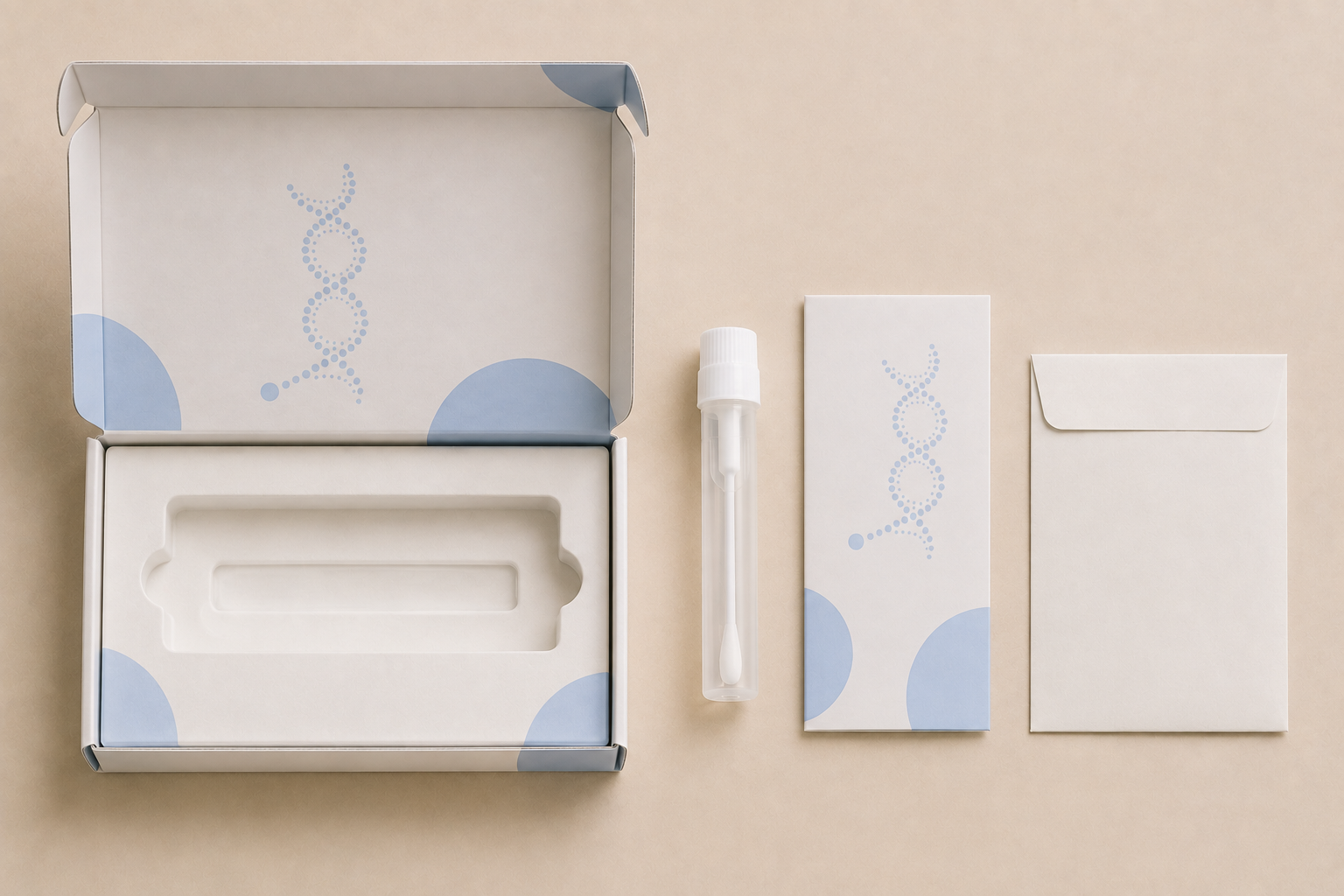
    What’s Typically in the Box

    The collection device. This is either a saliva collection tube or a cheek swab, depending on the company. Saliva kits include a funnel-topped tube with a fill line; swab kits include one or two individually wrapped swabs.

    A stabilizing solution (saliva kits only). Saliva tubes usually have a small reservoir of blue liquid built into the cap. When you seal the tube, this solution mixes with your sample to preserve the DNA during shipping — this is a normal, expected part of the process, not something to be concerned about.

    An activation code or barcode. This unique identifier links your physical sample to your online account. It’s usually printed on a card, on the tube itself, or both.

    Instructions. A printed quick-start guide walking through registration, collection, and return steps. Some companies also print a QR code linking to a video walkthrough.

    A prepaid return package. This typically includes a biohazard bag (a standard precaution for any biological sample, not a sign of something unusual), an outer shipping box or envelope, and a prepaid shipping label already affixed or included separately.

    Sometimes: alcohol wipes or extra materials for cheek swab kits, used to clean the inside of the cheek area before swabbing if specified in the instructions.

    What You Actually Need to Send Back

    This trips people up more than it should: you’re only sending back the sealed sample tube or swab, packaged in the provided biohazard bag and shipping materials — nothing else. You keep the instructions, the outer box the kit arrived in, and any promotional materials.

    Some kits ask you to write your activation code on the outer shipping label or include a card with the code inside the return package, so double-check your specific instructions here, since this step varies by company and missing it can cause processing delays.

    Step-by-Step: What the Return Process Actually Looks Like

    1. Register your kit online first. Before you even open the collection materials, activate your kit using the barcode or activation code through the company’s website. This step cannot be skipped or done later — the lab cannot process an unregistered sample.

    2. Follow the pre-collection instructions. For saliva kits, this usually means avoiding food, drink (other than water), gum, and smoking for at least 30 minutes beforehand. For swab kits, timing tends to be less strict, but check your specific instructions.

    3. Collect your sample. Saliva kits: spit into the tube until you reach the fill line, then seal the cap, which releases the stabilizing solution. Swab kits: swab the inside of each cheek for the specified time (often 30-60 seconds per side).

    4. Seal the sample in the provided biohazard bag. This is standard practice for shipping any biological sample and doesn’t require any special handling beyond following the printed instructions.

    5. Package it in the return shipping materials. Place the bagged sample into the return envelope or box, and confirm the prepaid shipping label is attached and legible.

    6. Drop it in any standard mailbox or post office. Most kits use standard postal services rather than requiring a special drop-off location — check your specific instructions, but this is the case for the majority of major kits.

    7. Track your kit’s status online. Most companies show a status update once your sample is received at the lab, giving you a rough sense of where you are in the timeline even before results are ready.

    Common Return Mistakes to Avoid

    Forgetting to register before mailing. This is the single most common source of processing delays, covered in more detail in our guide on DNA testing mistakes to avoid.

    Sending back the wrong items. Occasionally people mail back extra materials (instruction booklets, the outer box) unnecessarily, which doesn’t cause harm but isn’t needed and can occasionally cause confusion at sorting facilities if the package looks unusual.

    Not sealing the tube completely. For saliva kits, an improperly sealed cap can lead to leakage during transit, which sometimes results in a rejected sample and a replacement kit being sent.

    Losing the activation code before registering. If you misplace the card or can’t find the code before registering online, most companies have a lookup tool using your order number, so don’t panic — just check your original order confirmation email.

    What Happens After You Mail It

    Once the lab receives your package, most companies update your account status accordingly, and processing begins. From here, it’s purely a waiting game — turnaround time varies significantly by company, from as fast as two to three weeks with some wellness-focused kits, up to six to eight weeks or longer with more detail-heavy ancestry kits.

    Frequently Asked Questions

    Do I need special packaging to mail back a DNA sample? No. The kit includes everything required — a biohazard bag, return packaging, and a prepaid shipping label. Standard mail services and mailboxes are used for the vast majority of kits.

    What if I forgot to register my kit before sending it? Register online as soon as you realize, and contact customer support — some companies can still match an unregistered sample to your account manually, though this can add delays.

    Can I use a kit past its “use by” date if I still have an old one lying around? It depends on the company and how the stabilizing solution has held up. Contact customer support to check, since results from a degraded sample can sometimes come back inconclusive.

    The Bottom Line

    The actual mechanics of sending back a DNA test are simpler than they look from the outside — register first, follow the collection instructions carefully, and send back only what’s specified. Most delays and complications come from skipping the registration step or rushing the collection process, both of which are entirely avoidable with a few extra minutes of care.

  • 23andMe Review 2026: Is the Ancestry + Health Combo Worth It?

    23andMe Review 2026: Is the Ancestry + Health Combo Worth It?

    Affiliate Disclosure: This post contains affiliate links. If you buy through one of them, we may earn a small commission — at no extra cost to you. We only recommend kits we’ve actually researched and would suggest to a friend.

    The Kit That Tries to Do Two Jobs at Once

    Most DNA kits pick a lane — ancestry or health, not both. 23andMe is the exception, and it’s built its entire identity around combining the two. That’s an appealing pitch on paper: one kit, one wait, two very different kinds of answers.

    The real question is whether combining them actually works well, or whether you end up with a decent version of two things instead of a great version of either. Here’s the honest breakdown.

    Who Should Look Elsewhere

    A few honest exceptions before we get into it:

    If you want the absolute deepest ancestry database available, AncestryDNA’s sheer size still outperforms 23andMe for relative matching and historical records integration.

    If health insights are your main priority and you want the most detailed wellness-focused report possible, a dedicated kit like DNApower goes considerably deeper into diet, fitness, and lifestyle markers than 23andMe’s health tier does.

    If budget is a major concern, 23andMe’s combo pricing tends to run higher than choosing a single specialized kit in either category.

    Otherwise, here’s what you’re actually getting.

    How the Kit Works

    23andMe uses a saliva sample. You register online, spit into the provided tube, seal it, and mail it back in the prepaid packaging — a straightforward five-minute process similar to most other saliva-based kits.

    Results typically take three to five weeks, occasionally longer during peak season. Once ready, both your ancestry composition and health reports (if you purchased the higher tier) appear in the same dashboard, alongside trait reports covering things like predicted physical characteristics.

    What 23andMe Actually Gets Right

    The combo genuinely saves you from managing two kits

    If you want a reasonable amount of both ancestry and health information without the hassle of two separate accounts, two separate wait times, and two separate dashboards, 23andMe solves that logistical problem better than piecing together two specialized kits yourself.

    Health reports are genuinely useful, within limits

    The Health + Ancestry tier includes reports on carrier status for certain inherited conditions, along with genetic predisposition reports for things like specific health risks. These aren’t diagnostic-grade, but they’re presented clearly, with context about what the findings do and don’t mean — a meaningfully more careful presentation than some wellness-focused competitors offer.

    The interface is clean and beginner-friendly

    Whether you’re looking at ancestry composition, DNA matches, or health reports, the dashboard doesn’t require any specialized knowledge to navigate. This matters for a kit trying to serve two different audiences (ancestry enthusiasts and health-curious users) without overwhelming either one.

    Trait reports add a fun, low-stakes layer

    Beyond the core ancestry and health data, 23andMe includes trait reports covering things like predicted eye color or whether you’re likely to have a sweet tooth. These aren’t medical-grade, but they’re a genuinely entertaining addition that rounds out the experience.

    Where It Falls Short

    Ancestry depth doesn’t match dedicated ancestry kits

    The ethnicity breakdown and database, while solid, don’t reach the same scale as AncestryDNA’s, and historical records integration isn’t part of 23andMe’s offering at all. If genealogy research is your main goal, this is a real gap.

    Health insights don’t reach the depth of dedicated wellness kits

    While genuinely useful, the health reporting here is broader and less granular than what a specialized wellness kit like DNApower provides for diet, fitness, and lifestyle-related traits specifically.

    Pricing reflects the combo, for better or worse

    The Health + Ancestry tier costs more than either a standalone ancestry kit or a standalone wellness kit typically would. You’re paying for the convenience of combination, not necessarily for the deepest version of either feature.

    Privacy has been a recurring topic of discussion

    23andMe’s data handling practices have drawn more public conversation over the years than some competitors, partly due to the company’s history and scale. It’s worth reading the current privacy policy directly before testing, rather than relying on general reputation either way.

    What You’re Actually Paying For

    23andMe offers tiered pricing: an Ancestry-only option at a lower price point, and the Health + Ancestry tier at a meaningfully higher cost that unlocks the health and carrier status reports. Sales are fairly frequent, particularly around major holidays, which can narrow the price gap between tiers somewhat.

    So, Is It Worth It?

    If you genuinely want both ancestry and health information and don’t want to manage two separate kits, yes — 23andMe handles that combination better than trying to bolt two specialized products together yourself.

    If you have a strong preference for one category over the other — deep genealogy research, or detailed wellness insights specifically — a dedicated kit in that category will likely serve you better and may cost less.

    Final Take

    23andMe’s core strength is convenience: a reasonably good version of two different things in one purchase, one wait, one dashboard. It’s not the deepest option in either category, but for someone who wants a taste of both without picking a lane, it does exactly what it promises.

    Frequently Asked Questions

    Is 23andMe more accurate than AncestryDNA? Neither is more accurate in a general sense — 23andMe’s ancestry database is solid but smaller than AncestryDNA’s, which affects match volume more than the accuracy of the underlying ethnicity calculation.

    Do I need the Health + Ancestry tier, or is Ancestry-only enough? It depends on your goals. If health insights aren’t a priority, the Ancestry-only tier is a more affordable option that still covers ethnicity estimates and relative matching.

    Are 23andMe’s health reports a substitute for medical genetic testing? No. They’re informational and not diagnostic-grade — any specific health concerns raised by the results are worth discussing with a doctor rather than treating as a medical diagnosis.

    Comparing 23andMe to the Rest of the Field

    If you’re still deciding between 23andMe and a more specialized option, our full comparison of the major DNA testing kits lays out how it stacks up against dedicated ancestry and wellness kits.

  • 8 DNA Testing Mistakes People Make Before They Even Get Results

    8 DNA Testing Mistakes People Make Before They Even Get Results

    Affiliate Disclosure: This post contains affiliate links. If you buy through one of them, we may earn a small commission — at no extra cost to you. We only recommend kits we’ve actually researched and would suggest to a friend.

    Most Mistakes Happen Before the Lab Ever Sees Your Sample

    A lot of DNA testing frustration doesn’t come from bad luck or a flawed company — it comes from a handful of avoidable missteps that happen well before results ever show up. Some cost you weeks of extra waiting. Others just lead to disappointment based on expectations the test was never going to meet in the first place.

    Here’s what actually trips people up, based on the patterns that show up again and again.

    1. Not Registering the Kit Before Collecting Your Sample

    This is the single most common delay, and it’s entirely avoidable. Almost every company requires you to create an account and activate your kit’s unique barcode online before you collect your sample. Skip this step, and the lab has no way to match your sample to your account once it arrives — leading to processing delays or, in some cases, a request to send a new sample entirely.

    The fix: Register online the moment the kit arrives, before you even open the collection tube.

    2. Eating, Drinking, or Smoking Too Close to Collection

    For saliva-based kits especially, food particles and other contaminants can interfere with sample quality, sometimes leading to a rejected sample and a replacement kit — adding weeks to your timeline.

    The fix: Most companies recommend avoiding food, drink (other than water), gum, and smoking for at least 30 minutes before collection. Check your specific kit’s instructions, since exact timing varies.

    3. Choosing a Kit Based on Price Alone, Without Checking Database Strength

    The cheapest kit isn’t always the best value if your ancestry falls outside that company’s strongest reference regions. A budget-friendly test with a database that barely covers your background will leave you with a vague, unsatisfying ethnicity estimate regardless of price.

    The fix: Match the kit to your known or suspected ancestry before comparing prices — our comparison of the major DNA testing kits breaks down which companies are strongest for which regions.

    4. Expecting Ancestry Percentages to Be Fixed, Permanent Facts

    A lot of first-time confusion (and occasional frustration) comes from ethnicity percentages shifting after a company updates its reference database. This is normal and doesn’t mean the original test was wrong — but it catches people off guard if they weren’t expecting it.

    The fix: Go in understanding that ethnicity estimates are best-guess calculations based on current reference data, not permanent, unchangeable facts.

    5. Not Thinking Through Unexpected Results Beforehand

    This is less a technical mistake and more an emotional preparation gap. DNA testing can occasionally surface unexpected information — an unknown biological relative, a surprising gap in a family story, or an ethnicity result that doesn’t match family lore. People who haven’t considered this possibility beforehand are sometimes caught off guard in a way that’s harder to process than it needs to be.

    The fix: Before testing, spend a few minutes genuinely considering how you’d want to handle an unexpected result, rather than assuming everything will simply confirm what you already know.

    6. Ignoring the Privacy Policy Until After Testing

    Consent settings around data sharing, relative matching visibility, and law enforcement access vary meaningfully between companies. Some people only look into these details after testing, when it’s harder to make an informed choice about settings they’ve already agreed to by default.

    The fix: Read the consent options during sign-up, not after. Most companies let you adjust settings like relative-matching visibility, and it’s easier to set these up correctly from the start.

    7. Buying a Combo Kit Without Actually Wanting Both Features

    Combo kits like 23andMe bundle ancestry and health features together, but the price reflects that bundling. If you only care about one side of that equation, you may be paying for depth you’ll never use, when a specialized kit in just the category you want would have served you better and often cost less.

    The fix: Get clear on whether you actually want ancestry, health insights, or genuinely both before choosing between a specialized kit and a combo option.

    8. Assuming a Low Centimorgan Match Is a Confirmed Relative

    Distant matches (particularly under 20 centimorgans) sit in a genuinely uncertain zone. Treating every match on your list as a confirmed relative, rather than a hypothesis worth investigating further, can lead to confusion or incorrect assumptions about your family tree.

    The fix: Understand what your match numbers actually indicate — our guide on what a centimorgan actually measures breaks down how to interpret match strength more accurately.

    A Quick Pre-Testing Checklist

    Before you mail your sample back, it’s worth confirming: your kit is registered and activated, you’ve followed the pre-collection instructions (no food, drink, or smoking beforehand for saliva kits), you understand roughly what timeline to expect, and you’ve thought at least briefly about how you’d handle an unexpected result if one comes up.

    Frequently Asked Questions

    What’s the most common reason DNA test results get delayed? Failing to register the kit before mailing back the sample is the most frequent avoidable delay, since the lab can’t process an unregistered sample.

    Can I fix a rejected sample without buying a whole new kit? Usually, yes — most companies send a replacement collection tube at no extra cost if your first sample was rejected due to insufficient quantity or contamination, though this does add time to your overall wait.

    Is it normal for ethnicity results to change after testing? Yes, this is expected as companies update and refine their reference databases over time, and it doesn’t indicate an error in your original test.

    The Bottom Line

    Most DNA testing disappointment traces back to one of these avoidable missteps rather than the test itself being flawed. Register your kit properly, choose based on your actual ancestry and goals rather than price alone, and go in with realistic expectations about what the results will and won’t tell you — and the whole experience becomes considerably smoother.

  • Always Tired Despite “Eating Well”? Your Genes Might Be Blocking Nutrient Absorption

    Always Tired Despite “Eating Well”? Your Genes Might Be Blocking Nutrient Absorption

    Affiliate Disclosure: This post contains affiliate links. If you buy through one of them, we may earn a small commission — at no extra cost to you. We only recommend kits we’ve actually researched and would suggest to a friend.

    Doing Everything Right, Still Feeling Off

    You eat reasonably well. Maybe you even take a multivitamin. And yet you’re tired more often than seems fair, or a blood test comes back showing a deficiency you genuinely didn’t expect given your diet. It’s a frustrating spot to be in — following what sounds like solid advice, and still not getting the results that advice promises.

    Diet quality is only half the equation. The other half is absorption — how efficiently your body actually processes and uses the nutrients you’re taking in — and genetics plays a bigger role in that than most people realize.

    Why “Eating Enough” Doesn’t Always Mean “Absorbing Enough”

    Nutrient absorption isn’t a single, uniform process. Specific genes influence how efficiently your body converts, transports, and utilizes different vitamins and minerals, independent of how much you’re actually consuming. Two people can eat identical diets and end up with meaningfully different nutrient levels, purely because of how their genetics handle the processing step.

    A Few Well-Studied Examples

    Vitamin D. Certain genetic variants affect how efficiently your body converts vitamin D into its active, usable form. This means someone can have adequate sun exposure and dietary intake and still run low, simply because the conversion process itself is less efficient for their specific genetic profile.

    Folate (Vitamin B9). A well-documented genetic variant affects an enzyme involved in folate metabolism. People with this variant may need more dietary folate, or may benefit more from the already-active form (methylfolate) rather than standard folic acid, which their body processes less efficiently.

    Vitamin B12. Absorption efficiency varies genetically, and some variants are associated with a higher likelihood of B12 deficiency even with adequate dietary intake, particularly relevant for anyone already following a diet lower in animal products.

    Iron. Genetic factors influence iron absorption and regulation, affecting whether someone tends to run low despite eating iron-rich foods, or conversely, tends to accumulate iron more readily than average.

    Why This Actually Matters Day to Day

    Low-grade nutrient inefficiencies don’t always show up as an obvious diagnosis — they often show up as vague, hard-to-pin-down symptoms: persistent fatigue, difficulty concentrating, mood fluctuations, or just generally not feeling like yourself despite nothing showing up as clearly “wrong” on a standard check-up. Understanding a genetic tendency toward lower absorption of a specific nutrient can turn a vague, frustrating pattern into a specific, addressable question worth raising with a doctor.

    What This Doesn’t Mean

    A genetic tendency toward less efficient absorption of a particular nutrient isn’t a diagnosis, and it doesn’t mean supplementation is automatically necessary or safe for you specifically. Some vitamins carry real risks in excess (fat-soluble vitamins like A and D, in particular, can build up to harmful levels), so any specific supplementation decisions are worth discussing with a doctor rather than self-prescribing based on a genetic report alone.

    How a DNA Test Identifies This

    This is a core part of what wellness-focused genetic testing looks at, distinct from the ancestry-focused kits most people are more familiar with. A test like DNApower includes nutrient metabolism markers as part of its broader wellness report, covering tendencies across vitamins and minerals like the ones above.

    Rather than guessing which supplement might help based on generic advice built for an average person, a genetic report gives you specific areas worth discussing with a doctor — turning “I feel tired all the time and don’t know why” into a more targeted conversation about what’s actually worth investigating first.

    Turning This Into an Actual Conversation With a Doctor

    The most useful thing a genetic nutrient report does isn’t replace medical testing — it’s narrowing down what’s worth testing for in the first place. Rather than a doctor ordering a broad, expensive panel covering everything, you can walk in with a more specific starting point: “my genetic results suggest a tendency toward lower folate metabolism efficiency — is it worth checking my levels directly?” That’s a considerably more productive conversation than starting from scratch with vague fatigue as the only symptom to go on.

    Frequently Asked Questions

    Can a DNA test diagnose a vitamin deficiency? No. It identifies genetic tendencies toward less efficient absorption or metabolism of specific nutrients, which is useful context for further testing, not a diagnosis on its own. Actual deficiency requires a blood test.

    Should I start taking supplements based on genetic results alone? This is worth discussing with a doctor first, especially for fat-soluble vitamins that can build up to unsafe levels in excess. Genetic results are a starting point for conversation, not a self-prescribing guide.

    Is nutrient absorption testing part of ancestry DNA kits? No, this is specific to wellness-focused genetic testing, which analyzes entirely different markers from ancestry-focused kits like AncestryDNA or MyHeritage DNA.

    The Bottom Line

    If you’re doing what sounds like all the right things and still not feeling your best, it’s worth considering that absorption — not just intake — might be part of the story. A genetic tendency toward lower efficiency with a specific nutrient doesn’t mean anything is fundamentally wrong with you; it just means your body may need a slightly different approach than generic advice assumes, and that’s worth knowing.

    👉 Check current DNApower pricing

  • Why One Cup of Coffee Wrecks You (and Doesn’t Touch Your Friend)

    Why One Cup of Coffee Wrecks You (and Doesn’t Touch Your Friend)

    Affiliate Disclosure: This post contains affiliate links. If you buy through one of them, we may earn a small commission — at no extra cost to you. We only recommend kits we’ve actually researched and would suggest to a friend.

    The Coffee Double Standard

    You know the person. They order a double espresso at 8 PM and sleep like a rock. Meanwhile, you have half a cup before noon and you’re still wired at midnight, heart doing something you’d rather it didn’t. Same coffee, wildly different experience — and it’s not just about tolerance built up from habit.

    This comes down to genetics more directly than most people assume, and understanding it can actually change how you approach caffeine, workouts, and even your afternoon energy crashes.

    The Gene Behind It: CYP1A2

    The main player here is a gene called CYP1A2, which controls an enzyme responsible for breaking down caffeine in your liver. People generally fall into one of two broad categories based on variants of this gene:

    Fast metabolizers break caffeine down quickly and efficiently. Coffee clears their system faster, side effects are milder, and they can often drink it later in the day without much impact on sleep.

    Slow metabolizers process caffeine much more gradually. Caffeine lingers longer in their system, effects (both the good and the jittery) are more pronounced, and even a morning coffee can still be affecting their sleep quality that night.

    This isn’t about willpower or “handling it better” — it’s a measurable difference in how efficiently your liver enzyme processes the compound in the first place.

    Why This Matters Beyond Just Feeling Jittery

    Sleep quality. Slow metabolizers often don’t realize how much a lunchtime coffee is still affecting their sleep hours later, since the caffeine simply hasn’t fully cleared their system by bedtime.

    Exercise performance. Caffeine is a common pre-workout ingredient specifically because it can improve performance and focus — but for slow metabolizers, the same dose that helps a fast metabolizer perform better might instead cause jitteriness or an elevated heart rate that actually hurts performance.

    Anxiety and heart palpitations. Some research links slow caffeine metabolism to a higher risk of anxiety symptoms and even elevated blood pressure with regular caffeine intake, since the compound stays active in the system longer.

    Long-term health associations. Some studies have found associations between caffeine metabolism speed and cardiovascular risk factors when caffeine intake is high, though this research is still developing and shouldn’t be treated as a definitive verdict on any individual’s risk.

    What This Doesn’t Mean

    Knowing you’re a slow metabolizer doesn’t mean you need to quit caffeine entirely — plenty of slow metabolizers still enjoy coffee, just with more awareness of timing and quantity. It’s information for making more deliberate choices, not a restriction imposed on you. Similarly, being a fast metabolizer doesn’t mean unlimited caffeine is risk-free; other factors like overall health, sleep habits, and total daily intake still matter.

    How a DNA Test Actually Identifies This

    Caffeine metabolism is one of the more well-established genetic markers included in wellness-focused DNA testing, as distinct from ancestry-focused kits. A test like DNApower includes this specifically as part of its broader wellness report, alongside related markers like nutrient metabolism and exercise response.

    Rather than piecing this together through years of trial and error — “why do I feel awful after 3pm coffee but my partner doesn’t” — a genetic report gives you a direct, evidence-based answer, and packages with a consultation call can help translate that into practical timing and quantity adjustments.

    Practical Adjustments Based on Metabolizer Type

    If you learn you’re a slow metabolizer, shifting your last coffee earlier in the day, or switching to a lower-caffeine option in the afternoon, often makes a noticeable difference in sleep quality within just a few days of adjustment.

    If you’re a fast metabolizer using caffeine specifically for workout performance, you may have more flexibility in timing your pre-workout coffee closer to your session without the jitteriness a slow metabolizer might experience at the same dose.

    Beyond Coffee: Where Else This Shows Up

    Caffeine metabolism speed doesn’t just affect your morning cup — it applies to any source, including tea, energy drinks, and pre-workout supplements, all of which can catch slow metabolizers off guard if they’re not accounting for cumulative intake across the day. Someone who has a coffee at breakfast, tea at lunch, and a pre-workout supplement before an evening gym session may be layering far more caffeine into their system than they realize, particularly if they’re a slow metabolizer whose body hasn’t cleared the earlier doses yet.

    This is also part of why some people report feeling fine after coffee alone but notice a stronger reaction specifically on days they combine multiple caffeine sources — it’s less about any single product and more about total accumulated load relative to how quickly their body clears it.

    Frequently Asked Questions

    Can I just figure out my caffeine sensitivity through trial and error instead of testing? To some extent, yes — most people develop a rough sense of this over time. A genetic test provides a more precise, evidence-based confirmation rather than an educated guess, along with the “why” behind the pattern you’ve already noticed.

    Does slow caffeine metabolism mean I should quit coffee entirely? Not necessarily. It’s information for adjusting timing and quantity, not an automatic restriction — many slow metabolizers still enjoy coffee with some adjustments to when and how much they drink.

    Is caffeine sensitivity testing part of ancestry DNA kits? No, this falls under wellness-focused genetic testing, which analyzes different markers entirely from ancestry-focused kits like AncestryDNA or MyHeritage DNA.

    The Bottom Line

    If coffee treats you noticeably differently than it treats the people around you, there’s likely a real, identifiable genetic reason behind it — not just a difference in willpower or built-up tolerance. Understanding your caffeine metabolism type turns a vague “coffee just doesn’t agree with me” into something you can actually plan around.

    👉 Check current DNApower pricing

  • Struggling to Build Muscle? Your Genetics Might Explain Why

    Struggling to Build Muscle? Your Genetics Might Explain Why

    Affiliate Disclosure: This post contains affiliate links. If you buy through one of them, we may earn a small commission — at no extra cost to you. We only recommend kits we’ve actually researched and would suggest to a friend.

    Two People, Same Gym, Very Different Results

    You’ve probably seen this play out at some point — two people follow a nearly identical training program, put in comparable effort, and one visibly builds muscle faster than the other. It’s tempting to chalk this up to genetics in a vague, hand-wavy way (“some people are just built for it”), but there’s actually specific biology behind why this happens, and it’s more concrete than most people realize.

    This isn’t about excusing inconsistent effort — training and nutrition still matter enormously. It’s about understanding why your body might respond differently to the exact same program than someone else’s does.

    The Muscle Fiber Type Explanation

    At the core of this is something called muscle fiber composition — specifically the ratio of fast-twitch to slow-twitch fibers in your muscles, which is significantly influenced by genetics.

    Fast-twitch fibers are built for short bursts of power and tend to respond well to heavy strength training, growing more visibly in response to resistance exercise. People with a genetically higher proportion of fast-twitch fibers often find muscle-building progress comes somewhat more readily with traditional strength training.

    Slow-twitch fibers are built for endurance and sustained effort. People with a genetically higher proportion of these fibers tend to excel at endurance activities but may find visible muscle growth from strength training happens more gradually, even with consistent, well-structured training.

    Neither type is “better” — they’re suited to different kinds of physical performance. But knowing which tendency you lean toward can meaningfully change how you approach training, rather than assuming a program built for someone else’s biology will work identically for you.

    Beyond Fiber Type: Other Genetic Factors at Play

    Recovery speed. Some genetic variants are associated with faster muscle repair between training sessions, which affects how often you can effectively train the same muscle group without overtraining.

    Testosterone and hormone sensitivity. Muscle growth isn’t just about training stimulus — how your body responds to and processes anabolic hormones plays a role too, and this varies genetically between individuals.

    Tendon and connective tissue structure. Some people are more prone to overuse injuries during strength training due to genetic factors affecting connective tissue, which can indirectly slow progress if training has to be scaled back to accommodate recovery.

    What Genetics Doesn’t Excuse

    To be clear: genetics explains differences in the rate and pattern of muscle growth, not whether growth happens at all for a healthy individual with consistent training. Progressive overload, adequate protein intake, sufficient recovery, and consistency over months (not weeks) remain the foundation regardless of genetic tendencies. Genetics changes how efficiently your effort translates into results — it doesn’t replace the effort itself.

    How a DNA Test Fits Into This

    This is exactly the kind of question a wellness-focused DNA test is built to address, as opposed to an ancestry-focused kit. A test like DNApower analyzes genetic markers tied to exercise response, which can offer insight into whether your biology leans toward better response from strength-focused training versus endurance-based activity, along with related factors like recovery tendencies.

    Rather than guessing through months of a program that may not suit your specific biology, a genetic report gives you a more informed starting point — and packages that include a consultation call can help translate the raw findings into an actual, adjusted approach to training.

    What This Actually Looks Like in Practice

    If your results suggest a genetic lean toward fast-twitch dominance, that might mean your training could emphasize heavier loads with lower rep ranges, since that style tends to align well with that fiber type’s natural response pattern.

    If your results suggest a stronger slow-twitch tendency, a training approach that leans slightly more toward higher rep ranges and volume, alongside patience with the pace of visible change, tends to be a more realistic framework — not because progress won’t happen, but because it may build more gradually than it would for someone with a different fiber composition.

    None of this is a rigid prescription — it’s a starting hypothesis to test against your own actual results over time, adjusted with a trainer or coach if you’re working with one.

    Frequently Asked Questions

    Can genetics completely prevent someone from building muscle? No. For a healthy individual, consistent progressive training and adequate nutrition will produce muscle growth regardless of genetic fiber type — genetics affects the rate and pattern of that growth, not whether it’s possible.

    Does a DNA test tell me exactly how to train? Not precisely — it identifies genetic tendencies that can inform training decisions, best used alongside guidance from a trainer or coach rather than as a rigid, standalone program.

    Is fiber type testing the same as an ancestry DNA test? No. This falls under wellness-focused genetic testing, which analyzes entirely different markers than ancestry-focused kits, with no overlap between the two categories.

    The Bottom Line

    If you’ve put in consistent, genuine effort and still feel like progress comes slower than it seems to for others, genetics may well be part of the explanation — not as an excuse, but as useful context for adjusting your approach to match your actual biology rather than a generic program built for an average that may not represent you at all.

    👉 Check current DNApower pricing

  • Why Your Diet Isn’t Working: Could Your Genes Be Part of It?

    Why Your Diet Isn’t Working: Could Your Genes Be Part of It?

    Affiliate Disclosure: This post contains affiliate links. If you buy through one of them, we may earn a small commission — at no extra cost to you. We only recommend kits we’ve actually researched and would suggest to a friend.

    Same Diet, Different Results — Why?

    You’ve probably seen it happen, maybe even to yourself: two people follow the exact same eating plan, put in a similar amount of effort, and end up with noticeably different results. It’s easy to chalk this up to willpower or consistency, but that’s not the whole picture. Genetics plays a real, measurable role in how your body processes food, stores fat, and responds to exercise — and for a lot of people, that’s the missing piece they’ve never actually looked into.

    This isn’t about genetics being destiny, or an excuse to skip the basics. It’s about understanding why a plan that worked great for a friend might be fighting against your own biology.

    What Genetics Actually Influences Here

    How you metabolize carbohydrates and fats. Certain genetic variants affect how efficiently your body processes different macronutrients. Someone with a genetic tendency toward slower carbohydrate metabolism, for example, may see better results from a lower-carb approach than someone without that variant — not because of willpower, but because of how their body is wired to handle that specific type of food.

    Your baseline hunger and satiety signals. Some genetic variants are linked to how strongly your body signals fullness, or how quickly hunger returns after eating. This can make certain eating patterns feel dramatically harder for some people than others, even with identical calorie intake.

    How your body responds to exercise. Not everyone’s muscles and metabolism respond to the same type of exercise in the same way. Some people see faster results from strength training; others respond more to cardio-based activity. Genetic factors play a role in which type of exercise your body tends to adapt to more efficiently.

    Caffeine and stimulant sensitivity. This affects more than just your morning coffee — it can influence how effectively certain fat-burning supplements or pre-workout compounds actually work for your specific body, versus someone else’s.

    What Genetics Doesn’t Explain

    It’s worth being direct here: genetics is one factor among many, not a complete explanation. Sleep quality, stress levels, overall activity, consistency, and the basic reality of calories in versus calories out still matter enormously. A genetic predisposition toward slower carb metabolism doesn’t mean a low-carb diet will work like magic — it just means that approach may align better with your biology than it would for someone else.

    Think of genetics as one input into a much larger equation, not the whole formula.

    How a DNA Test Actually Helps Here

    This is where wellness-focused DNA testing comes in, as distinct from the ancestry-focused kits most people think of first. A test like DNApower looks specifically at genetic markers tied to nutrient metabolism, exercise response, and related traits — the kind of information that can help explain why a particular approach has or hasn’t worked for you in the past.

    Rather than guessing your way through different diets by trial and error, a genetic report gives you a starting hypothesis based on your actual biology. Combined with a consultation call (included in some packages), this can turn abstract genetic data into a specific, actionable next step — something like “your results suggest better fat metabolism with a lower-carbohydrate approach” rather than a vague list of genetic terms you have to interpret yourself.

    What the Results Typically Cover

    Wellness-focused DNA reports in this category generally break down into a few practical areas: macronutrient response (how you process carbs, fats, and protein), exercise type response (strength versus endurance tendencies), and sensitivity markers (caffeine, certain vitamins, and other compounds that affect how your body responds to specific foods or supplements).

    None of this replaces working with a doctor or registered dietitian, especially for anything involving a specific medical condition. But as a starting point for understanding your own biology, it’s considerably more specific than generic diet advice built for an average person who may process food nothing like you do.

    A Realistic Way to Think About This

    If you’ve tried multiple approaches and consistently struggled with one type of diet while a completely different approach clicked for you, genetics might be part of why. It’s not a guarantee, and it’s not a substitute for the fundamentals — but it can help explain a pattern you might have chalked up to lack of discipline, when the more accurate explanation is that you were working against your own biology rather than with it.

    Frequently Asked Questions

    Can a DNA test tell me exactly what to eat? Not exactly — it identifies genetic tendencies and likely responses, which are best used as a starting point for choices you make alongside a doctor or dietitian, not as a rigid, standalone meal plan.

    Is genetic testing for diet and fitness scientifically reliable? Some of the associations are well-established in research; others are based on newer or smaller studies. Treat results as a useful data point rather than an absolute, unchangeable verdict.

    How is this different from an ancestry DNA test? Ancestry tests focus on ethnicity and relative matching. Wellness-focused tests like DNApower look at an entirely different set of genetic markers related to metabolism, fitness response, and lifestyle traits — the two don’t overlap.

    The Bottom Line

    If your diet hasn’t been working despite genuine effort, it’s worth considering that the plan itself — not your discipline — might simply not match your biology. Understanding your genetic tendencies won’t do the work for you, but it can point you toward an approach that’s actually working with your body instead of against it.

    👉 Check current DNApower pricing

  • AncestryDNA vs. DNApower: Ancestry Giant Meets Wellness Specialist

    AncestryDNA vs. DNApower: Ancestry Giant Meets Wellness Specialist

    Affiliate Disclosure: This post contains affiliate links. If you buy through one of them, we may earn a small commission — at no extra cost to you. We only recommend kits we’ve actually researched and would suggest to a friend.

    Two Kits, Two Completely Different Jobs

    If you’ve found yourself comparing these two, there’s a good chance you’re actually deciding between two different types of DNA test, not just two brands. AncestryDNA is built for genealogy — tracing your family tree, finding relatives, understanding your ethnic background. DNApower is built for wellness — understanding what your genes suggest about diet, fitness, and lifestyle.

    They’re not really competitors. But if you’re weighing which one to spend your money on first, here’s how they actually differ.

    What AncestryDNA Actually Does

    AncestryDNA gives you an ethnicity breakdown, a list of DNA matches (other testers who share your DNA), and — its biggest strength — direct integration with historical records like census data, immigration documents, and military records. It has the largest consumer DNA database of any company, which means the best odds of finding real relatives.

    If your goal is understanding where your family came from, or actually building out a documented family tree, this is exactly what AncestryDNA is designed for.

    What DNApower Actually Does

    DNApower has no ancestry component at all — no ethnicity percentages, no relative matching, no family tree. Instead, it analyzes genetic markers related to nutrition, exercise response, and lifestyle traits, like how your body processes caffeine or carbohydrates.

    Higher-tier packages include a consultation call with a health professional, which helps translate the raw genetic findings into something you can actually act on day to day.

    Turnaround Time

    DNApower is notably faster — typically two to three weeks. AncestryDNA usually takes three to four weeks, sometimes longer during peak gifting season in December and January. If you’re impatient and leaning toward wellness insights anyway, DNApower’s speed is a nice bonus on top of its actual focus.

    Price

    The two aren’t directly comparable dollar-for-dollar since they cover different ground, but roughly speaking: AncestryDNA’s base kit is mid-range, with costs climbing if you add the historical records subscription. DNApower’s pricing scales with how many report categories and add-ons you select, including the optional consultation call, so the total can vary more depending on how deep you want to go.

    Data and Privacy

    AncestryDNA’s privacy considerations mostly center on ancestry-related data — your ethnicity information and DNA matches, which some people are more cautious about due to the chance of discovering unexpected relatives. DNApower’s data is narrower and health-focused; the company states it doesn’t sell genetic data to insurance companies or third parties, with lab processing through a CLIA-certified facility.

    Neither company’s practices are unusual for the industry, but it’s worth reading the specific policy relevant to the type of data each kit actually collects.

    How the Kits Feel Once They Arrive

    The experience of using each kit reflects its different purpose. AncestryDNA’s saliva collection takes a few minutes, and once results are ready, you’re dropped into a dashboard built for exploration — matches to browse, hints to follow, a tree to slowly build out over weeks or months. It’s less a one-time report and more an ongoing research project.

    DNApower’s cheek swab is similarly quick, but what comes after is more compact. You get a detailed report organized by category, and if you’ve chosen a higher tier, a scheduled call to walk through what it actually means for your daily choices. It’s designed to be actionable relatively quickly, rather than something you keep returning to over time.

    So, Which One Should You Actually Get?

    Choose AncestryDNA if:

    • You want to trace your family history or find new relatives
    • You’re interested in connecting DNA results to actual historical documents
    • Ancestry, not health or wellness, is your primary curiosity

    Choose DNApower if:

    • Ancestry isn’t your focus at all — you want wellness-related genetic insights
    • You want a faster turnaround and value having a consultation to interpret results
    • You’re specifically interested in diet, fitness, or lifestyle-related genetic markers

    Is There Any Overlap Between Them?

    Not really, and that’s actually a point in favor of getting both if you’re curious about each category. Since AncestryDNA and DNApower analyze essentially non-overlapping aspects of your genetics, there’s no redundancy in testing with both — unlike choosing between two ancestry-focused kits, where you’d be paying twice for similar information.

    If budget allows, some people order both around the same time: DNApower’s faster turnaround means those results typically land first, while the AncestryDNA kit is still being processed or you’re waiting to build out matches and connect records over the following weeks. There’s no technical reason the two orders would interfere with each other, since they’re processed by entirely separate labs and systems.

    Still Deciding Which Category You Actually Want?

    If you’re not sure whether ancestry or wellness insights matter more to you, our breakdown of ancestry-focused versus health-focused DNA tests walks through how to think about that choice before picking a specific brand.

    Frequently Asked Questions

    Can AncestryDNA tell me anything about my health? Only in a very limited sense — it includes light trait reports (like whether you likely have a sweet tooth), but nothing close to the depth of a dedicated wellness test like DNApower.

    Is DNApower a replacement for a genealogy test? No. DNApower has no ancestry, ethnicity, or relative-matching features whatsoever — it’s built entirely around wellness-related genetic markers.

    Which one is better value for the money? It depends entirely on what you’re trying to learn. Comparing price alone isn’t meaningful here since the two kits answer completely different questions.

    The Bottom Line

    This isn’t really a competition — it’s a fork in the road. Decide first whether you’re chasing your family history or wellness insights, and the choice between AncestryDNA and DNApower becomes far more obvious than trying to weigh their features against each other directly.

    👉 Check current DNApower pricing

  • MyHeritage DNA vs. DNApower: Two Completely Different Kinds of DNA Test

    MyHeritage DNA vs. DNApower: Two Completely Different Kinds of DNA Test

    Affiliate Disclosure: This post contains affiliate links. If you buy through one of them, we may earn a small commission — at no extra cost to you. We only recommend kits we’ve actually researched and would suggest to a friend.

    Not Really a Fair Fight — And That’s the Point

    Unlike most head-to-head comparisons on this site, this one isn’t really about which kit is “better.” MyHeritage DNA and DNApower aren’t competing for the same customer — they’re answering two entirely different questions. One traces where your family came from. The other looks at what your genes suggest about your diet, fitness, and daily wellness.

    If you’ve landed on this comparison, there’s a good chance you’re actually trying to figure out which type of test you want, not just which brand. So let’s break down both, honestly.

    What MyHeritage DNA Actually Does

    MyHeritage is an ancestry-focused kit. You get an ethnicity breakdown by region, a list of DNA matches (other testers who share DNA with you), and family tree-building tools that connect your matches to a documented genealogy.

    It’s particularly strong for European and Jewish ancestry specifically, thanks to the depth of its reference database in those regions. If your goal is understanding where your family came from, or finding relatives you didn’t know existed, this is squarely what MyHeritage is built for.

    What DNApower Actually Does

    DNApower skips ancestry entirely. There’s no ethnicity breakdown, no relative matching, no family tree. Instead, it analyzes genetic markers tied to nutrition, fitness response, and lifestyle-related traits — things like carbohydrate sensitivity, caffeine metabolism, and how your body responds to exercise.

    Higher-tier packages also include a consultation call with a health professional to walk through what the results actually mean for your day-to-day choices, which is a meaningfully different experience than opening a static PDF report.

    Turnaround Time

    This is one of the few areas where a direct comparison actually makes sense. DNApower is significantly faster, typically returning results in two to three weeks. MyHeritage takes three to four weeks on average, sometimes longer during peak season. If speed matters to you regardless of which category you’re after, DNApower has the edge.

    Price

    Both companies price competitively within their respective categories, but they’re not really comparable dollar-for-dollar since you’re paying for different things. MyHeritage’s base kit is one of the more affordable ancestry tests on the market and goes on sale frequently. DNApower’s pricing scales with how many report categories and add-ons (including the consultation call) you choose, so the total cost depends heavily on how deep you want to go.

    Data and Privacy Approach

    Both companies are reasonably transparent about data handling, though the context differs. MyHeritage’s privacy considerations center mostly around ancestry-related data — ethnicity estimates and relative matching, which some people are more cautious about due to the possibility of surfacing unexpected family connections.

    DNApower’s data is more narrowly health-related, and the company states clearly that it doesn’t sell genetic data to insurance companies or third parties, with processing through a CLIA-certified lab. Neither company’s practices are dramatically different from typical industry standards, but it’s worth reading each policy for the specific type of data you’d be sharing.

    How the Testing Process Differs

    The two also feel different from the moment the kit arrives. MyHeritage uses a cheek swab — register online, swab both cheeks for a few seconds each, seal, and mail it back. Once results are ready, everything lives in a single dashboard alongside your family tree, if you’ve started building one.

    DNApower also uses a cheek swab, but the experience afterward diverges. Because the higher-tier packages include a consultation call, getting your results isn’t necessarily the end of the process — you may be scheduling time with a health consultant afterward to actually walk through what the findings mean for your daily habits, rather than just reading a report on your own.

    So, Which One Should You Actually Get?

    Choose MyHeritage DNA if:

    • You want to know your ethnic background or build a family tree
    • You’re hoping to find new relatives
    • Your ancestry is European, Jewish, or Eastern European specifically

    Choose DNApower if:

    • Ancestry doesn’t interest you at all — you want wellness insights specifically
    • You want a fast turnaround and value having a consultation call to interpret results
    • You’re focused on diet, fitness, or lifestyle-related genetic markers

    Can You Get Both?

    Yes, and this is actually one of the more sensible reasons to consider two separate kits rather than a single combo product. Since MyHeritage and DNApower analyze completely different aspects of your genetics, there’s no overlap or redundancy — testing with both gives you a genuinely fuller picture than either one alone, without paying for features you won’t use in a combo kit like 23andMe.

    If You’re Still Deciding Between Categories

    If you’re genuinely torn between wanting ancestry information and wellness insights, it’s worth reading our breakdown of ancestry-focused versus health-focused DNA tests before committing to either kit specifically.

    Frequently Asked Questions

    Does MyHeritage DNA offer any wellness or health features? Health reporting exists as a limited add-on, but it’s not MyHeritage’s core focus or strength — DNApower’s wellness reports go considerably deeper in this specific area.

    Does DNApower offer any ancestry features? No. DNApower is exclusively focused on wellness-related genetic markers, with no ethnicity breakdown or relative-matching features at all.

    Is it worth buying both kits instead of a combo test like 23andMe? It can be, particularly if you want more depth in each category than a combo kit typically provides. The tradeoff is cost and managing two separate accounts and processing timelines.

    The Bottom Line

    This comparison isn’t really about picking a winner — it’s about recognizing that MyHeritage DNA and DNApower solve two different problems entirely. Get clear on whether you’re chasing ancestry answers or wellness insights first, and the right kit becomes obvious from there.

    👉 Check current DNApower pricing