タグ: DNA testing kits

  • AncestryDNA vs. Living DNA: Which One Should You Actually Get?

    AncestryDNA vs. Living DNA: Which One Should You Actually Get?

    Affiliate Disclosure: This post contains affiliate links. If you buy through one of them, we may earn a small commission — at no extra cost to you. We only recommend kits we’ve actually researched and would suggest to a friend.

    Massive Database vs. Microscopic Detail

    These two kits represent opposite philosophies. AncestryDNA goes wide — the largest consumer DNA database on the market, built to maximize your odds of finding relatives and connecting to historical records. Living DNA goes deep — a smaller database, but regional detail within the British Isles that few competitors even attempt to match.

    Neither approach is wrong. They’re just optimized for different goals, and figuring out which one actually fits you is what this comparison is for.

    Who Should Look Elsewhere

    If your ancestry sits well outside the UK, Ireland, Western Europe, or North America, both of these kits will likely disappoint you to some degree — Living DNA especially, since its whole value proposition is regional depth for a specific part of the world.

    If you’re chasing health insights specifically, neither kit is designed for that as its primary function.

    Otherwise, here’s the real comparison.

    Database Size: No Contest

    AncestryDNA has the largest database of any consumer DNA testing company, by a wide margin. Living DNA’s database is considerably smaller in comparison.

    This matters most for relative matching. More people in the database means dramatically higher odds of finding second cousins, distant relatives, and unexpected family connections. If discovering new relatives is a major part of why you’re testing, this single factor probably decides the comparison on its own.

    Regional Detail: Living DNA’s Entire Reason to Exist

    Here’s where the comparison flips completely. AncestryDNA’s ethnicity breakdown is solid and reasonably detailed for its size, but it generally reports at the level of larger regions — “England & Northwestern Europe,” for instance — rather than granular sub-regions.

    Living DNA, by contrast, can break the British Isles down into dozens of distinct sub-regions. If your family history runs through a specific part of England, Scotland, Ireland, or Wales, and you want detail specific enough to potentially point toward a particular historical county, Living DNA does something AncestryDNA simply doesn’t attempt at the same resolution.

    What Each Test Actually Analyzes

    AncestryDNA focuses on autosomal DNA — the standard approach most ancestry kits use, covering your broad ethnic makeup and relative matches.

    Living DNA goes further, testing autosomal, Y-DNA, and mitochondrial DNA together in a single kit. This gives you insight into your direct paternal and maternal lines specifically, not just your overall ethnic composition — a meaningful difference if you’re trying to trace a specific line of descent rather than get a general picture.

    Historical Records: AncestryDNA’s Strongest Card

    If your genealogy research plans include digging through census records, immigration documents, and military records, AncestryDNA is significantly ahead here. Its records integration is one of the most extensive available, and DNA matches connect directly into a documented family tree with automatically surfacing research hints.

    Living DNA doesn’t offer a comparable records archive. It’s built specifically as an ancestry testing tool, not a broader genealogy research platform, so if paper-trail research matters to you, this is a real gap.

    Turnaround Time

    AncestryDNA typically returns results in three to four weeks. Living DNA’s stated window is six to eight weeks, sometimes stretching to ten or twelve during busier periods. This is one of the more significant practical differences between the two — if you’re not particularly patient, or you’re testing for a specific occasion, the wait time alone might settle the decision.

    Price

    Both kits sit in a similar mid-range price bracket for the base test, and both run periodic sales. AncestryDNA’s overall cost tends to climb higher if you add the historical records subscription, which Living DNA doesn’t have an equivalent to. Living DNA’s optional wellbeing add-on is a smaller expense by comparison if you choose to add it.

    So, Which One Should You Choose?

    Choose AncestryDNA if:

    • Finding as many potential relatives as possible matters most to you
    • You want to do serious historical research using original documents
    • Your ancestry is broadly Western European, North American, or otherwise well-represented in a large database

    Choose Living DNA if:

    • Your family history is specifically rooted in the UK or Ireland
    • You want granular regional detail, not just a broad ethnicity percentage
    • You’re interested in direct paternal/maternal line analysis (Y-DNA and mitochondrial DNA)
    • You can comfortably wait out a longer turnaround time

    Testing With Both

    Because these two serve different purposes — broad discovery versus deep regional analysis — some people genuinely benefit from testing with both rather than picking one. It’s a bigger investment, but if you have known UK ancestry and also want the widest possible net for finding relatives, the combination covers more ground than either kit alone.

    Comparing Against the Rest of the Field

    If neither of these feels like a perfect fit, our full comparison of the major DNA testing kits covers how MyHeritage DNA, FamilyTreeDNA, and other options stack up as well.

    Frequently Asked Questions

    Is Living DNA worth it if I already tested with AncestryDNA? It can be, particularly if your ancestry includes UK or Irish roots and you want more granular regional detail, or if you’re interested in Y-DNA and mitochondrial line analysis that AncestryDNA doesn’t provide.

    Why does Living DNA take so much longer than AncestryDNA? Living DNA’s more extensive analysis — combining autosomal, Y-DNA, and mitochondrial testing — requires more lab processing time than AncestryDNA’s standard autosomal-only approach.

    Which kit has better historical records? AncestryDNA, by a significant margin. Its records archive is one of the most extensive in the industry, while Living DNA doesn’t offer a comparable historical document database.

    The Bottom Line

    If you want the biggest possible pool of potential relatives and strong historical research tools, AncestryDNA is the stronger overall choice. If your roots are specifically British or Irish and you want detail most competitors can’t match, Living DNA earns its place despite the smaller database and longer wait. The right pick depends less on which company is “better” and more on which type of answer you’re actually looking for.

  • Living DNA vs. MyHeritage DNA: Which One Should You Actually Get?

    Living DNA vs. MyHeritage DNA: Which One Should You Actually Get?

    Affiliate Disclosure: This post contains affiliate links. If you buy through one of them, we may earn a small commission — at no extra cost to you. We only recommend kits we’ve actually researched and would suggest to a friend.

    Two Specialists, Different Corners of Europe

    Neither of these kits is trying to be the biggest name in the room. Both Living DNA and MyHeritage DNA carved out a specific niche instead — deep regional detail rather than sheer database size — which makes comparing them less about “which is better overall” and more about “which specialty actually matches your background.”

    Here’s how they stack up.

    Who Should Look at a Different Kit Entirely

    If your ancestry sits well outside the UK, Ireland, or Europe, both of these kits will feel comparatively thin. A larger, more globally distributed database — like AncestryDNA’s — will likely serve you better.

    If health insights are your main goal, neither of these is built for that. Living DNA offers a separate wellbeing add-on, but it’s not the core product, and MyHeritage’s health reporting is similarly a secondary feature at best.

    Otherwise, let’s get into where each one actually shines.

    Regional Specialty: This Is the Real Decision Point

    This is genuinely the most important factor in choosing between these two, more than price or database size.

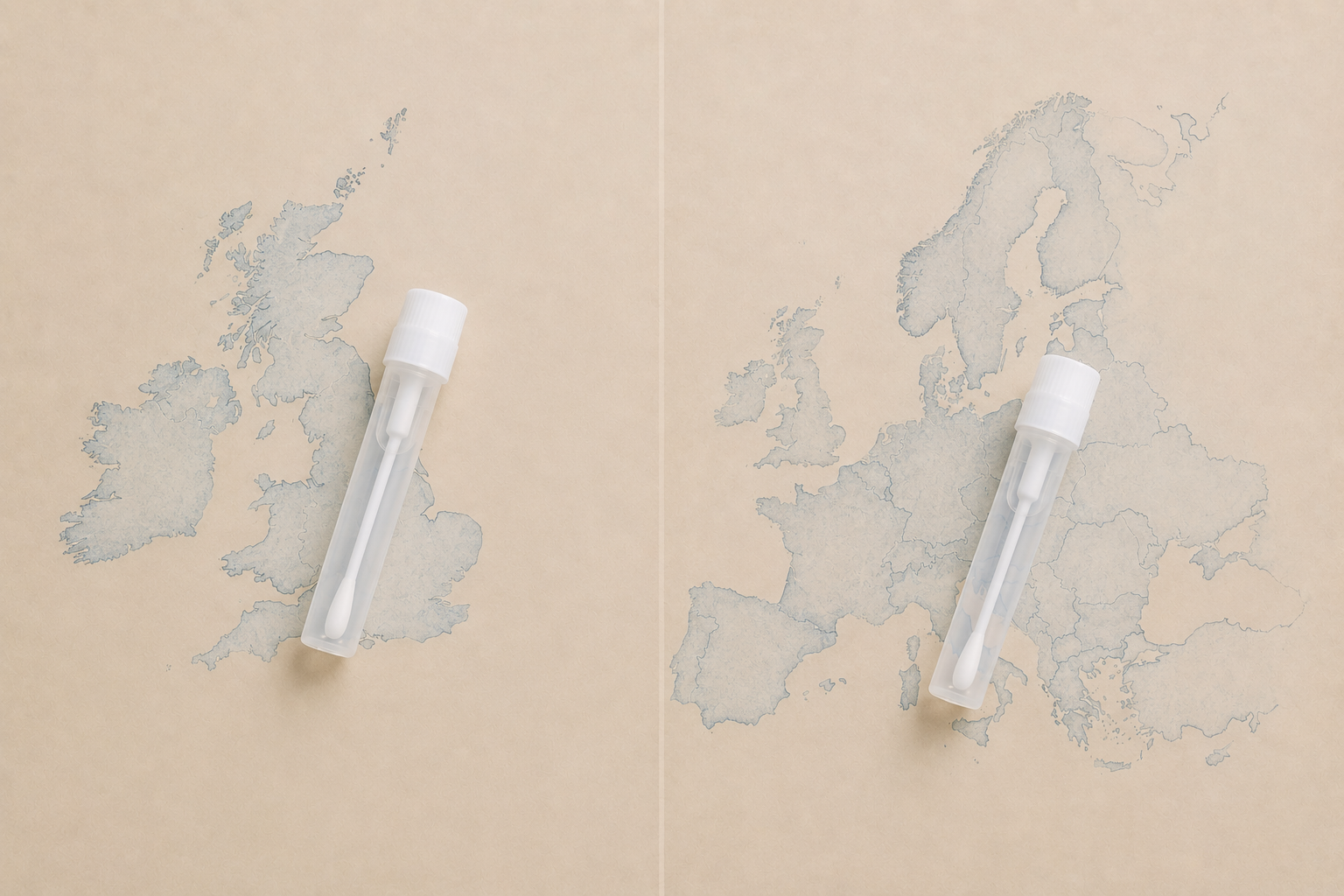
    Living DNA specializes in the British Isles. If your family history runs through England, Scotland, Ireland, or Wales, Living DNA’s regional breakdown goes deeper than almost any competitor — pinpointing sub-regions within the UK and Ireland rather than lumping everything into one broad category.

    MyHeritage specializes in continental Europe and Jewish ancestry. If your background points toward Poland, Italy, Germany, or Ashkenazi Jewish heritage specifically, MyHeritage’s reference database is noticeably deeper in these areas than most competitors, including Living DNA.

    If your ancestry overlaps both — say, British on one side of the family and Eastern European on the other — neither kit alone will give you the full picture, and testing with both (or uploading raw data between them) becomes genuinely worth considering.

    Database Size and Relative Matching

    Both companies have smaller overall databases compared to giants like AncestryDNA, but they’re not equal to each other either.

    MyHeritage’s database is meaningfully larger than Living DNA’s, which translates to more potential DNA matches across the board — not just within its specialty regions. If finding new relatives is a real priority alongside regional accuracy, MyHeritage has an edge here simply due to scale.

    What Each Test Actually Analyzes

    This is where Living DNA pulls ahead in a different way. It tests autosomal DNA, Y-DNA, and mitochondrial DNA together in one kit, giving you insight into both your direct paternal and maternal lines. MyHeritage’s standard test focuses on autosomal DNA only, which covers your broader ancestry but doesn’t provide that same direct paternal/maternal line analysis.

    If tracing a specific line of descent matters to you — not just an overall ethnicity picture — Living DNA’s broader testing scope is a genuine advantage, regardless of which regional specialty you need.

    Family Tree Tools

    MyHeritage has the more developed family tree platform of the two, with Smart Matches and Record Matches that surface automatically as your tree grows. It’s built to be a complete genealogy research environment, not just an ethnicity report.

    Living DNA’s tree-building tools are more basic by comparison. It’s a solid ancestry test, but it doesn’t try to compete as a full genealogy research platform the way MyHeritage does.

    Turnaround Time: Not Close

    This is one of the clearest differences between the two. MyHeritage typically returns results in three to four weeks. Living DNA’s stated window is six to eight weeks, and it’s not uncommon for it to stretch closer to ten to twelve weeks during busier periods.

    If you’re testing for a specific occasion or you’re simply impatient, this gap alone might tip the decision toward MyHeritage.

    Price

    MyHeritage DNA is generally the more affordable of the two, with frequent, fairly aggressive sales that push the price down further. Living DNA sits in a similar mid-range bracket normally, though it goes on sale less aggressively than MyHeritage does.

    So, Which One Should You Choose?

    Choose Living DNA if:

    • Your ancestry is specifically rooted in the UK or Ireland
    • You want combined autosomal, Y-DNA, and mitochondrial testing in one kit
    • You’re not in a hurry and can wait out the longer turnaround

    Choose MyHeritage DNA if:

    • Your background is European, Jewish, Italian, or Eastern European
    • You want faster results and a more developed family tree platform
    • You’re working with a tighter budget and want frequent sale pricing

    What If You’re Not Sure Which Region Fits?

    If you’re honestly uncertain where your ancestry concentrates most heavily, a broader database like AncestryDNA might be a more sensible starting point before narrowing in on a regional specialist. Our full comparison of the major DNA testing kits breaks down how all the major options stack up against each other.

    Frequently Asked Questions

    Which is more accurate, Living DNA or MyHeritage DNA? Neither is universally more accurate — each is strongest within its own regional specialty. Living DNA excels for UK and Irish ancestry; MyHeritage excels for European and Jewish ancestry.

    Which one gives faster results? MyHeritage DNA, typically by several weeks. Living DNA’s more detailed analysis takes longer to process, often six to eight weeks or more.

    Can I use both kits for a more complete picture? Yes. If your background spans both specialty regions, testing with both — or uploading raw data from one to the other where supported — can give a more complete picture than either kit alone.

    The Bottom Line

    This comparison really comes down to geography more than any other single factor. Match the kit to where your ancestry actually traces back to, and from there, weigh speed, price, and testing scope based on what matters most to you personally.

  • The Fastest DNA Testing Kits (When You Don’t Want to Wait Two Months)

    The Fastest DNA Testing Kits (When You Don’t Want to Wait Two Months)

    Affiliate Disclosure: This post contains affiliate links. If you buy through one of them, we may earn a small commission — at no extra cost to you. We only recommend kits we’ve actually researched and would suggest to a friend.

    When Six Weeks Feels Like Forever

    Most DNA testing timelines were clearly designed by people who’ve never actually been waiting on one. Six to eight weeks is standard across a lot of the industry, and if you’re testing for a specific reason — curiosity that’s genuinely eating at you, a milestone birthday, a family gathering where you’d love to share results — that wait can feel unreasonably long.

    The good news: turnaround time varies more than most people realize, and it’s rarely mentioned as prominently as price or database size. Here’s what actually moves faster, and why.

    Why Some Kits Take Longer Than Others

    Lab processing complexity. Kits analyzing more genetic markers, or running multiple types of analysis (autosomal plus Y-DNA and mitochondrial, for instance), naturally take longer to process than a more narrowly focused test.

    Seasonal demand. Nearly every DNA testing company sees a massive order spike around the December holidays, since kits are a popular gift. Labs get backed up, and stated turnaround times often stretch noticeably during January and February as a result.

    Report depth. Companies that pair your results with a written report, or in some cases a consultation call, need extra time on the back end after the lab work itself is done.

    Fastest to Slowest: How the Major Kits Compare

    DNApower — typically 2 to 3 weeks

    This is the fastest option among the mainstream kits, and it’s not particularly close. DNApower’s focus on wellness-related genetic markers, rather than a broad ancestry database with extensive relative-matching, means less back-end processing overall, which translates directly into a shorter wait.

    If speed is your top priority and you’re specifically interested in wellness insights rather than ancestry, this is the clearest choice.

    AncestryDNA — typically 3 to 4 weeks

    For an ancestry-focused kit, this is solidly on the faster end. AncestryDNA’s massive testing volume means its lab infrastructure is built to process samples efficiently, even during busier periods, though January backlogs can still push this toward the five-week mark.

    MyHeritage DNA — typically 3 to 4 weeks

    Similar timeline to AncestryDNA, and sometimes slightly faster outside of peak season. MyHeritage doesn’t publicly emphasize speed as a selling point, but in practice, it’s competitive with the other faster-turnaround ancestry kits.

    FamilyTreeDNA — typically 4 to 6 weeks

    A bit slower, partly because the standard test often includes more comprehensive analysis for genealogy purposes, and the company caters to a research-focused audience less concerned with rapid turnaround.

    Living DNA — typically 6 to 8 weeks (sometimes longer)

    The slowest of the major kits, and by a meaningful margin. The tradeoff is depth — Living DNA’s detailed regional analysis and combined autosomal, Y-DNA, and mitochondrial testing require more extensive lab work, which extends the timeline. If you’re choosing Living DNA specifically for its detail, budget extra patience to match.

    How to Actually Speed Up Your Results (Within Reason)

    Order outside of peak season. Avoiding late November through January can shave real time off your wait, since you’re not competing with a flood of holiday-gifted kits all hitting the lab at once.

    Register your kit immediately. A surprising number of delays come from people mailing back an unregistered sample. The lab can’t begin processing until your kit is activated online, so do this the moment it arrives, before you even collect your sample.

    Double-check your sample meets requirements. Insufficient saliva volume or contamination (from eating, drinking, or smoking too close to collection) is one of the most common reasons a sample gets rejected and a replacement kit has to be sent — which can add several weeks to your total timeline.

    Choose a swab-based kit if you tend to struggle with saliva samples. A rejected saliva sample due to insufficient volume is a genuinely common, avoidable delay. If you know spitting into a tube on command isn’t your strong suit, a cheek swab kit sidesteps that risk entirely.

    Is Faster Always Better?

    Not necessarily, and it’s worth weighing against what you’re actually looking for. DNApower’s speed comes from a narrower focus — you’re trading ancestry depth for a quick wellness snapshot. Living DNA’s slower timeline exists specifically because it’s doing more thorough regional analysis than most competitors. Speed is one factor among several, not the only one worth optimizing for.

    Comparing Speed Against Everything Else

    If turnaround time is just one piece of your decision, our full comparison of the major DNA testing kits lays out pricing, database size, and features side by side, so you can weigh speed against what else matters to you.

    Frequently Asked Questions

    What’s the fastest DNA test kit currently available? DNApower typically has the quickest turnaround among mainstream kits, usually two to three weeks, though it’s a wellness-focused test rather than an ancestry kit.

    Why do DNA test results take longer in January? Holiday gifting causes a major spike in orders through December, which backs up lab processing well into the new year for most companies.

    Can I pay extra for faster processing? Some companies offer expedited or priority processing as a paid add-on, though this isn’t universal — check the specific kit’s options at checkout if speed is a priority.

    The Bottom Line

    If you genuinely can’t stand the wait, DNApower is the clear speed leader, with AncestryDNA and MyHeritage DNA as solid middle-ground options for ancestry-focused testing. Just remember that the fastest kit isn’t automatically the best fit — match your choice to what you’re actually trying to learn, and treat speed as a tiebreaker rather than the main event.

  • AncestryDNA vs. MyHeritage DNA: Which One Should You Actually Get?

    AncestryDNA vs. MyHeritage DNA: Which One Should You Actually Get?

    Affiliate Disclosure: This post contains affiliate links. If you buy through one of them, we may earn a small commission — at no extra cost to you. We only recommend kits we’ve actually researched and would suggest to a friend.

    Two of the Biggest Names, One Decision to Make

    If you’ve narrowed your search down to these two, you’re not alone. AncestryDNA and MyHeritage DNA are two of the most recommended kits in the genealogy space, and on the surface, they look like they do the same thing — ethnicity estimates, DNA matches, family tree tools. Look closer, though, and they’re built for genuinely different strengths.

    Here’s how they actually compare, side by side.

    Who Should Skip This Comparison Entirely

    If health insights are your main goal, neither of these is really built for that — you’d get more value from a dedicated health-focused kit or a combo option like 23andMe.

    If you already know your ancestry is heavily concentrated outside the US, UK, Canada, Australia, or Europe, both of these databases will feel comparatively thin for your background, and it’s worth researching region-specific alternatives instead.

    Otherwise, let’s get into the actual comparison.

    Database Size: AncestryDNA Wins by a Wide Margin

    This is the single biggest differentiator between the two. AncestryDNA has the largest consumer DNA database of any company on the market. MyHeritage’s database is substantial, but noticeably smaller overall.

    What this means practically: if your main goal is finding new relatives — second cousins, distant branches of the family you never knew existed — AncestryDNA gives you meaningfully better odds simply because more people have tested there.

    The exception is regional strength. MyHeritage’s database, while smaller overall, is unusually deep for specific populations — particularly European and Ashkenazi Jewish ancestry — where it can actually out-perform AncestryDNA in terms of match relevance and regional detail.

    Ethnicity Estimate Detail

    Both companies provide a percentage-based ethnicity breakdown, but the regional granularity differs depending on your background.

    For users with predominantly US, UK, or broadly Western European ancestry, AncestryDNA’s estimate tends to be reliable and reasonably detailed, backed by its larger reference panel.

    For users with Jewish, Italian, Polish, or other specific European backgrounds, MyHeritage frequently provides sharper regional detail, a direct result of where the company built its early user base.

    Neither company is more “accurate” in some universal sense — they’re each strongest where their reference data is deepest.

    Historical Records: AncestryDNA’s Clear Advantage

    If you plan to actually build out a family tree using historical documentation — census records, immigration papers, military records — AncestryDNA is significantly ahead here. Its records integration is one of the most extensive in the industry, and DNA matches connect directly to documented family trees, surfacing research “hints” automatically.

    MyHeritage also offers historical records access through its own subscription, and it’s genuinely useful, particularly for European records. But in terms of sheer volume and depth, especially for US-based research, AncestryDNA has the stronger archive.

    Price Comparison

    MyHeritage DNA is consistently the more affordable option for the base kit, and it goes on sale frequently, often dropping well below its already competitive starting price.

    AncestryDNA’s base kit is also regularly discounted, particularly during major sale periods, and can end up similarly priced to MyHeritage during a promotion. Where AncestryDNA tends to cost more overall is the historical records subscription, which unlocks its most powerful features but isn’t included in the base kit price.

    If budget is the deciding factor and you don’t plan to subscribe to records access, MyHeritage is generally the cheaper path to a solid ancestry test.

    Family Tree Tools

    Both platforms let you build a family tree and connect DNA matches to it, but the experience feels slightly different.

    MyHeritage integrates the tree-building experience tightly with DNA matching — Smart Matches and Record Matches surface automatically as your tree grows, creating a fairly seamless research flow.

    AncestryDNA’s tree tools are also strong, and the “hints” system (leaf icons suggesting possible record matches) is one of the more well-known features in the genealogy space. Both are genuinely well-built; the choice here often comes down to personal preference for interface style rather than one being objectively better.

    Turnaround Time

    Both companies report similar processing windows, typically three to four weeks from when the lab receives your sample. Neither is notably faster than the other in normal circumstances, though both can slow down during peak gifting seasons like December and January.

    So, Which One Should You Choose?

    Choose AncestryDNA if:

    • Finding as many potential relatives as possible is your top priority
    • Your ancestry is primarily US, UK, Canadian, or broadly Western European
    • You want to do serious historical research using original documents

    Choose MyHeritage DNA if:

    • Your background is European, Jewish, Italian, or Eastern European specifically
    • You’re working with a tighter budget and want strong value on the base kit
    • You want a more affordable entry point with solid family tree tools included

    Can You Just Test With Both?

    Yes, and it’s a genuinely common approach among more experienced genealogy researchers. Since each company only matches you against its own database, testing with both — or uploading your raw data from one company to the other — can surface a wider set of relatives than either company alone.

    MyHeritage in particular accepts raw DNA data uploads from AncestryDNA and other major competitors, which is a budget-friendly way to access their matching database without paying for a second full test.

    See How They Compare to the Rest of the Field

    If you’re not fully set on either of these two, our full comparison of the major DNA testing kits covers how they stack up against Living DNA, FamilyTreeDNA, and other options.

    Frequently Asked Questions

    Is AncestryDNA or MyHeritage DNA more accurate? Neither is universally more accurate — each performs best where its reference database is deepest. AncestryDNA tends to be stronger for US, UK, and broadly Western European ancestry, while MyHeritage often provides sharper detail for European and Jewish ancestry specifically.

    Can I upload my AncestryDNA results to MyHeritage? Yes. MyHeritage accepts raw DNA data uploads from AncestryDNA and several other major testing companies, letting you access its match database without buying a second kit.

    Which one is cheaper? MyHeritage DNA’s base kit is typically the more affordable option and goes on sale frequently. AncestryDNA’s base kit is also often discounted, though its historical records subscription adds to the overall cost if you use it.

    The Bottom Line

    There’s no single winner here — the right choice depends on where your ancestry actually traces back to, and whether database size or regional precision matters more for your specific research goals. If in doubt, MyHeritage’s lower cost makes it a reasonable low-risk starting point, with AncestryDNA as a strong second test if you want to expand your match pool later.

  • What Is a Centimorgan? The DNA Match Number Everyone Ignores Until They Can’t

    What Is a Centimorgan? The DNA Match Number Everyone Ignores Until They Can’t

    Affiliate Disclosure: This post contains affiliate links. If you buy through one of them, we may earn a small commission — at no extra cost to you. We only recommend kits we’ve actually researched and would suggest to a friend.

    The Number Next to Every Match You’ve Been Skipping Past

    If you’ve ever scrolled through your DNA match list, you’ve seen it: a number next to each person’s name, followed by “cM” — like “1,245 cM” or “38 cM.” Most people scroll right past it, focusing instead on the estimated relationship label the platform provides.

    That’s a mistake, honestly. The centimorgan number is actually the more reliable piece of information — the relationship label is just the platform’s best guess based on that number. Once you understand what it means, you can start reading matches more accurately than the automated labels sometimes allow.

    The Actual Definition, Without the Genetics Lecture

    A centimorgan (cM) is a unit that measures the likelihood of DNA recombination — essentially, how “far apart” two points on a chromosome are in terms of how often they get separated during the process of passing DNA from parent to child.

    You don’t need to understand the biology behind that to use the number practically. Think of it more simply: the higher the total centimorgans you share with someone, the more DNA you have in common, and the more closely related you likely are. It’s a measurement of shared genetic material, not a measurement of time or generations directly — though it correlates with both.

    A Practical Relationship Chart

    Here’s roughly what different centimorgan ranges tend to indicate. These are approximate — actual inherited DNA varies due to the randomness of genetic recombination, so treat these as general zones rather than exact cutoffs.

    Parent/child: Around 3,400–3,700 cM (essentially half your total DNA)

    Full siblings: Roughly 2,300–3,400 cM

    Grandparent, aunt/uncle, or half-sibling: Roughly 1,300–2,300 cM

    First cousin: Roughly 550–1,300 cM

    Second cousin: Roughly 100–350 cM

    Third cousin: Roughly 45–200 cM

    Fourth cousin and beyond: Often under 50 cM, sometimes into single digits

    Notice how the ranges start overlapping significantly the more distant the relationship gets. That’s the core reason platforms give you a range of possible relationships (like “second to third cousin”) rather than a single definitive answer once you’re past close family.

    Why the Same cM Number Can Mean Different Relationships

    This trips people up constantly: two people can share, say, 400 cM with you, but end up being genuinely different types of relatives — one a first cousin once removed, another a second cousin. This happens because centimorgan totals reflect the amount of shared DNA, but multiple different family relationships can theoretically produce a similar amount.

    This is exactly why tools like the Shared Centimorgan Project exist — a crowdsourced resource that maps out the realistic probability distribution for each cM range, rather than pretending there’s one clean answer. If you’re seriously trying to figure out a specific match, cross-referencing your cM number against a probability tool like this is far more useful than relying on the single relationship label your testing platform suggests.

    Half Relationships Complicate Things Further

    Half-relationships — a half-sibling, half-aunt, half-cousin — share roughly half the DNA of their full equivalent. A half first cousin, for example, shares roughly the same cM range as a first cousin once removed, which is part of why distinguishing between these possibilities purely from a cM number alone isn’t always straightforward. Family tree context, shared matches, and sometimes direct conversation with the match are usually needed to fully resolve genuinely ambiguous cases.

    When a Low cM Match Is Worth Taking Seriously

    Matches under roughly 20 cM sit in a genuinely uncertain zone. Some represent real, if distant, shared ancestry. Others can reflect smaller genetic overlaps that don’t necessarily point to a specific, easily traceable common ancestor within a realistic number of generations.

    That doesn’t mean low matches are worthless — plenty of real family connections get confirmed at 15–20 cM — but it does mean they’re worth treating as a starting hypothesis rather than a settled fact, especially without additional supporting evidence like shared matches or family tree overlap.

    How This Connects to Reading Your Full Results

    Understanding centimorgans is really just one piece of getting comfortable with your overall DNA results. If you want the broader picture — ethnicity estimates, shared matches, and how to approach your dashboard as a first-timer — our guide on how to read your DNA test results walks through the rest of it.

    Frequently Asked Questions

    What’s considered a “good” centimorgan match? It depends entirely on what you’re looking for. Matches above a few hundred cM reliably indicate close-to-moderate family relationships, while matches under 20 cM are more uncertain and worth treating cautiously.

    Can two people share the same cM total but be different types of relatives? Yes, this is common, especially for more distant relationships, since multiple family connections can theoretically produce similar shared DNA totals. Shared matches and family tree research usually help narrow it down.

    Do all DNA testing companies measure centimorgans the same way? The underlying measurement is standardized, but companies sometimes calculate slightly differently due to which parts of the genome they analyze, which is part of why the same two people can see slightly different cM totals on different platforms.

    The Bottom Line

    The centimorgan number is more useful than most people realize — it’s the actual data behind the relationship guess your platform gives you, not just a technical footnote. Once you know roughly what different ranges mean, you can read your match list with a lot more confidence than relying on the automated label alone.

  • The Cheapest DNA Testing Kits That Are Actually Worth Buying

    The Cheapest DNA Testing Kits That Are Actually Worth Buying

    Affiliate Disclosure: This post contains affiliate links. If you buy through one of them, we may earn a small commission — at no extra cost to you. We only recommend kits we’ve actually researched and would suggest to a friend.

    Cheap Doesn’t Have to Mean “Cutting Corners” Here

    There’s a specific kind of anxiety that comes with buying the cheapest option in any category — that nagging feeling you’re about to regret it. DNA testing is a little different from most budget-purchase categories, though, because the core lab process is fundamentally similar across companies. You’re not usually sacrificing accuracy by choosing a cheaper kit; you’re mostly trading away extra features, database size, or add-ons.

    That distinction matters. Here’s how to actually save money on a DNA test without ending up with a genuinely worse product.

    Why Prices Vary So Much in the First Place

    Before comparing specific kits, it helps to understand what you’re actually paying for beyond the lab work itself.

    Database size and matching features. Companies with larger databases generally charge more, partly because building and maintaining that infrastructure costs more, and partly because the larger pool of potential relative matches is a genuine value-add.

    Historical records access. For genealogy-focused kits, the base test is often cheap, but full access to census records, immigration documents, and similar archives requires a separate, often pricier subscription.

    Health and wellness add-ons. Any kit that includes health-related reporting on top of ancestry data tends to cost more, since it involves additional analysis beyond the standard ethnicity breakdown.

    Turnaround speed. Faster processing sometimes comes at a premium, though this isn’t universal — some of the quicker kits are also among the more affordably priced.

    Where the Real Savings Are

    MyHeritage DNA is consistently one of the most affordable entry points

    Compared to AncestryDNA or 23andMe, MyHeritage DNA tends to sit at a noticeably lower price point for the base kit, and it goes on sale frequently enough that patient shoppers rarely pay full price. If your ancestry background leans European or Jewish, you’re also getting some of the sharpest regional detail available at this price tier — a rare case where “cheaper” doesn’t mean “less specific” for the right audience.

    DNApower offers solid value if wellness is your goal

    For health and wellness-focused testing specifically, DNApower is competitively priced against the alternative — paying extra for 23andMe’s combo ancestry-plus-health tier when you don’t actually want the ancestry portion. If wellness insights are genuinely your goal, skipping the combo kit in favor of a dedicated wellness test can be the smarter budget move, not just the cheaper one.

    AncestryDNA’s base kit is often cheaper than expected — the subscription is where costs climb

    A lot of people assume AncestryDNA is expensive across the board, but the standalone DNA kit itself is frequently discounted, especially around major sales periods. The real cost increase comes from the historical records subscription, which is entirely optional if you just want the ethnicity breakdown and match list.

    How to Time Your Purchase for the Best Price

    Watch for major sale periods. DNA testing companies tend to run their steepest discounts around late November through the end of December, plus smaller promotions around Mother’s Day, Father’s Day, and DNA Day (April 25th, an industry-specific promotional date most companies observe).

    Sign up for email alerts before you plan to buy. Many companies send subscriber-only discount codes that aren’t publicly advertised on the main product page.

    Compare bundle pricing against solo pricing. Sometimes buying two kits together (for yourself and a family member) unlocks a lower per-kit price than buying one at a time — worth checking if anyone else in your circle has been considering testing too.

    What Not to Cut Corners On

    Even on a budget, a couple of things are worth not compromising on.

    Avoid unfamiliar, unverified brands purely because they’re cheap. A DNA testing company you’ve never heard of, with no visible privacy policy or lab accreditation information, isn’t a real bargain — it’s a risk with your genetic data attached to it.

    Don’t skip reading the privacy policy just because the price is low. Cheaper kits aren’t inherently worse about data handling, but it’s still worth the five minutes to check before you commit, regardless of price point.

    Comparing the Full Lineup

    If you want to see how pricing stacks up against database size, features, and turnaround time across all the major options, our full comparison of the leading DNA testing kits lays it out side by side.

    Frequently Asked Questions

    Is a cheaper DNA test less accurate? Generally no — the core genetic testing process is fundamentally similar across reputable companies. Price differences usually reflect database size, added features, or subscription add-ons rather than the accuracy of the raw genetic reading itself.

    When do DNA testing kits go on sale most often? Late November through December tends to bring the steepest discounts, with smaller promotions around spring holidays and DNA Day in April.

    Is it worth buying a DNA kit from an unfamiliar, very cheap brand? Be cautious. Look for a clear privacy policy, transparent lab accreditation, and some public track record before trusting an unfamiliar company with your genetic data, regardless of how low the price is.

    The Bottom Line

    Saving money on a DNA test doesn’t usually mean settling for worse science — it means being deliberate about which extras (subscriptions, combo features, faster turnaround) you actually need versus which ones you’re paying for without using. Time your purchase around a sale, pick the kit that matches your actual goal, and you can get a genuinely solid test without overpaying for features you won’t touch.

  • Ancestry DNA Test vs. Health DNA Test: Which One Do You Actually Need?

    Ancestry DNA Test vs. Health DNA Test: Which One Do You Actually Need?

    Affiliate Disclosure: This post contains affiliate links. If you buy through one of them, we may earn a small commission — at no extra cost to you. We only recommend kits we’ve actually researched and would suggest to a friend.

    Same Tube, Very Different Questions

    Here’s something that trips people up before they even order: not every DNA test is trying to answer the same question. Some are built to tell you where your ancestors came from. Others are built to tell you about your genetic tendencies around diet, fitness, or health risk. A few try to do both.

    Picking the wrong type isn’t a disaster — you’ll still get real, accurate genetic data back — but you might end up with a report that doesn’t actually answer what you were curious about in the first place. Here’s how to tell these apart before you buy.

    What Ancestry-Focused Tests Actually Measure

    Ancestry kits compare your DNA against a reference database of people with documented family backgrounds from specific regions. The output is an ethnicity estimate — a percentage breakdown by geography — plus a list of DNA matches, meaning other people in that company’s database who share enough DNA with you to likely be relatives.

    This is the category that includes AncestryDNA, MyHeritage DNA, Living DNA, and FamilyTreeDNA. Each one’s strength depends heavily on where its reference database is deepest — AncestryDNA’s is broadest overall, while Living DNA specializes in fine-grained detail within the British Isles, and MyHeritage leans strong for European and Jewish ancestry specifically.

    If your goal is building a family tree, finding unknown relatives, or understanding your ethnic background in more detail, this is the category you want.

    What Health-Focused Tests Actually Measure

    Health and wellness kits look at specific, well-studied genetic markers tied to things like nutrient metabolism, exercise response, or in some cases, carrier status for certain inherited conditions. Instead of an ethnicity map, you get a report organized around categories like diet, fitness, or specific health predispositions.

    DNApower falls into this category, focused specifically on wellness-related traits — nutrition, fitness, and lifestyle markers — with a faster turnaround than most ancestry-focused kits. 23andMe sits in a slightly different spot, offering health predisposition reports as an add-on layered on top of its ancestry features.

    It’s worth being clear-eyed about what this category is and isn’t. These reports aren’t medical diagnoses. They’re a data point — sometimes a genuinely useful one — that’s best discussed with a doctor or dietitian rather than acted on alone.

    The Kits That Try to Do Both

    23andMe is the main example here, combining ancestry composition with health and trait reports in one kit, at a higher tier and price point than either category alone.

    The tradeoff with combo kits is usually depth. You’re getting a reasonably good version of both categories rather than the most specialized version of either. If you want the absolute best ancestry detail available, a dedicated ancestry kit will likely out-perform the ancestry portion of a combo kit. Same logic applies on the health side.

    A Simple Way to Decide

    Ask yourself which question you actually want answered first:

    “Where did my family come from, and who else am I related to?” → Ancestry-focused kit (AncestryDNA, MyHeritage DNA, Living DNA, or FamilyTreeDNA depending on your specific background)

    “What do my genes suggest about my health, diet, or fitness?” → Health-focused kit (DNApower)

    “I want a taste of both, and I don’t mind paying more for it” → Combo kit (23andMe)

    If you’re genuinely torn between the two, it often comes down to which question you’d be more disappointed to leave unanswered. That’s usually a clearer signal than trying to weigh feature lists against each other.

    Can You Get Both Without Buying a Combo Kit?

    Yes — this is a detail a lot of first-timers miss. Since ancestry and health-focused companies use different reference databases and testing panels, nothing stops you from testing with one ancestry-focused company and one health-focused company separately.

    This approach sometimes works out cheaper than a single all-in-one combo kit, and it lets you pick the specialist in each category rather than settling for a single company’s version of both. The downside is managing two separate accounts and two separate wait times, which is a fair tradeoff for some people and not worth the hassle for others.

    Comparing Your Options Side by Side

    If you’ve settled on which category fits your goal, the next step is comparing specific brands within it. Our full comparison of the major DNA testing kits breaks down pricing, database size, and turnaround time across both ancestry and health-focused options.

    Frequently Asked Questions

    Can an ancestry DNA test also tell me about my health? Not in any meaningful clinical sense. Most ancestry-focused kits include light trait reports (like whether you have a genetic predisposition toward a sweet tooth), but this is different from the depth of a dedicated health-focused test.

    Is a combo kit like 23andMe worth the extra cost? It depends on how much you value convenience versus depth. If you want a solid taste of both categories in one purchase, yes. If you want the most detailed version of either category specifically, a specialized kit will likely serve you better.

    Do I need a doctor’s involvement for a health-focused DNA test? Not to purchase or take one, but any specific health-related findings are worth discussing with a doctor or dietitian rather than acting on independently, since these reports are one data point among many, not a diagnosis.

    The Bottom Line

    The real decision isn’t “which brand is best” — it’s “which question am I actually trying to answer.” Get clear on that first, and choosing between ancestry-focused, health-focused, or combo kits becomes a lot more straightforward.

  • Best DNA Test Kits to Give as a Gift (Without Regretting It)

    Best DNA Test Kits to Give as a Gift (Without Regretting It)

    Affiliate Disclosure: This post contains affiliate links. If you buy through one of them, we may earn a small commission — at no extra cost to you. We only recommend kits we’ve actually researched and would suggest to a friend.

    The Gift That’s Either Perfect or Slightly Awkward

    DNA test kits have become one of those go-to gifts — for a parent who loves genealogy, a sibling who’s curious about health traits, a grandparent who wants to know more before it’s “too late” to ask. They also carry a specific kind of risk that a scarf or a coffee mug doesn’t: the results can surface things the recipient didn’t ask for.

    If you’re buying one as a gift, here’s how to actually choose well, and what to think through before you do.

    Who This Gift Isn’t For

    A few honest exceptions worth considering before you buy:

    If the recipient has ever expressed discomfort about a company “having their DNA,” respect that instinct rather than assuming a gift will change their mind. This isn’t the kind of surprise gift that tends to land well if the underlying hesitation is about privacy.

    If there’s any known family complexity — an unknown biological parent, a closed adoption, a family secret someone suspects but has never confirmed — a DNA test can surface it without warning. That’s a meaningful thing to hand someone unprepared, even with good intentions.

    If the recipient already has strong genealogy knowledge and has likely already tested, check first. Duplicate kits are a surprisingly common and mildly annoying gifting mistake.

    What Makes a DNA Kit a Good Gift

    Ease of use matters more for gifts than for yourself. If you’re testing out of personal curiosity, you’ll push through a slightly clunky sign-up process. A gift recipient — especially an older relative — is more likely to actually finish the process if it’s simple from the first step.

    Consider what they’re actually curious about. A grandparent piecing together family history wants something different from a sibling who’s into wellness trends. Matching the kit to the actual interest matters more than picking whichever brand is most popular.

    Factor in the wait. If you’re gifting for a specific occasion and hoping results arrive in time for a follow-up conversation or reveal, check turnaround times carefully — some kits take six to eight weeks or longer, which can outlast the excitement of the original gift moment.

    Kit Recommendations by Recipient

    For the family historian or genealogy enthusiast

    AncestryDNA tends to be the strongest fit here, thanks to its massive database and deep integration with historical records. If they’re the type to already have a family tree partially built, this kit gives them the most to work with.

    For someone with known European or Jewish ancestry

    MyHeritage DNA offers sharper regional detail for these backgrounds than some bigger-name competitors, plus built-in family tree tools that make the whole experience feel connected rather than fragmented.

    For UK or Irish roots specifically

    Living DNA is the specialist pick if you know the recipient’s family traces back to a specific region within the British Isles. Just budget extra time — this one has the longest typical turnaround on this list.

    For the wellness-curious relative

    If ancestry isn’t really their interest and they’re more into fitness, nutrition, or general self-optimization, DNApower is a better match than a genealogy-focused kit, and it comes back faster than most.

    How to Actually Present the Gift

    Include a note about what to expect, not just the box. A short card explaining roughly how long results will take, and that the process is simple (spit or swab, mail it back), removes a lot of the initial hesitation some people feel about starting.

    Offer to help with setup if needed, especially for older recipients. The account registration and activation step trips up more people than the actual sample collection does.

    Gently mention the possibility of unexpected results, without being ominous about it. A brief, low-key “just so you know, sometimes these turn up surprises — nothing to worry about, just something people don’t always expect” can soften the landing if something unusual does come up later.

    Frequently Asked Questions

    What’s the best DNA test kit for an older relative? Prioritize ease of use over depth of features — a straightforward sign-up process and clear instructions matter more than advanced tools they may not use.

    How far in advance should I buy a DNA kit as a gift? Order at least two months ahead if you want results to arrive in time for a specific occasion or follow-up conversation, especially for kits with longer processing windows.

    Should I test my own DNA before gifting a kit to someone else? Not necessary, but it can help you speak from experience about what the process and results actually involve, which can make the gift feel more thoughtful.

    Timing It Around the Holidays

    DNA kits are one of the most heavily discounted gift categories around major holiday seasons, particularly Black Friday through the end of December. Prices on the kits themselves often drop noticeably compared to the rest of the year, though processing times can stretch longer than usual as labs handle a surge in orders all at once.

    If you’re buying for a holiday gift specifically, it’s worth deciding upfront whether you want the physical box to be part of the surprise (with results arriving later) or whether you’d rather order early enough that results are actually in hand by the big day. Both are common approaches — just be honest with yourself about which one you’re actually going for, since it changes how far in advance you need to order.

    The Bottom Line

    A DNA test kit can be one of the more meaningful gifts you give — but only if it matches what the recipient is actually curious about, and only if you’ve thought through the small chance of an unexpected result. Pick based on their specific interest, give them a heads-up about the process, and it tends to be a gift people genuinely appreciate rather than one that sits in a drawer.

  • DNA Test Kit for Beginners: What to Actually Expect

    DNA Test Kit for Beginners: What to Actually Expect

    Affiliate Disclosure: This post contains affiliate links. If you buy through one of them, we may earn a small commission — at no extra cost to you. We only recommend kits we’ve actually researched and would suggest to a friend.

    Your First DNA Kit Is Sitting on the Counter. Now What?

    Maybe someone gave it to you as a gift. Maybe you finally clicked “buy” after weeks of research. Either way, there’s a decent chance the box is sitting there while you wonder what you actually signed up for.

    This is the walkthrough I wish existed before my first kit — what actually happens, in order, from unboxing to reading your results.

    Before You Even Open the Box

    Pick your goal first, not the brand. The single biggest mistake first-timers make is choosing a kit based on price or a friend’s recommendation, without first deciding what they actually want to learn — ancestry, health, or both. That choice should come before the brand choice, not after.

    Check the collection method. Kits use either a saliva sample (spit into a tube) or a cheek swab. If you have trouble producing saliva on demand, or you’re testing a child, a swab-based kit tends to be easier to manage.

    Register the kit before you use it. Almost every company requires you to create an online account and activate the kit’s unique barcode before you collect your sample. Skipping this step is the single most common reason people delay their results — the lab can’t process an unregistered sample.

    The Collection Process Itself

    This part is faster and less unpleasant than most first-timers expect.

    For saliva kits, you’ll typically need to avoid eating, drinking, smoking, or chewing gum for about 30 minutes beforehand, since food particles and other DNA sources can contaminate the sample. You spit into the provided tube up to a fill line, seal it with the included solution, and package it back up.

    For cheek swab kits, you swab the inside of each cheek for roughly 30 to 60 seconds per side, then let it air dry briefly before sealing.

    Either way, the whole process takes about five to ten minutes, and the prepaid return packaging makes mailing it back straightforward — usually just a trip to any mailbox or post office drop.

    The Waiting Period

    This is the part nobody prepares you for: the wait genuinely varies, from as fast as two to three weeks with some wellness-focused kits, up to six to eight weeks (sometimes longer) with more detail-heavy ancestry kits like Living DNA.

    A few things happen during this window that you generally can’t speed up:

    • The lab confirms your sample meets quality standards (occasionally, a sample is rejected for insufficient DNA and a replacement kit is sent — annoying, but not common)
    • Your DNA is processed and read at hundreds of thousands of specific points
    • Results are compiled and checked before being released to your account

    You’ll get an email the moment things are ready, so there’s no need to keep manually checking during this stretch.

    What Your First Login Actually Looks Like

    When results land, expect a dashboard with a few core sections: an ethnicity or ancestry breakdown, a list of DNA matches (other testers who share DNA with you), and depending on your kit, trait or health reports.

    It’s genuinely a lot to take in at once. Most first-timers benefit from starting with the ethnicity overview for the big picture, then slowly working through the match list over the following days rather than trying to absorb everything in one sitting.

    Common First-Timer Questions, Answered Honestly

    Do I need to know anything about genetics beforehand? No. Every major platform is built for a general audience, with plain-language explanations built into the dashboard itself.

    Will I definitely find new relatives? Not guaranteed, but likely if you test with a company with a large database — the bigger the pool of testers, the higher your odds of a meaningful match. Distant matches (think fourth cousins or further) are common; close, previously-unknown relatives are less certain but do happen.

    Can I test if I’m adopted or don’t know one side of my family? Yes, and this is actually one of the more common — and often emotionally significant — reasons people test. Just know that connecting with unexpected close relatives is a real possibility, and it’s worth thinking through how you’d want to handle that before you get results.

    What if I don’t like what I find? You’re allowed to simply not act on information you’re not ready for. Most platforms let you turn off relative matching, hide specific results, or delete your data entirely if you decide testing wasn’t for you.

    Choosing Your First Kit

    If you’re still deciding which company to test with, the right pick really does depend on your specific goal — genealogy-focused kits, health-focused kits, and regional specialists all serve different purposes. Our comparison of the major DNA testing kits breaks down which one fits which situation.

    Frequently Asked Questions

    How long does a DNA test kit take from order to results? Including shipping, expect roughly four to ten weeks total, depending on the company and time of year — processing tends to slow down during peak gifting seasons.

    Is it normal to feel nervous before getting results? Yes, and it’s worth sitting with that feeling rather than rushing past it. Many first-timers find it helpful to think in advance about what they’re hoping to learn, and what they’d do with unexpected information if it came up.

    Can I test more than once with different companies? Absolutely, and many experienced users eventually do, since each company only matches you against its own database of testers.

    The Bottom Line

    Your first DNA test is mostly waiting, punctuated by a few minutes of actual effort on your end. The best way to make the whole experience less overwhelming is deciding what you actually want to learn before you order, and going in with realistic expectations about timing and what the results will — and won’t — tell you.

  • How to Read Your DNA Test Results (Without Getting Lost)

    How to Read Your DNA Test Results (Without Getting Lost)

    Affiliate Disclosure: This post contains affiliate links. If you buy through one of them, we may earn a small commission — at no extra cost to you. We only recommend kits we’ve actually researched and would suggest to a friend.

    The Email Arrives, and Then… Now What?

    You get the notification. Results are ready. You click through, and suddenly you’re staring at a dashboard full of percentages, colored regions on a map, a list of hundreds of “DNA matches” with unfamiliar names, and terms like “centimorgans” that nobody warned you about.

    It’s a lot, all at once. Here’s how to actually make sense of it, section by section.

    Starting With the Ethnicity Estimate

    This is usually the first thing you’ll see, and it’s the part most people zoom in on immediately — a pie chart or map showing your ancestry broken down by region and percentage.

    A few things worth knowing as you read it:

    The percentages are estimates, not facts. They’re calculated by comparing your DNA to a reference database, so two different companies can give you somewhat different breakdowns for the exact same DNA. Neither is necessarily “wrong” — they’re working from different comparison data.

    Broad categories tend to be more reliable than narrow ones. A result showing “40% Northern European” is on firmer ground than a result claiming a precise 3% from one small, specific sub-region. The more granular the claim, the more it’s worth treating as a rough signal rather than a fixed number.

    Small percentages (under 5%) deserve some skepticism. These can sometimes reflect statistical noise rather than a real, traceable ancestral line — not always, but often enough that it’s not worth building a whole family narrative around a 2% result alone.

    Understanding DNA Matches and Centimorgans

    This is the section that trips up the most people, mostly because of one unfamiliar unit: the centimorgan (often abbreviated cM).

    A centimorgan is a unit of measurement for shared DNA — think of it as roughly analogous to how “miles” measures distance. The more centimorgans you share with someone, the more closely related you likely are. As a rough guide:

    • Parent/child or full siblings: several thousand shared cM
    • First cousins: typically several hundred cM
    • Second cousins: usually somewhere in the low hundreds
    • Distant cousins (fourth and beyond): often under 50 cM, sometimes just a handful

    That last category is where things get genuinely uncertain. A very low cM match could represent a real but distant relative, or in rare cases, a coincidental small overlap that doesn’t reflect a recent common ancestor at all. Most testing platforms will show you an estimated relationship range (like “third to fifth cousin”) rather than a single definitive answer, precisely because of this uncertainty.

    Making Sense of Shared Matches

    Beyond your direct match list, most platforms show you “shared matches” — other people who match both you and a specific relative. This feature is more useful than it might first appear.

    If you’re trying to figure out how a mystery match connects to your tree, looking at who else they share DNA with (and how those people connect to your known family) can help triangulate the relationship, especially when the mystery match hasn’t filled out a family tree of their own.

    What Trait and Wellness Reports Actually Tell You

    If your kit includes trait or wellness reports — things like caffeine sensitivity, or whether you’re likely to have a sweet tooth — it helps to read these differently than the ancestry or match data.

    These reports are based on specific genetic markers with varying levels of scientific support behind them. Some are backed by substantial research; others are based on smaller or newer studies. Treat them as an interesting data point about your biology, not a definitive verdict — and definitely not medical advice, even if the report format looks clinical.

    A Practical First-Time Checklist

    When you first open your results, it can help to go through them in a specific order rather than jumping around:

    1. Start with the ethnicity estimate for the big picture, but don’t over-interpret small percentages yet.
    2. Skim your closest matches (highest cM) first — these are the most reliable and often the most immediately useful.
    3. If you’re building a family tree, work backward from known relatives before chasing distant, unfamiliar matches.
    4. Save trait and wellness reports for last, and read them as general interest rather than fact.

    When the Results Don’t Match What You Expected

    Sometimes results surface something unexpected — an ethnicity percentage that doesn’t match family stories, or a close match you weren’t expecting. This happens more often than people assume, and there are usually non-dramatic explanations: incomplete family knowledge, migration patterns nobody documented, or simply a reference database that’s still refining its regional accuracy.

    If a result raises a genuinely sensitive question about family history, it’s worth taking time before drawing conclusions — and in some cases, worth discussing with a professional genetic genealogist rather than working it out alone from a dashboard.

    Comparing How Different Platforms Present Results

    Not every company organizes this information the same way — some make the match list and shared-match tools more intuitive than others. If you’re still deciding which kit to test with, our comparison of the major DNA testing kits covers how each platform’s dashboard and matching tools stack up.

    Frequently Asked Questions

    What’s a good centimorgan number for a “real” relative? There’s no strict cutoff, but matches above roughly 20 cM are generally more reliable indicators of a genuine, traceable relationship than matches in the single digits, which can sometimes reflect more distant or ambiguous connections.

    Why do my ethnicity percentages look different from my sibling’s? Because you each inherit a different random half of your parents’ DNA, siblings can show meaningfully different ethnicity breakdowns even though you share the same family tree.

    Should I trust a very specific, narrow ethnicity result? Treat highly specific, small percentages with some caution — broader regional estimates tend to be more statistically reliable than very fine-grained claims.

    The Bottom Line

    Your results aren’t meant to be read all at once and fully understood on the first pass — they’re closer to a research tool you’ll return to over time. Start with the big, reliable signals (close matches, broad ethnicity categories), treat the fine details as interesting rather than definitive, and the whole dashboard becomes a lot less overwhelming.